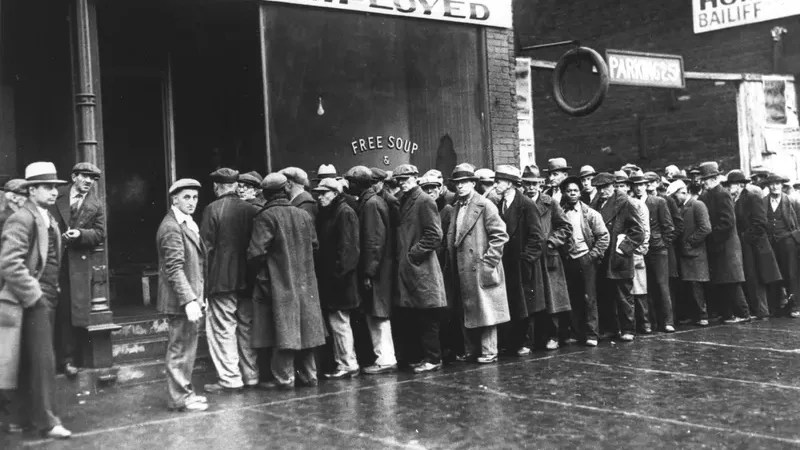
Things were still terrible, but there were glimmers of hope in 1933. The inflation rate turned positive at 1%, and GDP growth turned slightly positive by summer. But 2 million Americans were homeless. Industrial production was half of its 1929 high.
Unemployment was at its highest yet – 25%.
Franklin D. Roosevelt
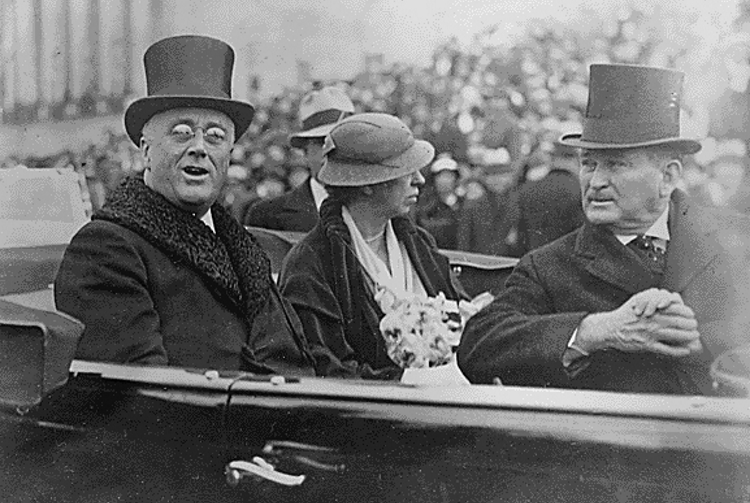
Roosevelt was inaugurated March 4, 1933, the 37th President of the United States.
A week later, he began his “Fireside Chats”, keeping the country informed and encouraged about the government’s efforts to fight the Depression.
The New Deal
Whereas Herbert Hoover had done “too little, too late,” Roosevelt introduced a flurry of legislation and executive orders. In his first hundred days, fifteen laws are passed to fight the Great Depression.
Five days after being sworn in as President, Roosevelt created the Emergency Banking Act, closing all banks to stop bank runs and failures. It was the first major action of the New Deal.
The New Deal was a series of public projects, financial reform, and regulations.
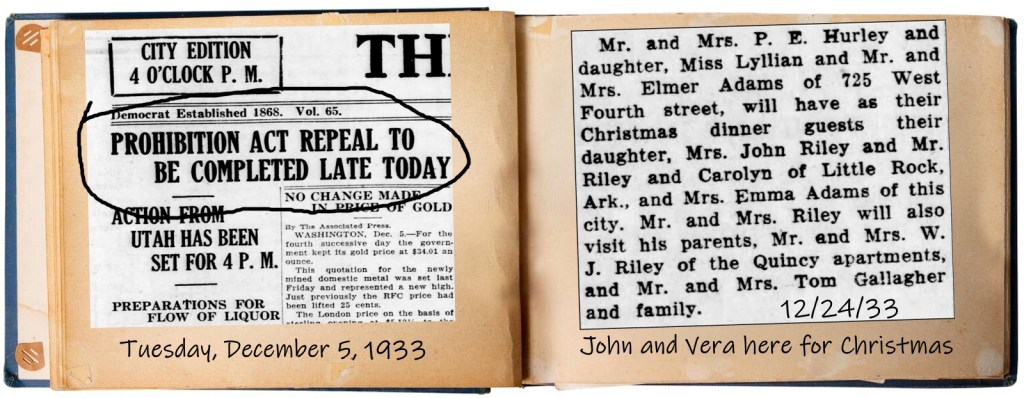
The end of Prohibition
On January 16, 1933, Prohibition was 13 years old. 13 years since Will Riley lost his liquor and beer distributorship. 13 years since Josie Riley’s Pensa brothers quit their saloon businesses in St. Louis.
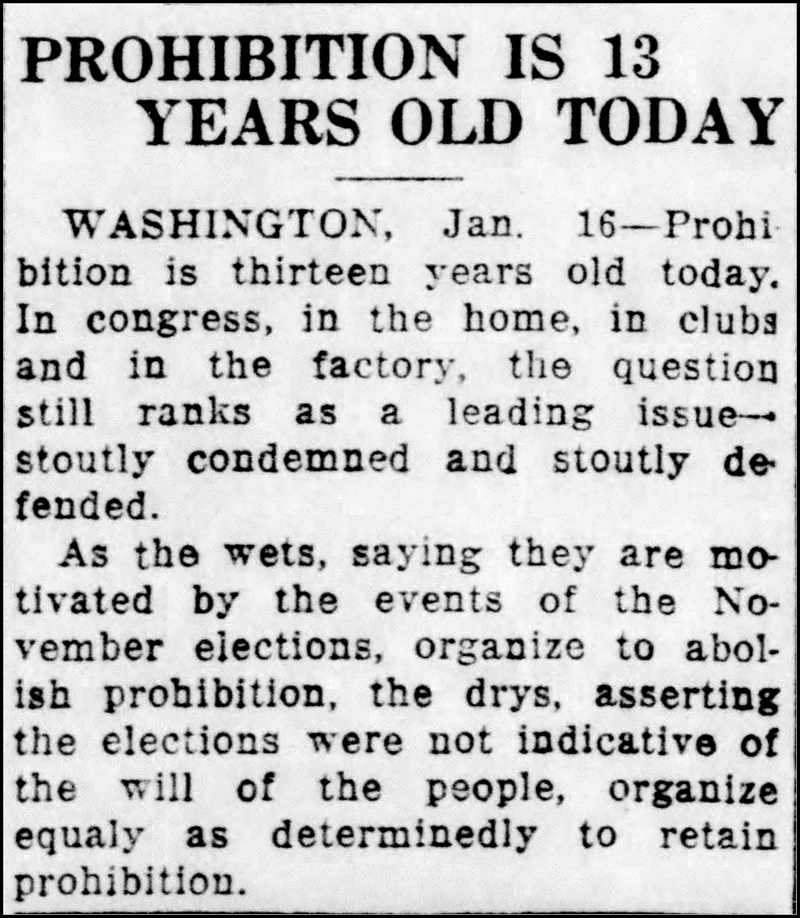
Public sentiment had changed during those 13 years. There was political pressure to repeal Prohibition.
Congress first proposed the 21st Amendment in February 1933, which would repeal the 18th Amendment and Prohibition. Now it was up to the states to ratify the new Amendment.
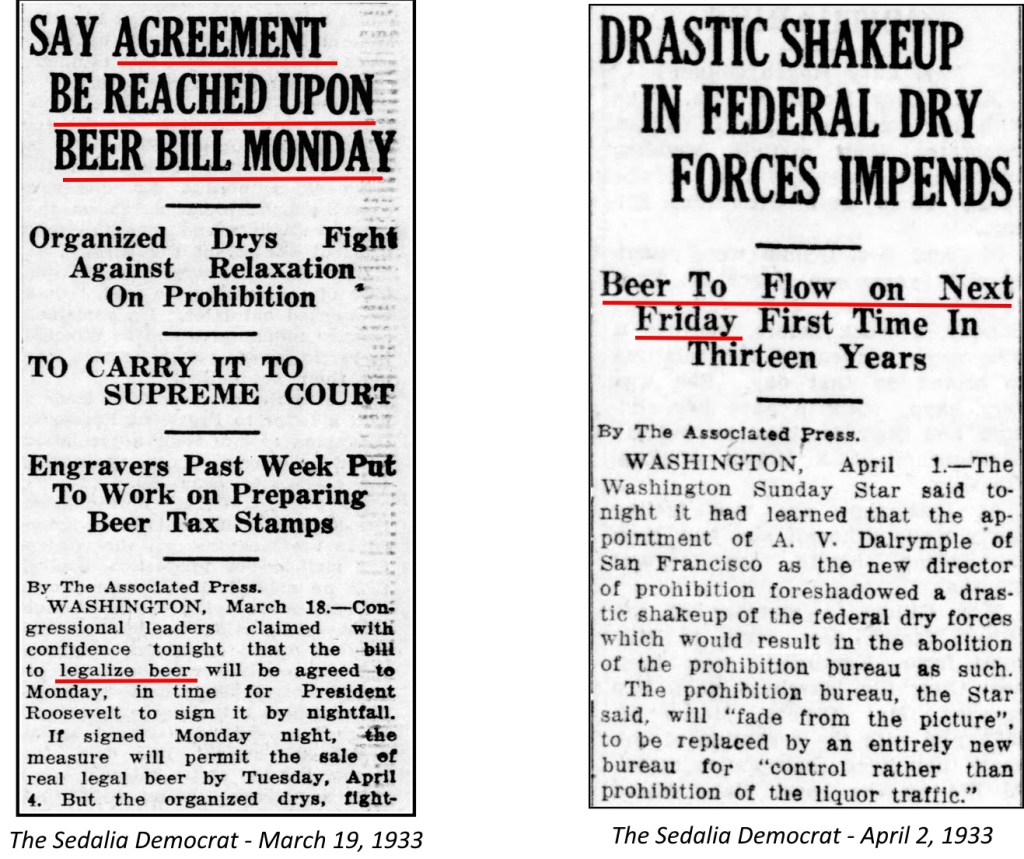
The Cullen-Harrison Act, signed about 10 months before the 21st Amendment was ratified, allowed people to drink low-alcohol content beer and wine. Incoming President Franklin D. Roosevelt had the Volstead Act amended in April 1933 to allow people to have a beer, or two, while they waited for the 21st Amendment to be ratified. The first team of Budweiser Clydesdales was sent to the White House to give President Roosevelt a ceremonial case of beer.
Five interesting facts about Prohibition’s end in 1933
By April, beer sales would be legal. Later in the year, Prohibition was likely to be completely repealed.
A business plan
Perhaps Will Riley had been waiting for this moment for 13 years. Maybe he could get back into the business he knew so well. Maybe he could recapture his financial success.
Will Riley, Jr. was trained as an accountant. He could keep the books and run the office.
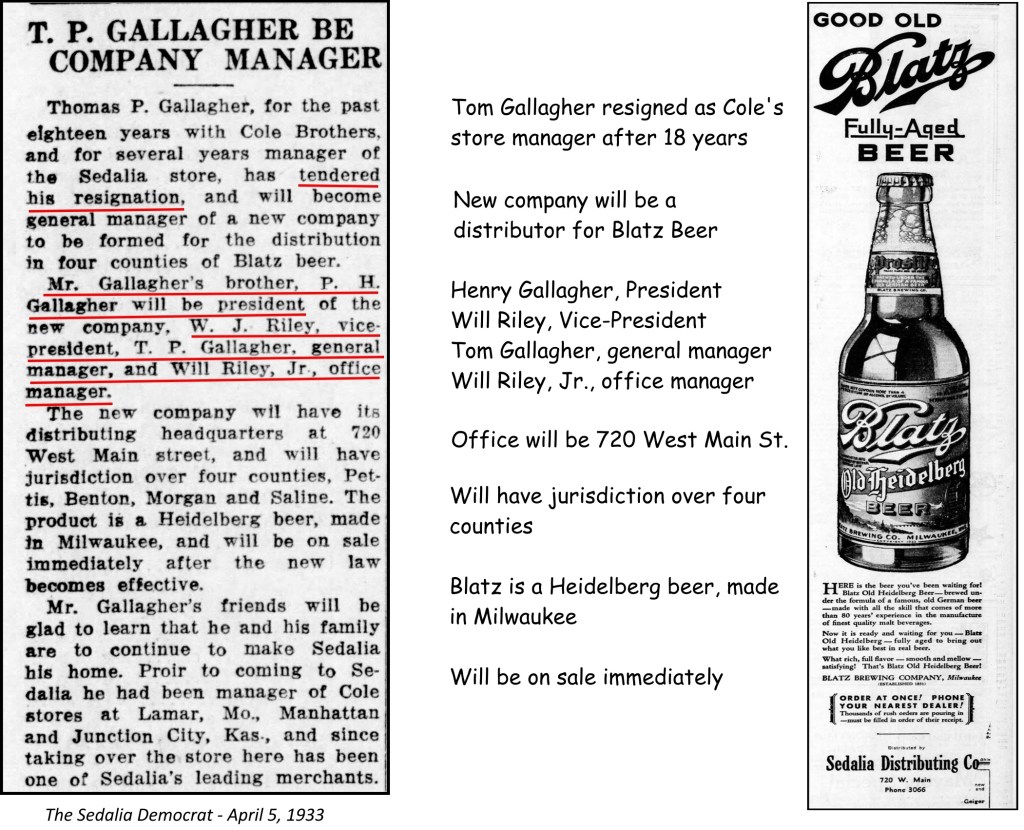
Tom Gallagher knew everyone in town, and had management experience. He would make a great general manager. Henry Gallagher had even more managerial experience. Henry felt his influence at Cole’s was waning, and he was ready for something else.
The excitement in the Riley and Gallagher households must have been palpable. Was this their opportunity? Was this their time?
It was too good to be true.
Sedalia Distributing Company
The Rileys and Gallaghers formed a beer distributorship company – Sedalia Distributing Company. Will Riley’s experience was invaluable. They had already negotiated an agreement with Blatz Beer of Milwaukee, granting them agency for Sedalia and four surrounding counties.
Tom and Henry resigned from Cole Brothers. Tom had worked for Cole’s for 18 years, 13 of those in Sedalia. Henry had worked for Cole’s for 21 years.
Sedalia Distributing Company was in business in April 1933.
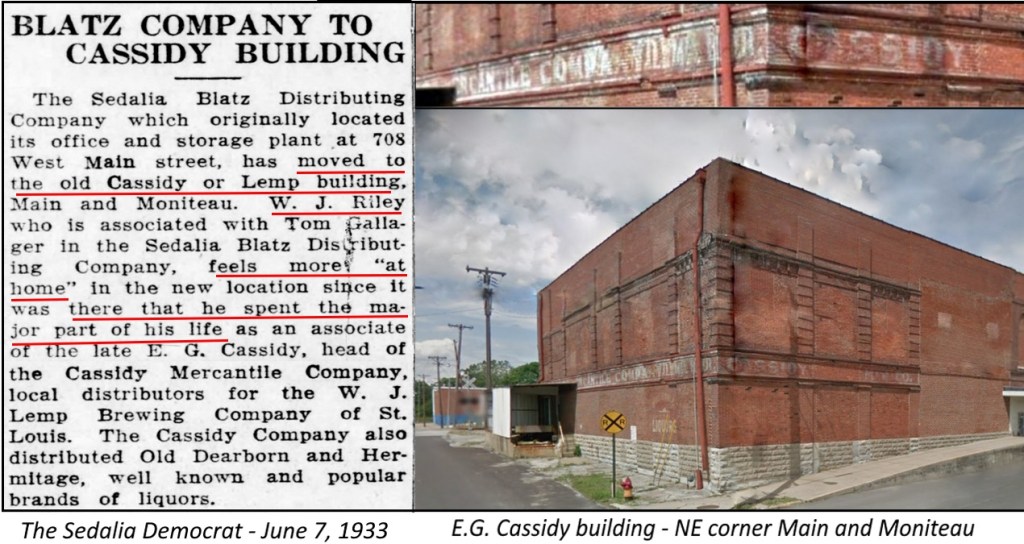
Move to Cassidy building
In May 1933, Sedalia Distributing moved down the street to the E.G. Cassidy Building, 310 West Main Street. It was in that building that Will Riley had spent most of his career, first as a salesman for Ed Cassidy, and later as the owner of the business and the building.
Will must have felt right at home.
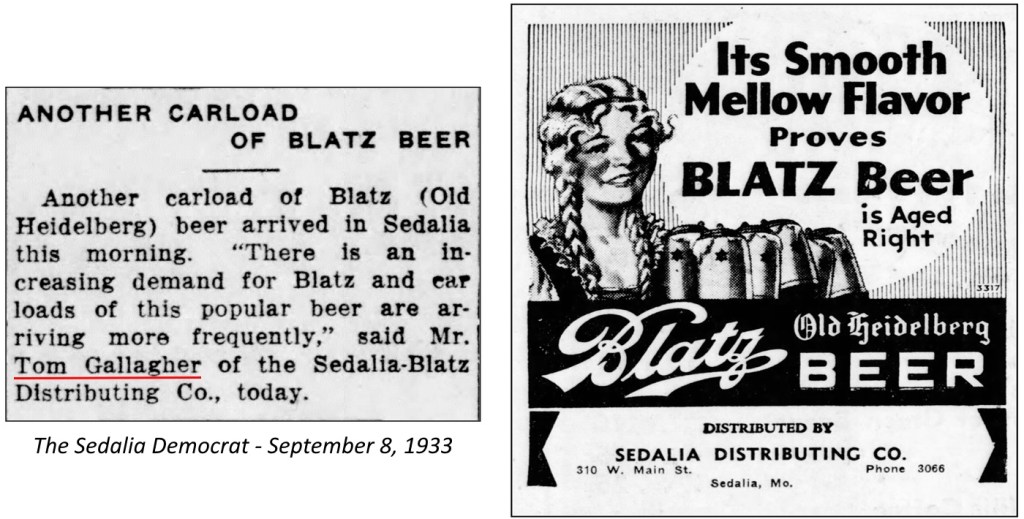
They set to work. Blatz and other distributors had to build up capacity after 13 years of Prohibition, so stock was slow to arrive. Likewise, there were no local businesses with licenses to sell alcohol, so those had to apply and acquire permits.
Everyday life
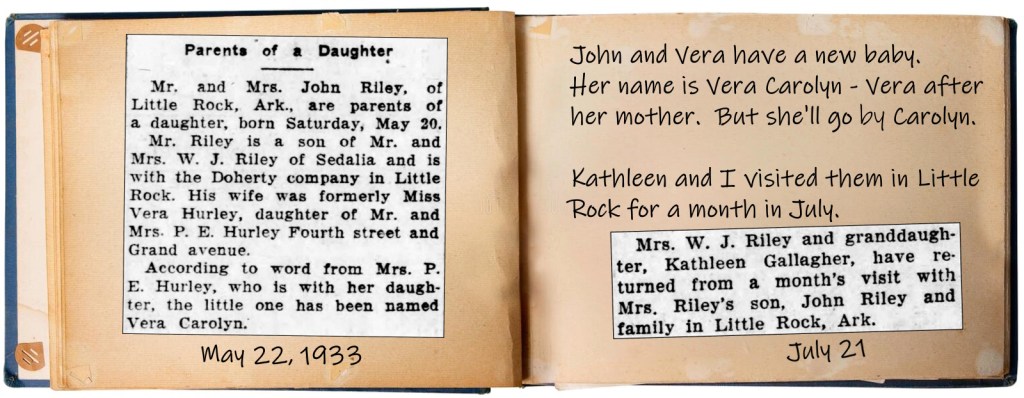
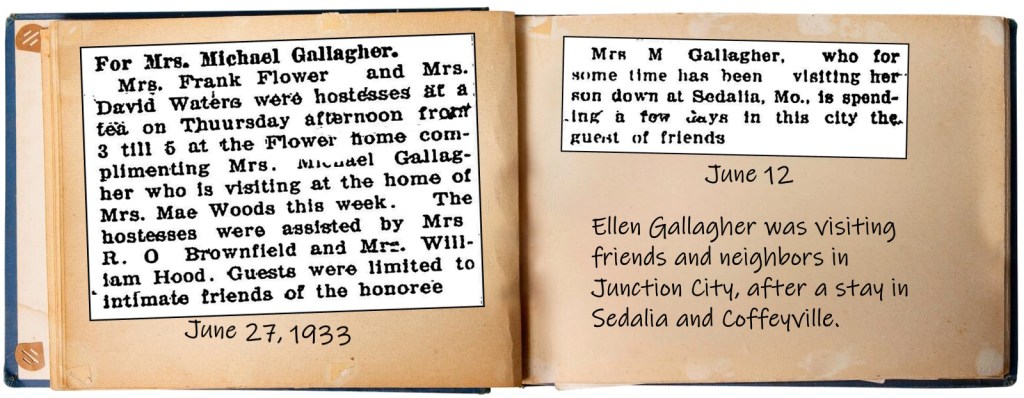
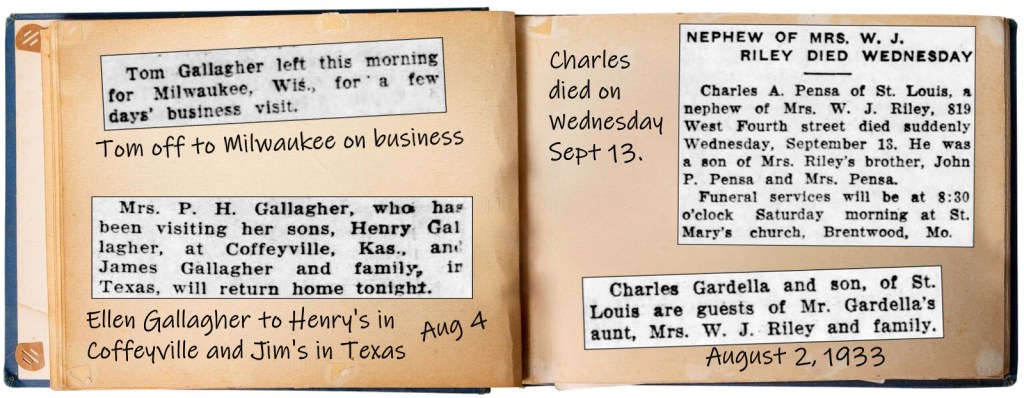
Of course, 1933 wasn’t all about Blatz Beer. Other family members were going about their daily affairs. The Depression was in full swing, and it was obvious. But, still, everyday life continued.
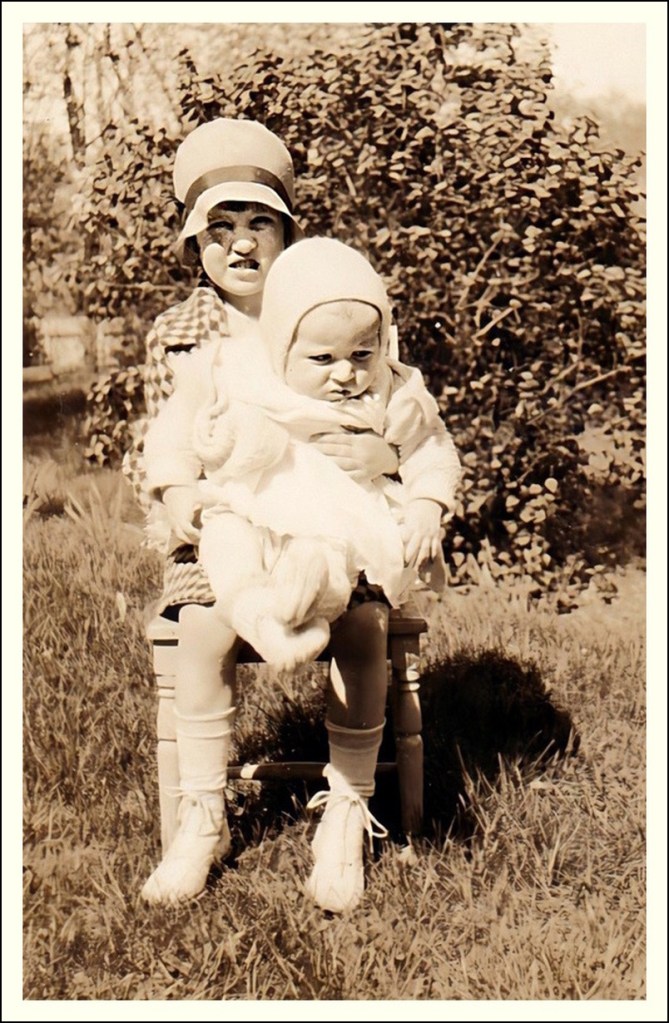
Kathleen and Jane
And another move
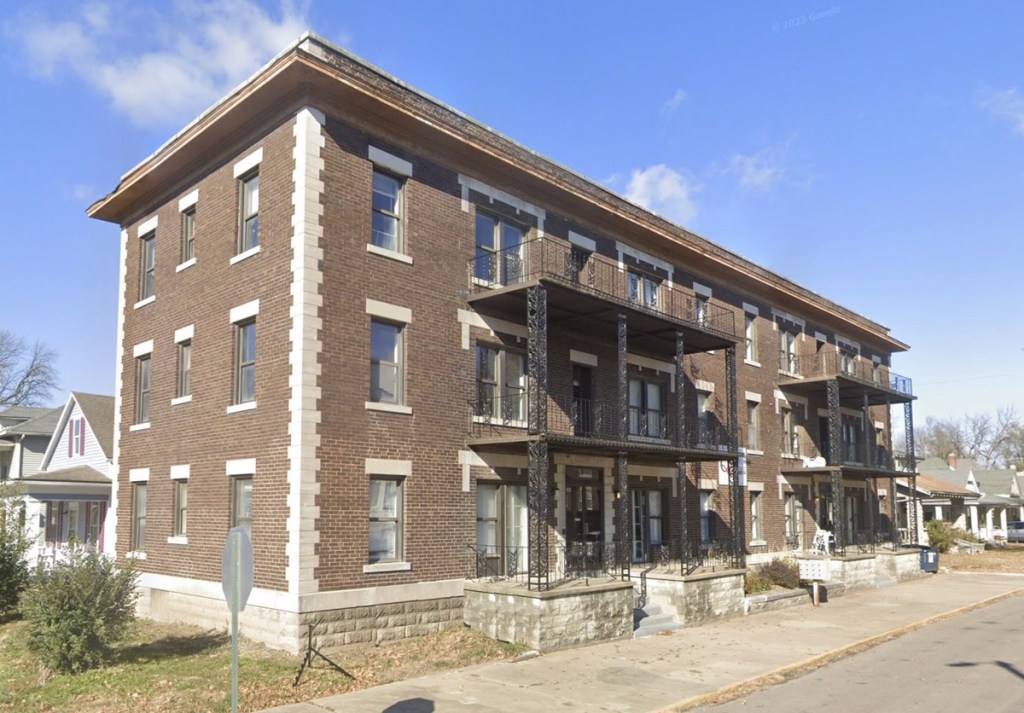
As they had done in each of the last several years, the Rileys and Gallaghers moved. This time, they moved to separate residences. It was the first time in six or seven years that they hadn’t lived in the same abode.
Will and Josie Riley moved into the Quincy Apartments, 230 South Quincy Street. Tom and Mary Agnes Gallagher and children moved to 1110 West Third Street.
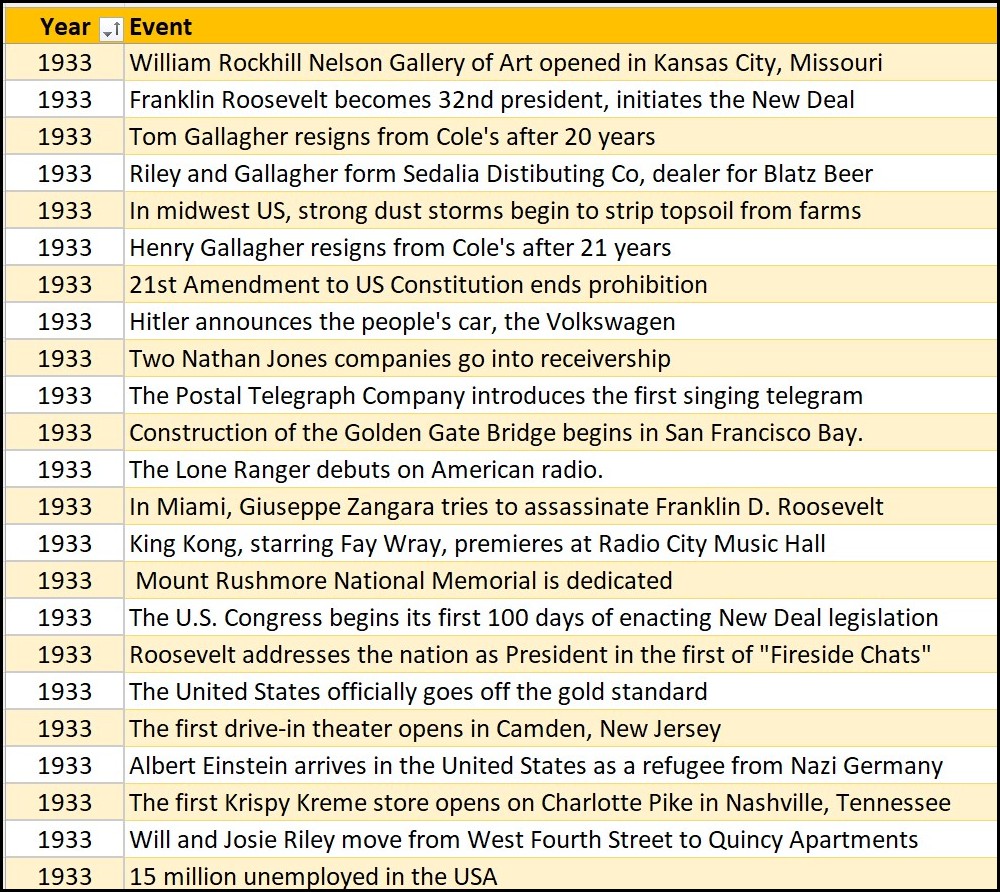
Timeline
Sources
- Newspaper articles – The Junction City Daily Union – various dates – newspapers.com
- Newspaper articles – The Junction City Republic – various dates – newspapers.com
- Newspaper articles – The Sedalia Democrat – various dates – newspapers.com
- Image – Unemployed men outside a soup kitchen opened in Chicago by Al Capone – Rare Historical Photos – https://rarehistoricalphotos.com/al-capones-soup-kitchen-great-depression-chicago-1931/
- Photo – President and Mrs. Roosevelt and Senator Joseph T. Robinson on Inauguration Day. March 4, 1933 – FDR Presidential Library – http://www.fdrlibrary.marist.edu/daybyday/resource/january-1934-8/
- Quote – Cullen-Harrison Act – Five interesting facts about Prohibition’s end in 1933 – NCC Staff – December 5, 2022 – https://constitutioncenter.org/blog/five-interesting-facts-about-prohibitions-end-in-1933
- Image – Cassidy Building – Sedalia, Missouri – Google Maps
- Image – Quincy Apartments – Sedalia, Missouri – Google Maps
- Music – Mama’s Gone, Goodbye – Thelma Terry and he Playboys – A hodge-podge of off-beat Jazz 2 1926-1930 (MFC 5) – by Satyr-78rpm – https://ia904505.us.archive.org/8/items/14-a-hodge-podge-of-off-beat-jazz-2-1926-1930-mfc-5_20210630/12%20A%20hodge-podge%20of%20off-beat%20Jazz%202%201926-1930%20MFC-5.mp3
 Family Nibbles
As always Mark your timeline is very informative. Sure glad Krispy Kreme made it onto the scene.
LikeLike