Franklin D. Roosevelt’s New Deal platform created an incredible number of different federal agencies to carry out new policies and regulations. Almost all of these agencies had an acronym like the CCC, TVA, or HOLC. Therefore, these collectively came to be known as FDR’s “Alphabet Soup Agencies.”
Alphabet Soup Agencies – Students of History

The Alphabet Soup Agencies weren’t some abstract far-away concept. They directly touched people in their everyday lives. Tom Gallagher had jobs with several of the agencies. Mary Agnes and children worked with and benefited from these agencies.
Alphabet soup jobs
Tom Gallagher had a series of jobs with short-term government relief projects. As one project or agency was completed or replaced, Tom sought work with another agency project.
MRRC cannery

In October 1934, the Missouri Relief and Reconstruction Commission (MRRC) had opened a meat cannery in Sedalia City Hall to buy cattle and can the meat for food relief.
Tom Gallagher was a timekeeper.
The cannery only operated for eight months. It closed in February 1935.
WPA warehouse
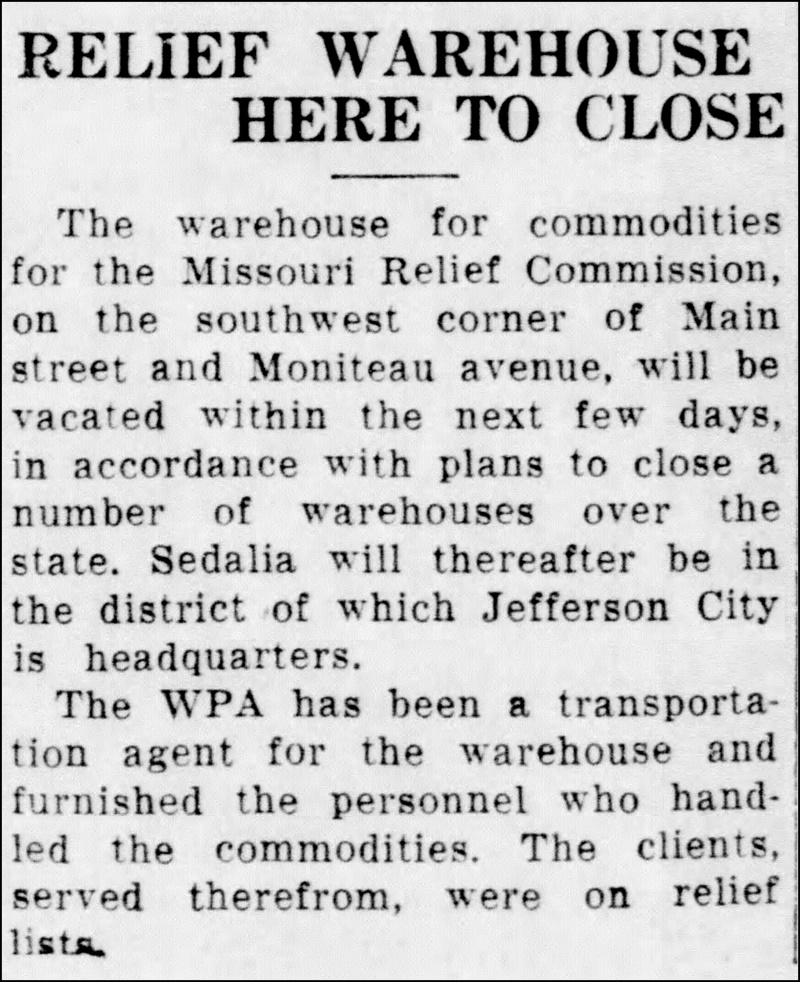
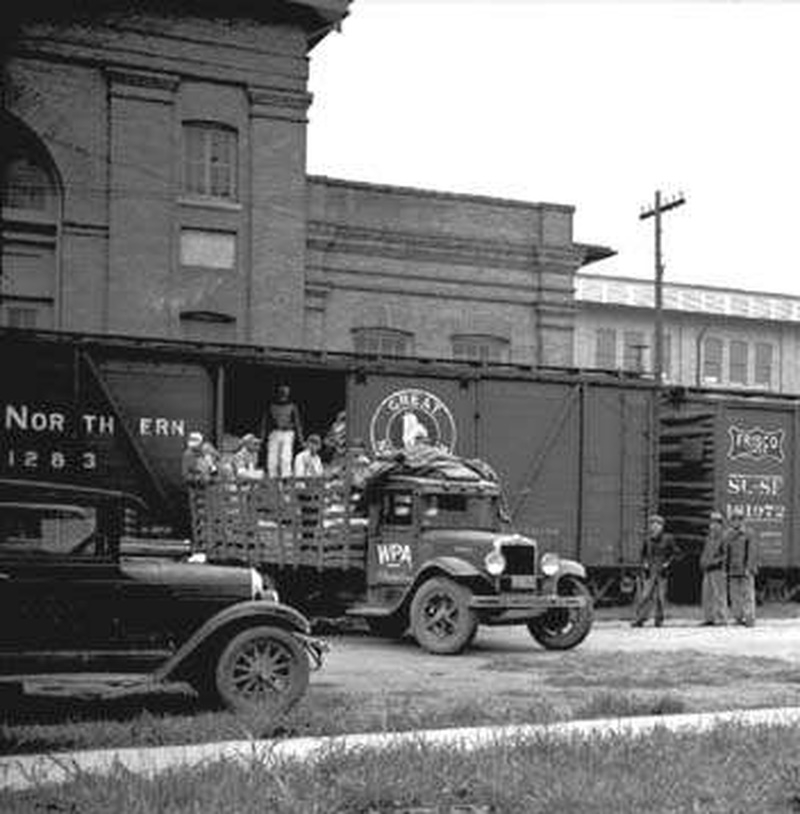
In February 1936, Tom had been hired by the Works Progress Administration (WPA) to manage a warehouse that distributed relief clothing and food to the counties surrounding Sedalia.
In March 1937, the warehouse would be closed. Furthermore, the Sedalia WPA district would be consolidated into the Jefferson City District.
Tom transitioned from WPA to the Resettlement Administration (RA).
RA flood relief
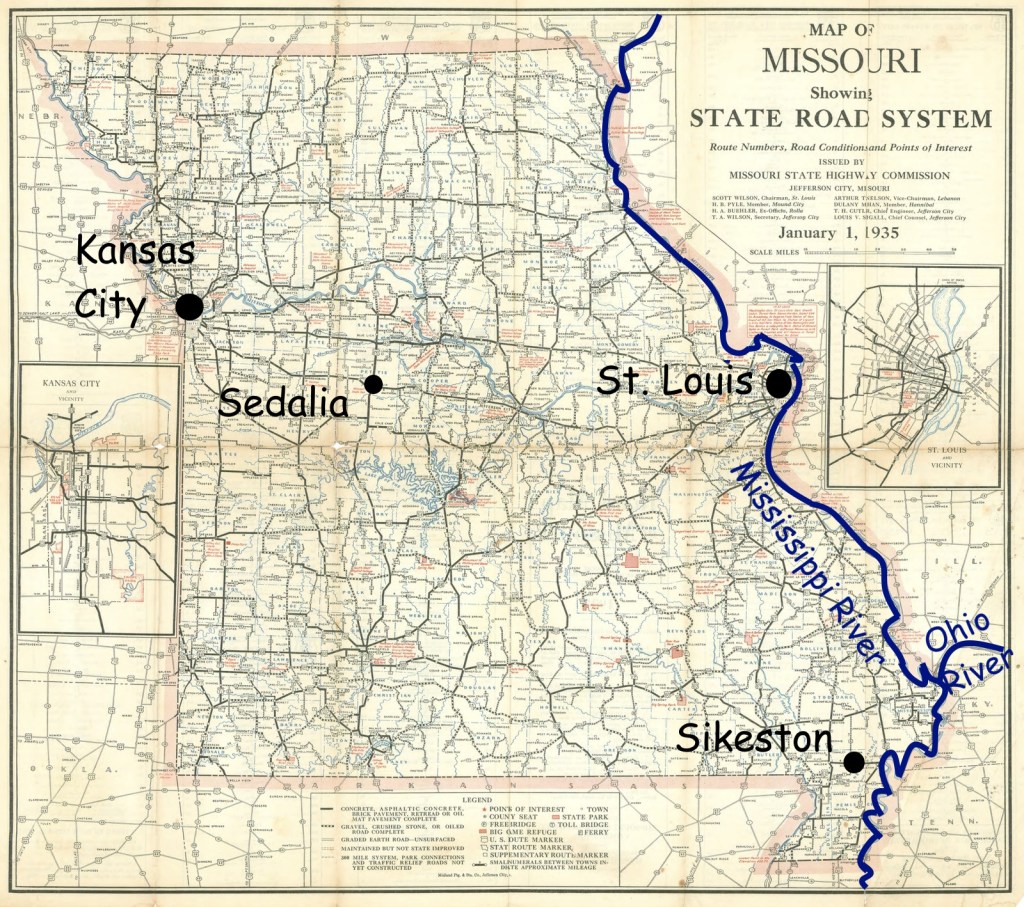
In January 1937, a record-setting flood surged down the Ohio River, leaving dead and homeless and millions in property damage. When the flood crest reached the Mississippi River near the Missouri bootheel, it wiped out levees and flooded farms and towns.
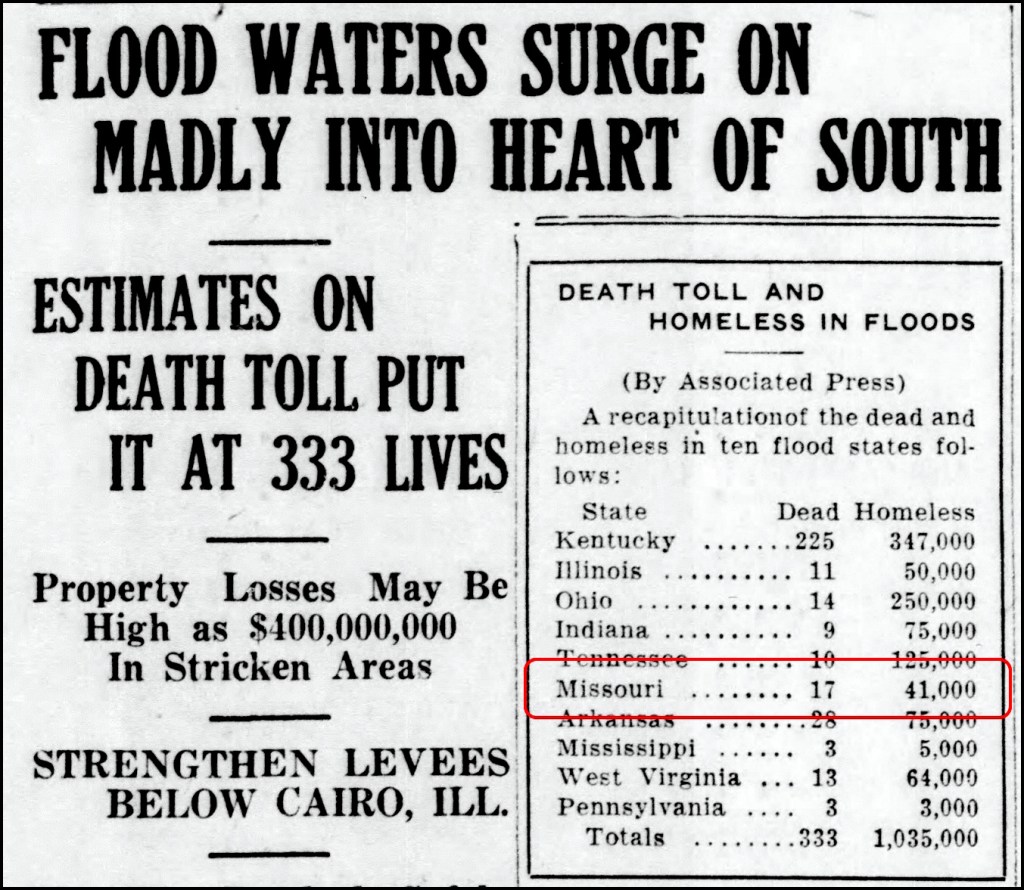
Thousands were left without food or shelter. The floods left over 40,000 homeless in southeast Missouri. Throughout the Ohio and Mississippi River valleys, over one million were without shelter and food.
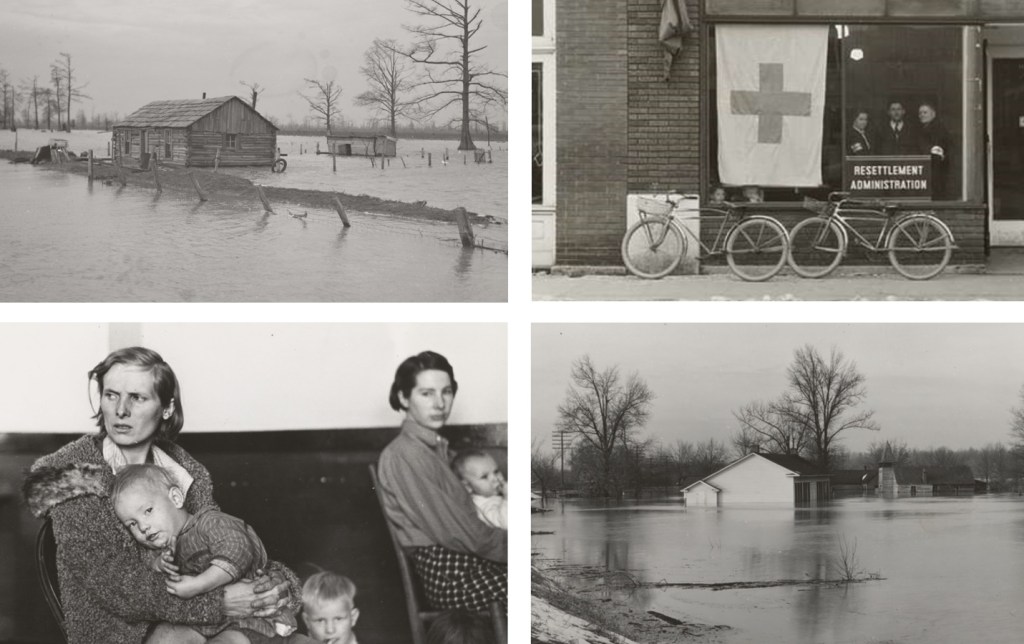
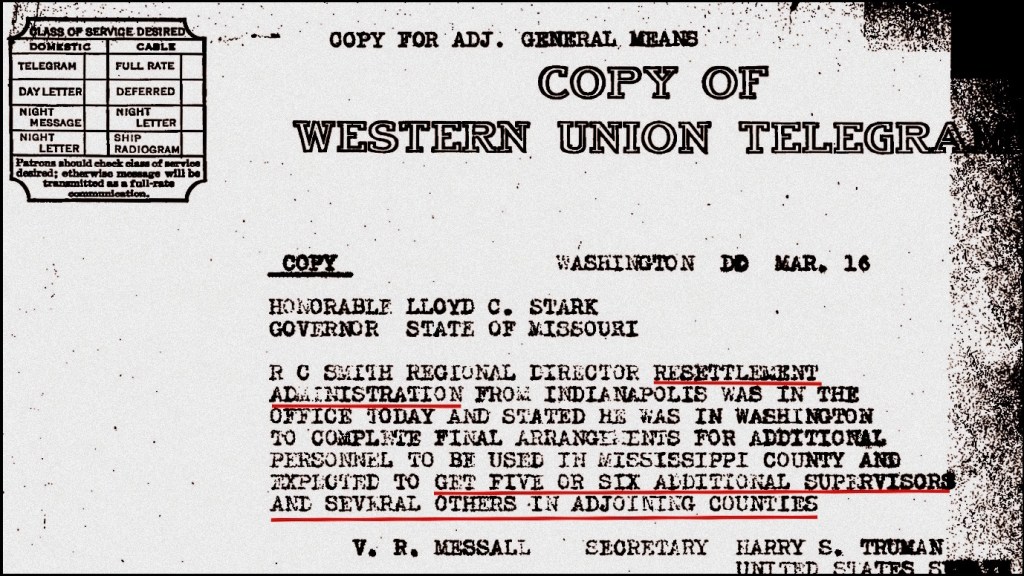
National Guard and federal relief agencies responded. Senator Harry Truman requested additional personnel from the Resettlement Administration (RA). RA organizers and managers were sent to the area to help, including Tom Gallagher.
Tom Gallagher was assigned to Sikeston, Missouri, a center for relief efforts. Mary Agnes and children joined him during his assignment to Sikeston. Their children transferred to Sikeston schools for the remainder of second semester 1937. Kathleen recalled that their temporary housing in Sikeston wasn’t very nice.
RA farms
In March 1937, the Resettlement Administration (RA) had announced plans for a project in northern Pettis County. The RA would buy distressed farms, build low-income housing on 80-acre plots, and provide financing for families to purchase the housing and small farms.
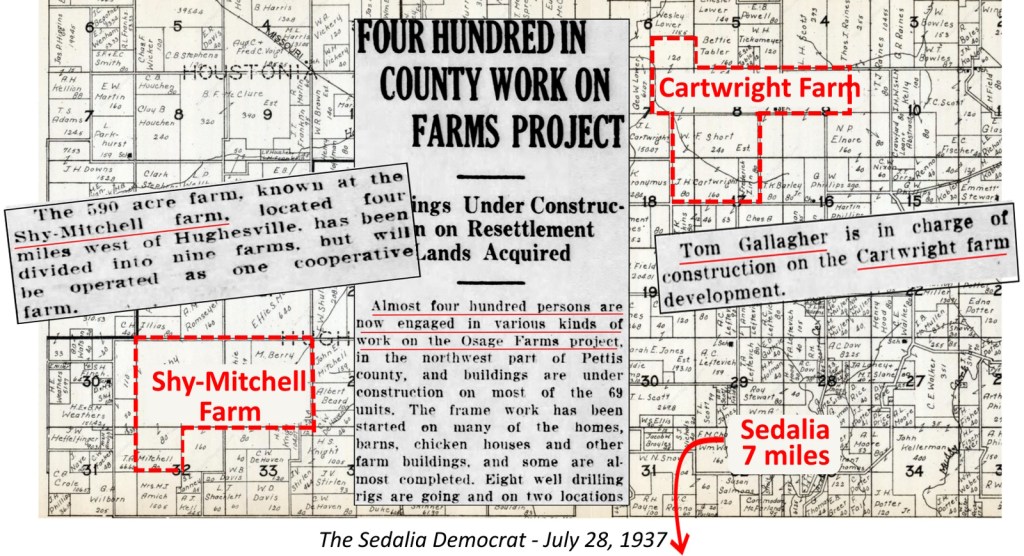
In northern Pettis County, the RA planned the Osage Farms Project. The project would buy 10,000 acres of land from struggling farmers. It would subdivide the land into 80-acre farms and build a house on each. The occupants would get long term loans at low interest.
By May 1937, Tom and Mary Agnes and family returned from assignment to Sikeston, and Tom took on the construction management of the Cartwright Farm. Tom Gallagher was the construction manager for the Cartwright Farm, one of the parcels of the Osage project.
RA to FSA

It was great that Tom Gallagher had a job. But once again, the project was to be completed in December 1937.
Furthermore, the Resettlement Administration was also ended and folded into the Farm Security Administration (FSA).

The job hunt would begin anew.
Home life
While Tom was working for relief agencies, Mary Agnes was trying to maintain home and children. Kathleen was age 14, Buddy 11, and Jane 5. They were living at 1110 West Third Street in Sedalia.
Kathleen graduated

In May 1937, Kathleen Gallagher graduated from 8th grade at Sacred Heart School, the parochial school of Sacred Heart Church. She had attended the school from 1st grade.

Kathleen to camp
In June 1937, Kathleen and the girls from Girl Scout Troop 1 were headed for Camp Pin Oak. The camp was at Lake of the Ozarks, 60 miles southeast of Sedalia.
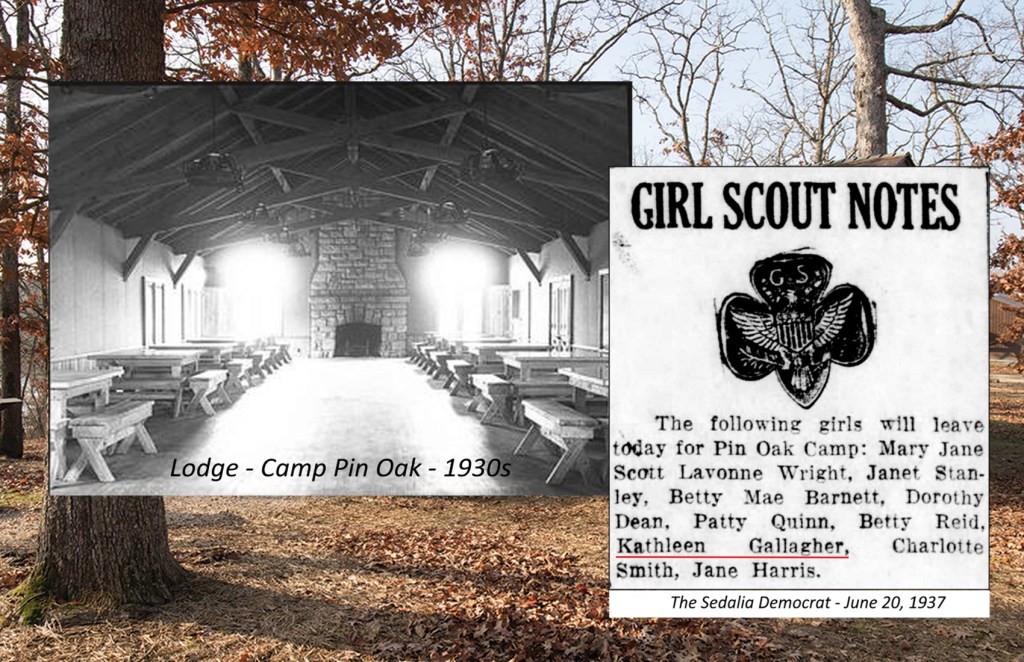
Camp Pin Oak was another New Deal project. More alphabet soup. The Civilian Conservation Corps (CCC) was created in 1933 to hire unemployed young men. It employed over three million men. The CCC was involved in projects in state and national parks, forests, and historic sites.
Built in the 1930s by the Civilian Conservation Corps, Pin Oak Facility has been the site for generations of gatherings by nonprofit youth groups such as Girl Scouts and Boy Scouts. Campfire sing-alongs, new friends and outdoor adventures made the camp a lasting memory for youth of all ages.
Pin Oak Facility – Missouri State Parks
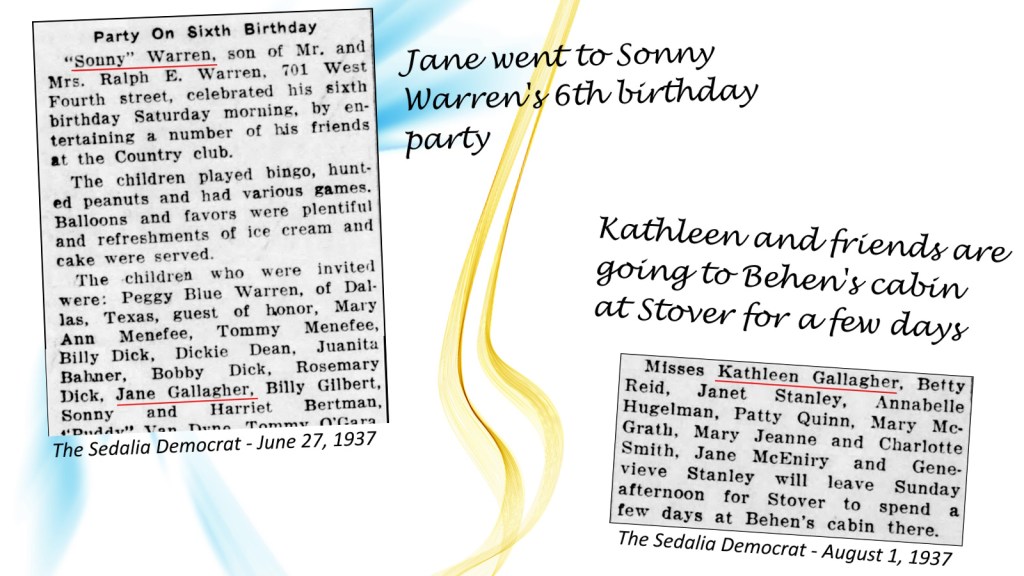
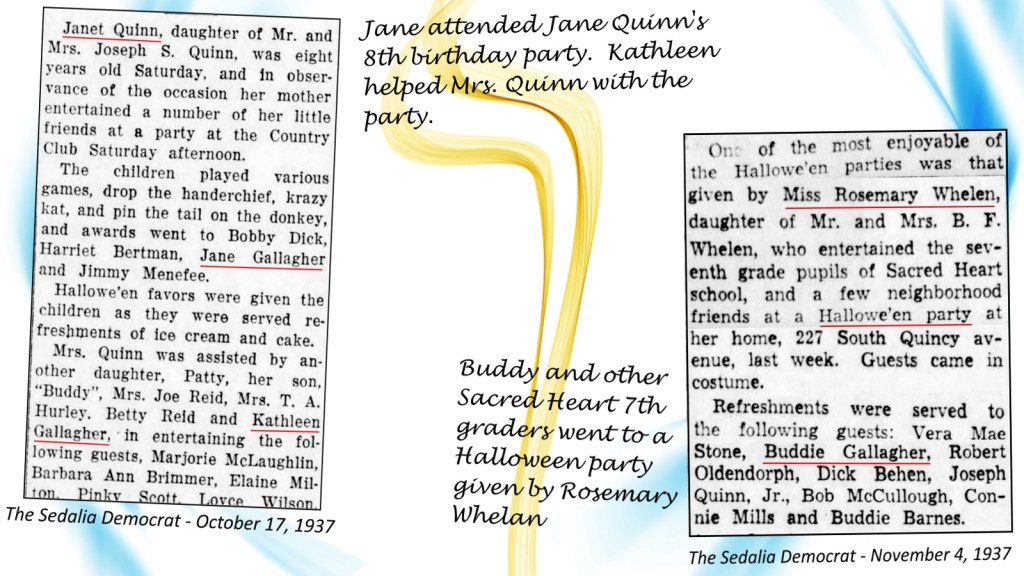
Party party
The Gallagher children, their cousins, and their friends were somewhat insulated from the worst effects of the Depression. Most of their families didn’t suffer chronic unemployment.
There were still birthday parties, Halloween parties, and girl scouts.

The Rileys
1937 was a difficult year for the Rileys. They were living at one of the Hurley apartment buildings at 606 1/2 South Grand Avenue in Sedalia.
None of their children lived at home, as Will had moved to Jefferson City and married there. Tom and Mary Agnes Gallagher weren’t living with the Rileys, as they had for several years.
Will Riley was age 74, Josie was 69.
Will Riley had a heart attack
Over the last few years, we’ve seen that Will Riley had continued bouts of illness. Those bouts continued into 1937. Josie spent much of her time caring for Will.
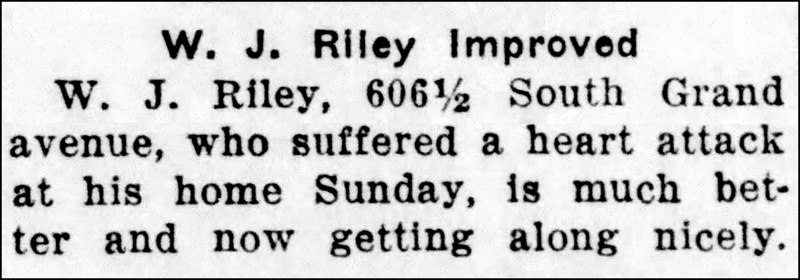
In April, Will suffered a heart attack, but recovered.
Will Riley seriously ill
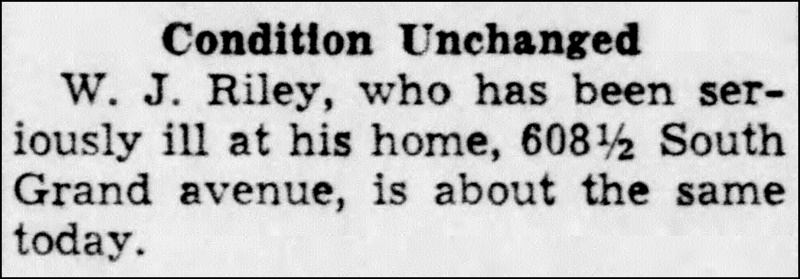
In early December 1937, Will fell ill again. This time it persisted for weeks.
Will Riley died

William Joseph Riley died at home at 5:45 am, Thursday, December 30, 1937. He was age 74.
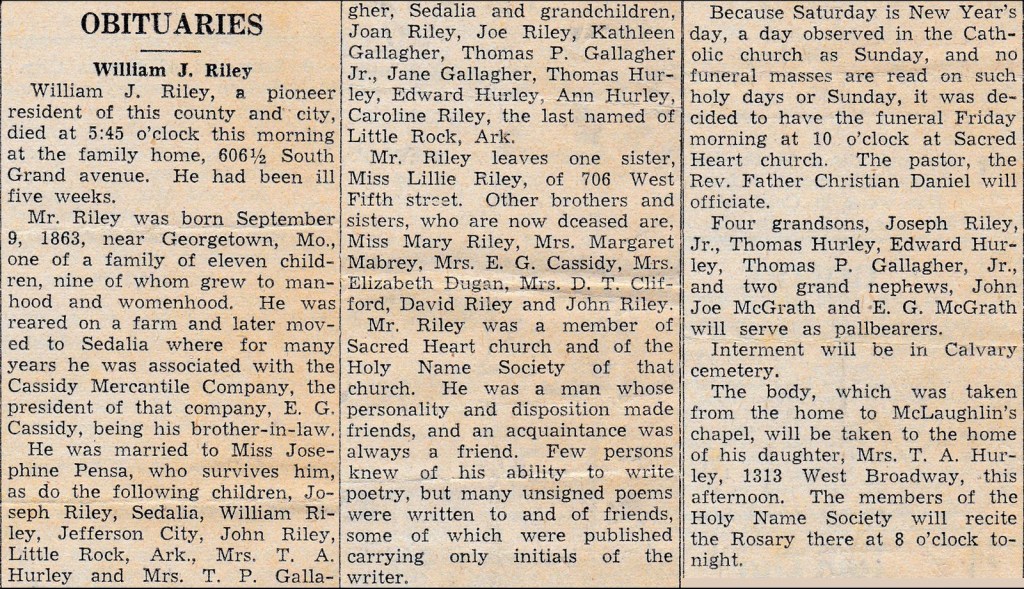
Because New Year’s Day is a Catholic Day of Obligation, the funeral was held on Friday, New Year’s Eve, one day after Will died. His grandsons were pall bearers.
Will was buried at Calvary Cemetery in Sedalia, Lot W-5, Block AA, Grave 5.
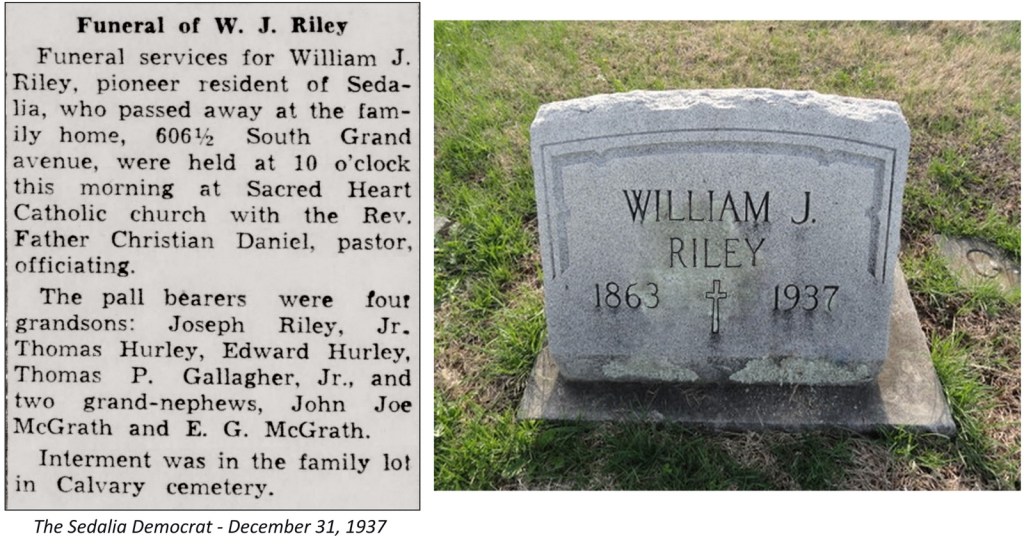
Will Riley was a patriarch of our family in the early 20th century. He was a man of many facets; husband, father, salesman, business owner, local politician, actor, and poet.
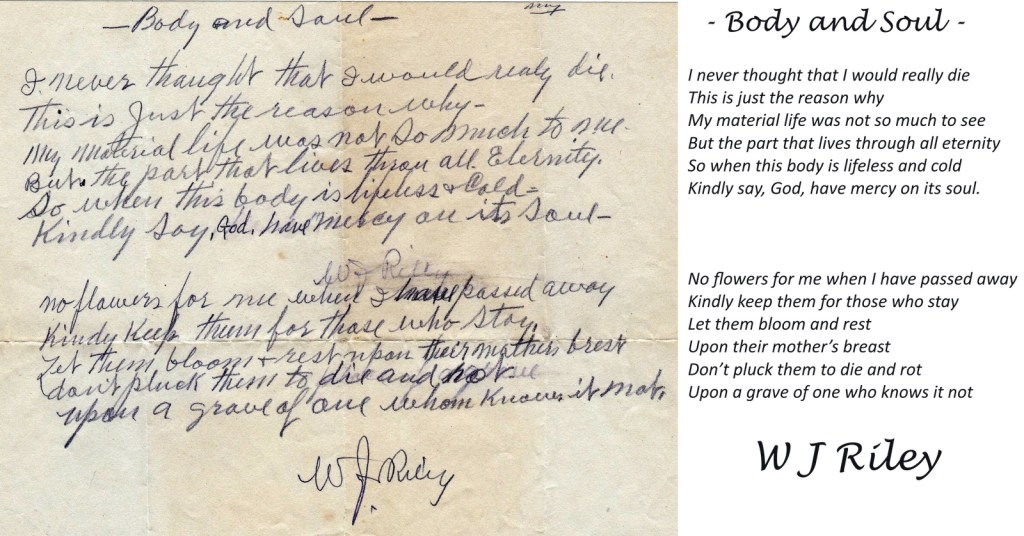
You’re not surprised that he left us a verse about his death…
Timeline
Sources
- Newspaper articles – The Junction City Daily Union – various dates – newspapers.com
- Newspaper articles – The Junction City Republic – various dates – newspapers.com
- Newspaper articles – The Sedalia Democrat – various dates – newspapers.com
- Newspaper articles – The Junction City Daily Union – various dates – The Community History Archive of the Dorothy Bramlage Public Library – Junction City, Kansas – https://jclib.advantage-preservation.com/
- Quotation – Alphabet Soup Agencies – Students of History – https://www.studentsofhistory.com/the-new-deal-alphabet-soup
- Image – Cannery (former) Kirkland WA – The Living New Deal – https://livingnewdeal.org/projects/cannery-former-kirkland-wa/
- Images – 1937 Mississippi River flood – New York Public Library – Digital Collections – Farm Security Administration Collection – Russell Lee – https://iiif-prod.nypl.org/index.php?id=57832206&t=v – https://iiif-prod.nypl.org/index.php?id=57832033&t=g – https://iiif-prod.nypl.org/index.php?id=57832021&t=v – https://iiif-prod.nypl.org/index.php?id=57859013&t=v
- Telegram – Harry S. Truman, Washington, D. C. to Lloyd Crow Stark, Jefferson City, Cole County, March 16, 1937 – https://mdh.contentdm.oclc.org/digital/collection/p16795coll5/id/483/rec/109
- Map – Missouri Highway Map – 1935 – https://www.modot.org/sites/default/files/documents/1935002_reduced%5B1%5D.pdf
- Image – Work Pays America Poster – Wikimedia Commons – https://commons.wikimedia.org/wiki/File:WPA-Work-Pays-America-Poster.jpg
- Image – Sacred Heart School – c 1920 – Facebook – https://www.facebook.com/gogremlins/photos
- Diploma – Kathleen Gallagher – Sacred Heart School – Teply family documents – Catherine Teply Jarvis collection
- Quotation – Pin Oak Facility – Missouri State Parks – https://mostateparks.com/page/55099/pin-oak-facility
- Image – Camp Pin Oak lodge – Historic Camp Pin Oak Lodge Rises From the Ashes – Tom Uhlenbrock, Missouri State Parks – eMissourian.com – https://www.emissourian.com/features_people/senior_lifetimes/historic-camp-pin-oak-lodge-rises-from-the-ashes/article_20dc025b-e179-5ca2-bdbc-c0c8a173e0be.html
- Headstone – William J. Riley – Calvary Cemetery – Sedalia, Missouri – FindAGrave – https://www.findagrave.com/cemetery/1917967/memorial-search?firstName=&lastName=Riley&includeMaidenName=true
- Poem – Body and Soul – W.J. Riley – Gallagher family documents – Catherine Jarvis collection
- Music – Hot Coffee – Ruby Green and her Manhattan Madcaps – A Bag Of Sleepers 2 Hot Licks 1927-1930 (Arcadia 2004) – by Satyr-78rpm – https://ia904504.us.archive.org/33/items/04-a-bag-of-sleepers-vol-2-hot-licks-1927-1930-arcadia-2004_20210629_1439/05-A%20bag%20of%20sleepers%20vol%202%20Hot%20licks%201927-1930%20Arcadia%202004.mp3
 Family Nibbles
