
In April 1940 Germany attacked Denmark and Norway. In May, Germany took Belgium and the Netherlands. In June, France fell to the conquering Germans. Japan had overrun China. In September, Italy joined Germany and Japan in an Axis treaty.
Realizing that conflict was inevitable, the United States began a frenetic attempt to increase military readiness. In 1940, the U.S. had 270,000 military troops. It was argued that two million were needed, and perhaps double that number.
To house and equip and train such an army, expanded military camps were needed as soon as possible. The biggest existing military camps were the obvious targets for expansion, including Fort Riley, Kansas.
Long-Manhattan-Watson
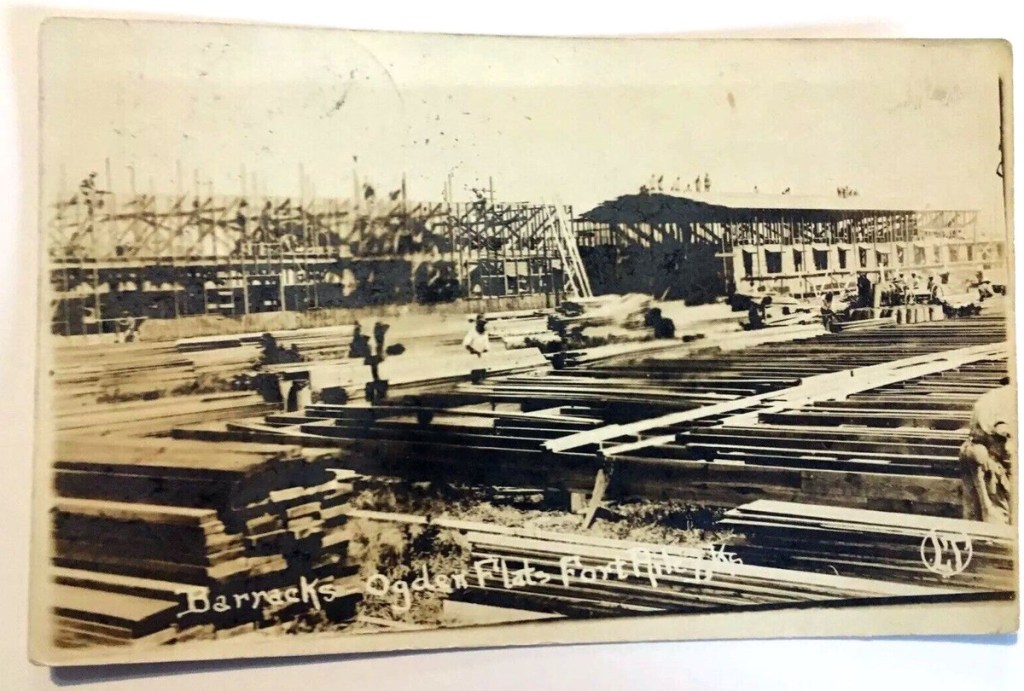
In 1939 and 1940, several large contracts at Fort Riley were awarded to Long-Manhattan-Watson Construction Company (LMW). The company was a joint venture, consisting of Long Construction Company of Kansas City, Manhattan Construction of Oklahoma, and Watson Construction of Topeka.
In November 1939, LMW had worked on a $2M project to build a hospital, a post exchange, a theater, a chapel, and other facilities at Fort Riley.
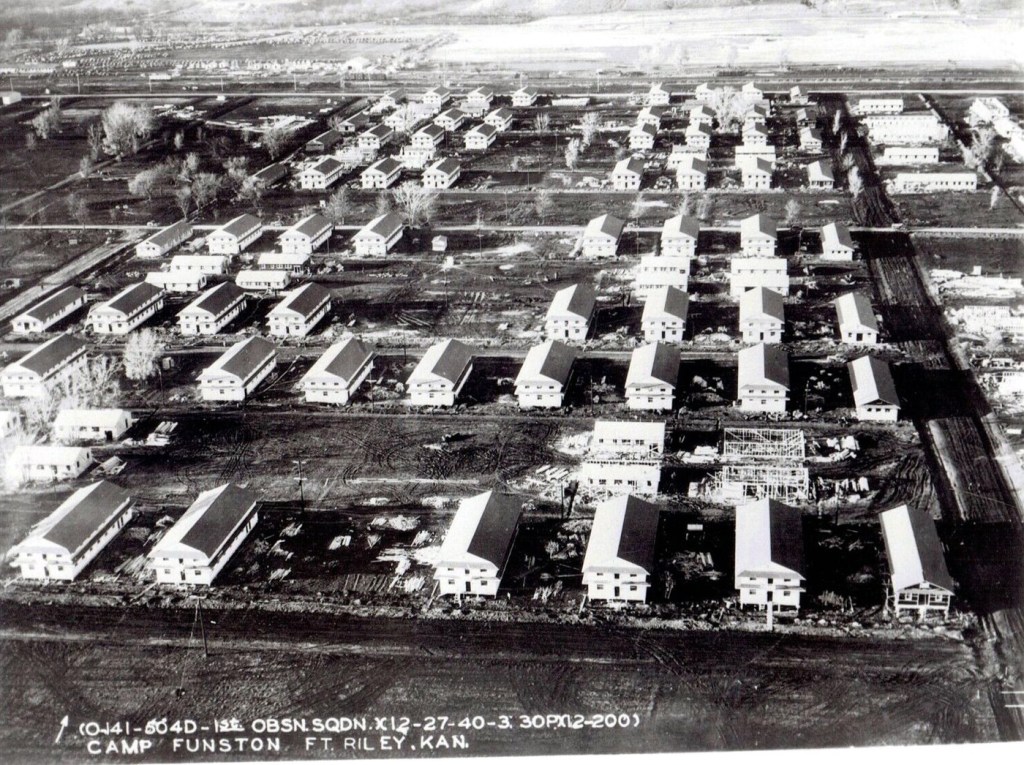
In March and July 1940, LMW was awarded two more contracts worth $7M to build barracks and buildings at Camp Funston, a camp on the east side of Fort Riley.
These were large projects. Besides the buildings, the projects included sitework, roads, sewer and water systems, plumbing, lighting, heating, etc.
Tom Gallagher worked for LMW
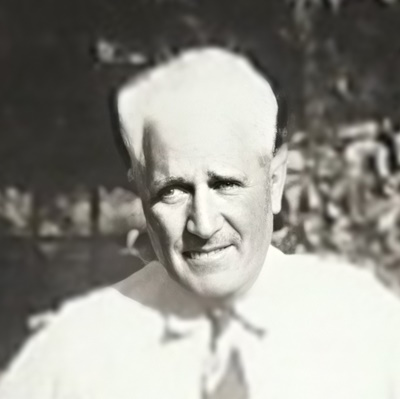
There were few people with the skills and experience to help manage these projects. Tom Gallagher was one who did. He had managerial experience at Cole’s. He had managed the MRRC food cannery in Sedalia. He was the logistics manager for the WPA relief warehouse in Sedalia. He’d been construction manager for Cartwright Farms for the Resettlement Administration. He helped manage disaster relief in the aftermath of the Sikeston, Missouri flood.
Tom went to work for Long-Manhattan-Watson Construction as a sanitation officer. His group worked on the sewer, water, and plumbing systems.
Biggest projects ever
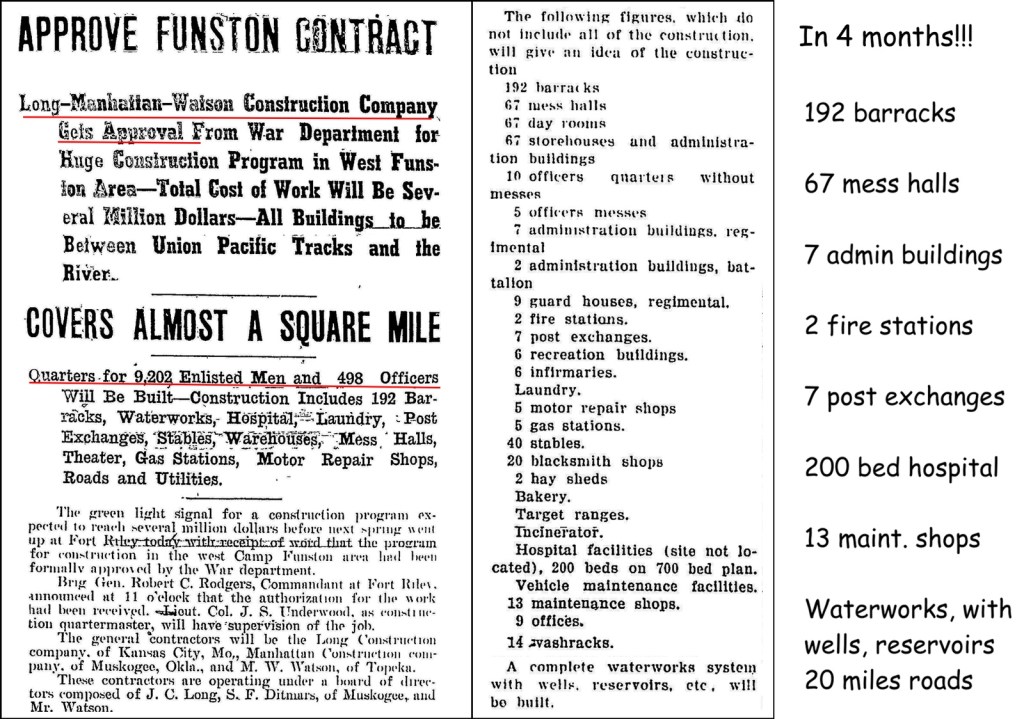
Through the summer of 1940, the War Department made plans for the most ambitious projects yet. At 11 military bases and 7 National Guard camps around the country, contracts would be awarded for facilities to housed and train 400,000 men. And the projects must be completed in four months.
Fort Riley / Camp Funston was one of those selected bases.
Secret meetings
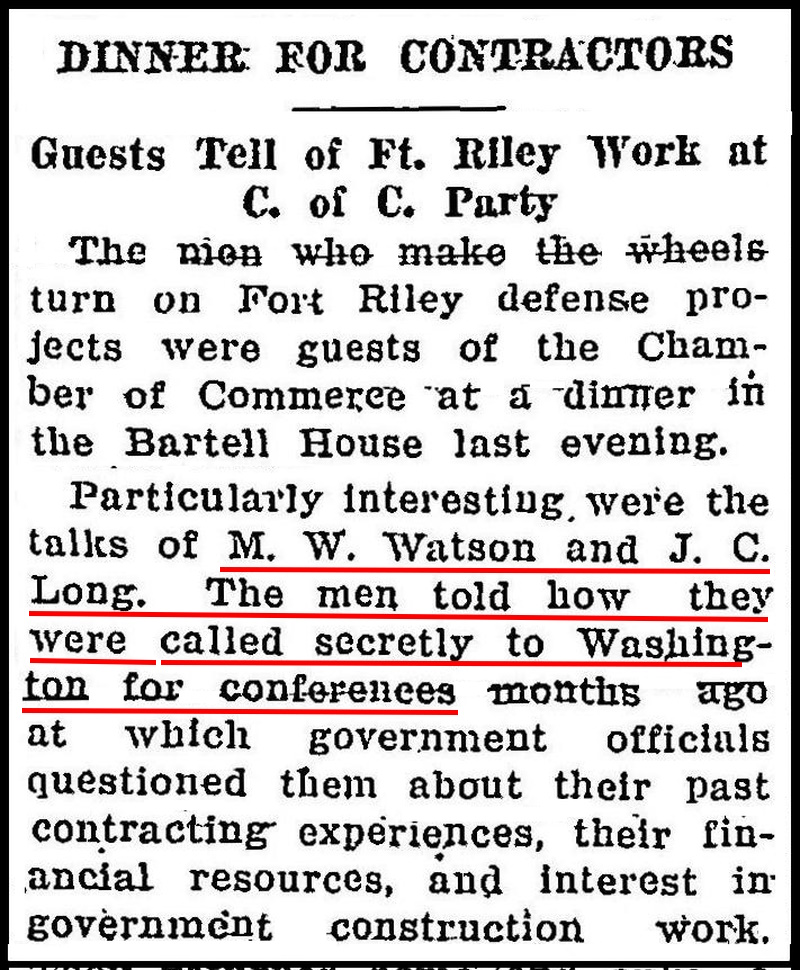
Secret meetings were held with large contractors who had displayed the ability to manage large government projects. These companies were interviewed and vetted, and then awarded huge contracts. The contractors were to be reimbursed for every expense, and then paid a flat fee for their profit.
Big contracts
At Fort Riley, Long-Manhattan-Watson was the selected contractor. On November 14, the contract was awarded. It was a huge project. And it had to be completed in four months.
Construction Quartermaster
The projects would be supervised by the Construction Quartermaster department of the military. The Quartermaster hired civilians for the majority of their work force.
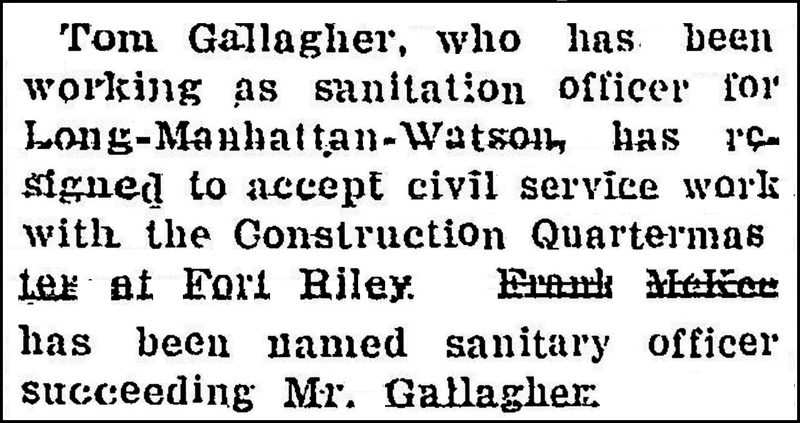
On November 26, Tom Gallagher resigned from LMW and went to work for the Construction Quartermaster. He would help supervise the contractor’s accounting.
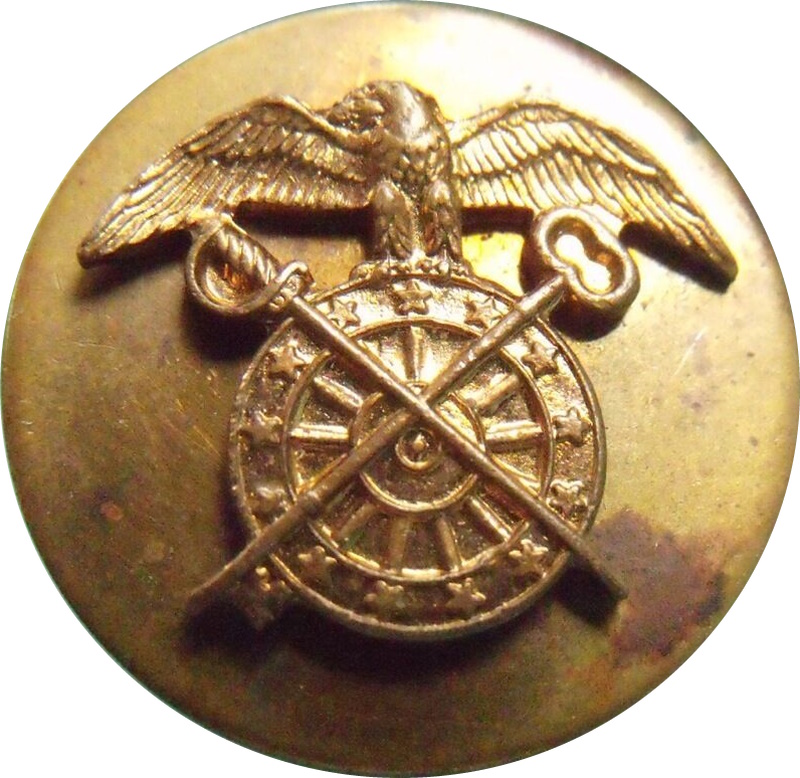
The U.S. Army Quartermaster Corps mission is to support the development, production, acquisition, and sustainment of general supply, Mortuary Affairs, subsistence, petroleum and water, and material and distribution management during peace and war to provide combat power to the U.S. Army.
United States Army Quartermaster Corps – Wikipedia
In 1940, the mission of the Quartermaster Corps included two other areas, later given to other agencies:
- military transportation, which was given to the newly established Army Transportation Corps in 1942
- military construction, which was given to the Corps of Engineers in the early 1940s
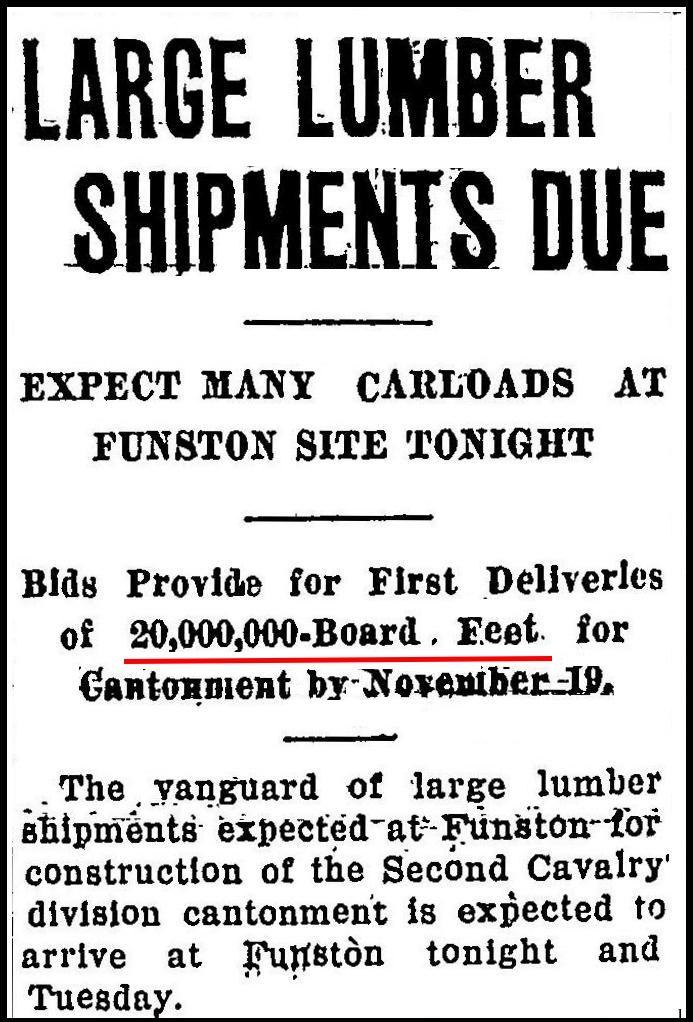
For example, large shipments of lumber began to arrive. The government had ordered 20 million board feet of lumber to be delivered to Funston, and the first rail cars arrived less than a week after the contract was awarded. The quartermaster inspected the shipments and arranged for payment.
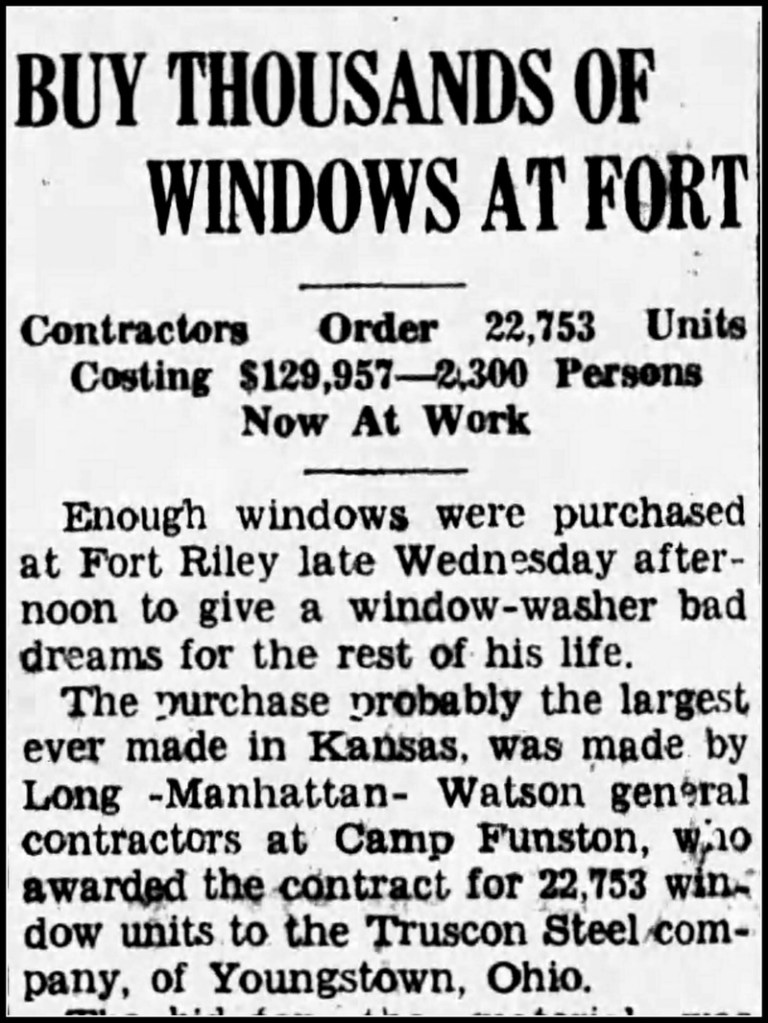
When the contractor ordered 22,000 windows a few days later, the quartermaster’s office would approve the invoice and arrange the reimbursement.
Thousands of jobs
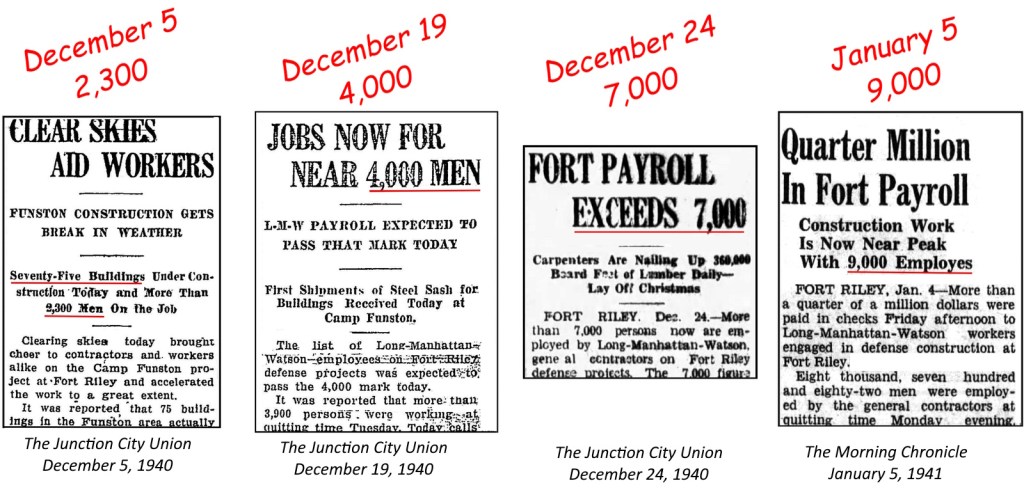
From contract award on November 14, the number of workers exploded. LMW was adding hundreds of workers each week.
Housing shortage
The unemployment rolls disappeared wherever these projects were being built around the country.
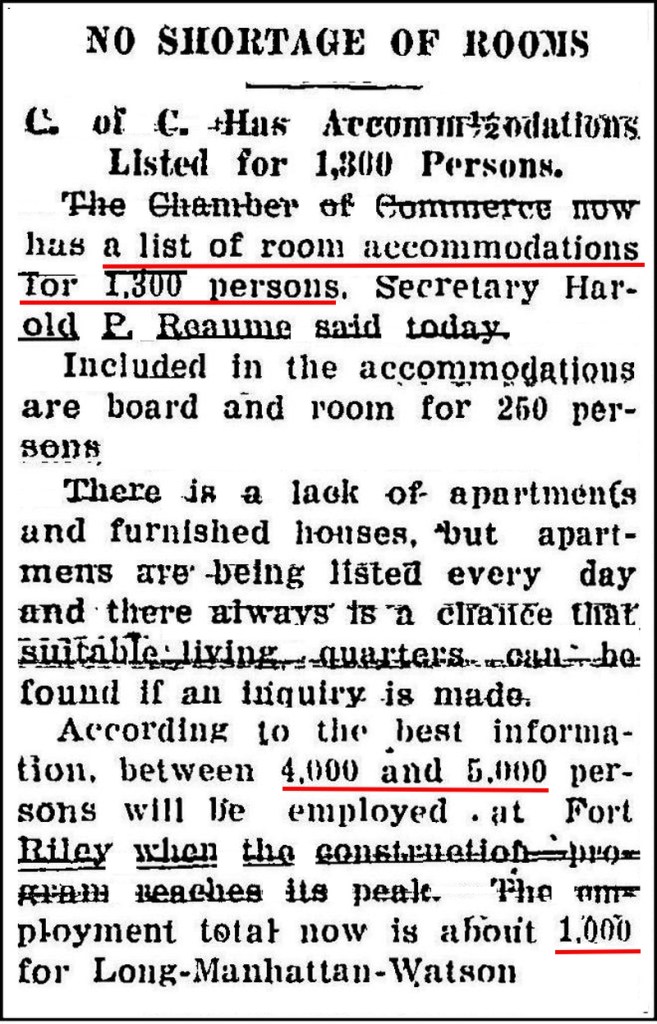
There were so many job seekers flocking to Junction City and Manhattan that the Chambers of Commerce were maintaining a list of rooms for rent. In November, when there were about 1,000 employed at the fort, the Junction City Chamber claimed there was “no shortage of rooms.” The chamber’s list had available rental rooms for 1,300 persons.
That list was quickly exhausted.
Quartermaster jobs
While the contractor jobs grew to thousands, the Construction Quartermaster ranks grew to about 250. Tom Gallagher was one of those.
The U.S. got a late start in building up their military readiness. The administration and congress tried to compensate for the late start by pushing huge sums of money toward the goal. It was a good thing, because the attack on Pearl Harbor was just months away.
Sources
- Newspaper articles – The Junction City Daily Union – various dates – newspapers.com
- Newspaper articles – The Sedalia Democrat – various dates – newspapers.com
- Newspaper articles – The Morning Chronicle – various dates – newspapers.com
- Newspaper articles – The Manhattan Mercury – various dates – newspapers.com
- Image – Barracks construction – Fort Riley, Kansas – eBay – https://www.ebay.com/itm/363592293671?chn=ps&mkevt=1&mkcid=28
- Image – Tom Gallagher – c 1941 – Teply family documents – Catherine Teply Jarvis collection
- Quotation – Quartermaster Corps mission – Wikipedia – https://en.wikipedia.org/wiki/United_States_Army_Quartermaster_Corps
- Image – Quartermaster Corps lapel disk – eBay – https://www.ebay.com/itm/201239172581?chn=ps&norover=1&mkevt=1&mkrid=711-117182-37290-0&mkcid=2&mkscid=101&itemid=201239172581&targetid=1263104805286&device=c&mktype=&googleloc=1020414&poi=&campaignid=14859008593&mkgroupid=130497710760&rlsatarget=pla-1263104805286&abcId=9300678&merchantid=8431304&gclid=Cj0KCQjwla-hBhD7ARIsAM9tQKtq7aPoHrjQ-zBgaXkQ8onKCfCE_0xmuHriCLTk8AM-eZkpHkBJ0nwaAoikEALw_wcB
- Image – Camp Funston – 1941 Vintage Photo WW2 aerial US Army base Camp Funston at Fort Riley Kansas eBay – https://www.ebay.com/itm/193980054183
- Music – Jimmy Dorsey – Bob Eberly – The Breeze and I -Joel Whitburn Billboard Project: 1940 (Pop Memories) – https://ia803403.us.archive.org/22/items/joel-whitburn-billboard-project-1940-pop-memories_202103/40_010%20-%20Jimmy%20Dorsey%20-%20Bob%20Eberly%20-%20The%20Breeze%20and%20I.mp3
 Family Nibbles