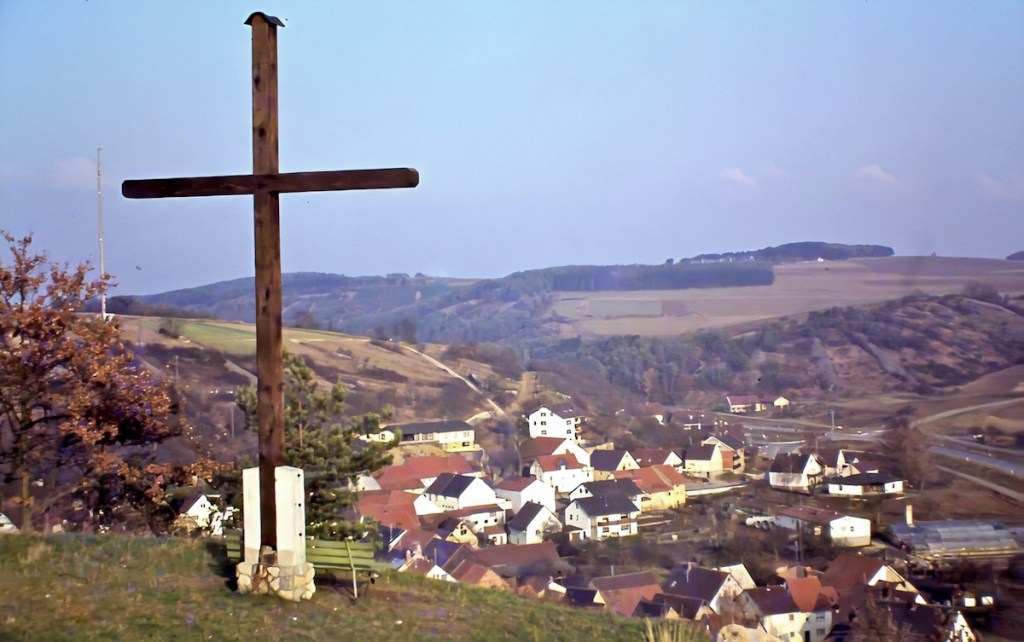
Dittwar was predominantly Catholic throughout the era of the Holy Roman Empire, and remains so today.
Dittwar hosts many religious sites and icons.

Except for a few families who only moved here after the last war, the entire community belongs to the Roman – Catholic faith.
Chronicle of the community of Dittwar – Manfred Maninger – 1968
Editor’s Note: In 1968, Manfred Maninger wrote a book about the history of Dittwar, “Chronicle of the community of Dittwar.” It’s an extensive history and legends and stories about Dittwar. You’ll find lots of excerpts from his book in our stories. http://www.hkvdittwar.de/chronik-der-gemeinde-dittwar.html
Obviously, the Holy Roman Empire mandated Catholicism in its territories. However, the Protestant Reformation of the 1500s had drastically changed religious life in the German territories. Some territories were ruled by families that had converted to Protestants, defying the Empire. This split caused wars for centuries.
Matthaeus Maninger and Maria Eva Giller (6G)
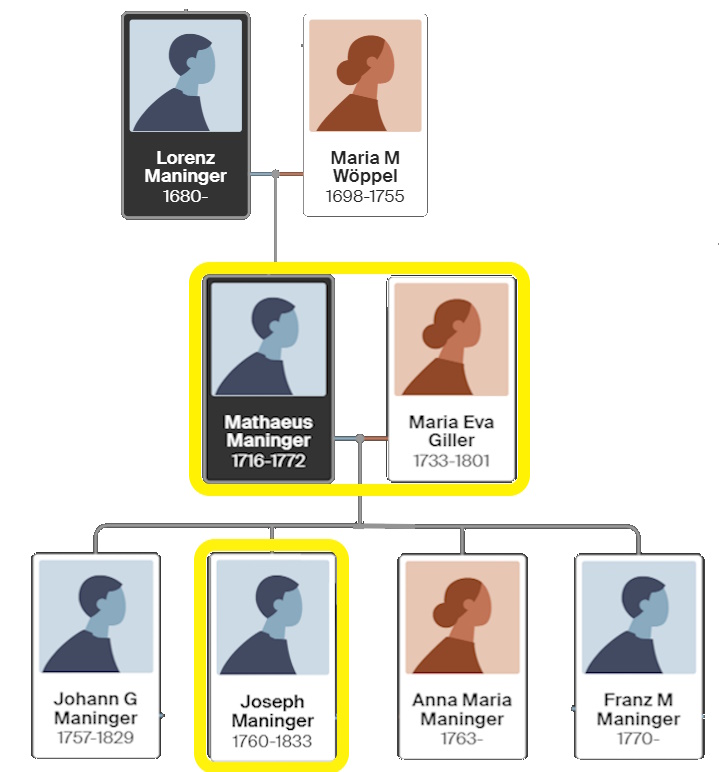
Matthaeus was the second oldest child of Lorenz and Margarethe Maninger, born 1716.
Eva was baptized in Dittwar May 6, 1733. She was probably born a day or two earlier to parents were Adam and Eva Giller.
Because of high infant mortality, it was common to baptize newborns as soon as possible after birth, with a day or two if there was a church nearby. Often the mother wasn’t present at baptism, because she had just given birth.
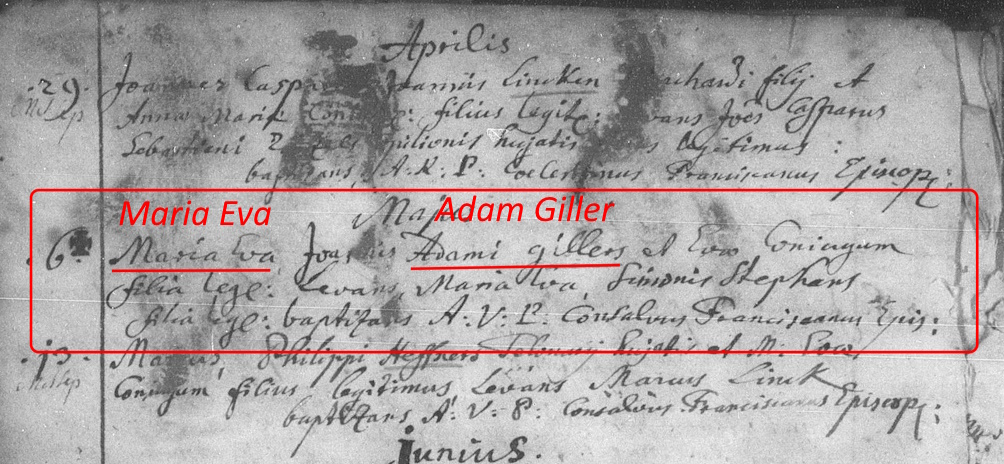
Matthaeus and Eva are our 6th great-grandparents.

Matthaeus Maninger and Maria Eva Giller married on Monday, February 2, 1756, at St. Laurentius Church in Dittwar. The church had been newly rebuilt, so Matthaeus and Eva were among the first to be married there.


Church of St. Laurentius
There has been a parish in Dittwar at least since 1340. A later church may have been built in 1549. Whatever the building’s history, by 1744 it was in bad repair.
The condition of the former church was reported to the Archbishop and Elector in Mainz on June 15, 1744 : “It is to be reported what a miserable, ruinous and worst condition the church in Dittwahr is in which can rightly be called a dive bar and sheepfold rather than the house of God.
The church is located on a mountain rich in springs, it is more of a waterhole than a prayer house, in which no service could be held for weeks . The priest has been several times up to the ankles in water. “We have to wade through water and mud to the Holy of Holies.”
300 years of the Kreuzkapelle – Paster Kleeman – 1983
The current church was built between 1753 and 1755 because the old one was dilapidated. It is already the fourth church; the first two were made of wood, the last two were stone buildings.
Chronicle of the Community of Dittwar – Manfred Maninger
In 1754, the old church was torn down. The residents raised money and pledged a lease on the community sheep farm to fund construction of a new building.


The inscription above the door is interesting. It reads “This new portal was built and was consecrated to God and the church patron saint Lawrence with the help of the parish.”
But it also includes a chronograph, a hidden date. The uppercase characters can be arranged as “DDCCCCCCLLXXWVWVIIII”, resulting in 1754.
The “Kreuzhölzle” miracle

It was in the bitter times after the Thirty Years’ War when a deaf-mute girl named Anna Maria Krank was sent into the forest by her uncle Johann Krank in the first weeks of winter in 1669 to collect wood. The 14-year-old discovered two figures in the hollow of an oak tree, representing the Sorrowful Mother of God and St. John.
Pilgrimage to Kreuzhölzle – Pastor Rupert Kleemann
Anna and her brother Jacob returned to the figures in the woods. Jacob carved his name in the tree, and they took the figures home. Miraculously, the figures returned to the tree in the forest. The priest had the figures locked in the church in Tauberbischofsheim, but they returned again to the forest. The priest ordered the tree cut down, but the axes splintered.

After that, the site became a pilgrimage and there were many healings and miracles. A chapel was built, and 14 stations of the cross were constructed on the ascent and path into the forest. Today the chapel and waystations are still a destination for pilgrims.

Maninger next generation…
Matthaeus and Eva Maninger raised four children in Dittwar:
- Johann Georg b. 1757
- Joseph b. 1760 *
- Anna Maria b. 1763
- Franz Michael b. 1770
* Joseph is our grandparent
And a passing
Margarethe Maninger, wife of Lorenz, died on November 17, 1755. She was age 57.
Just two weeks later, on December 5, 1755, Margarethe Maninger, daughter of Margarethe and Lorenz, died at age 27.
Circumstances like these make us wonder if the cause of death was a communicable disease or epidemic. We don’t know.

We don’t know when Lorenz died.
Whatever the case for births, marriages, and deaths, the lives of the Maningers in Dittwar continued. We’re lucky they did!
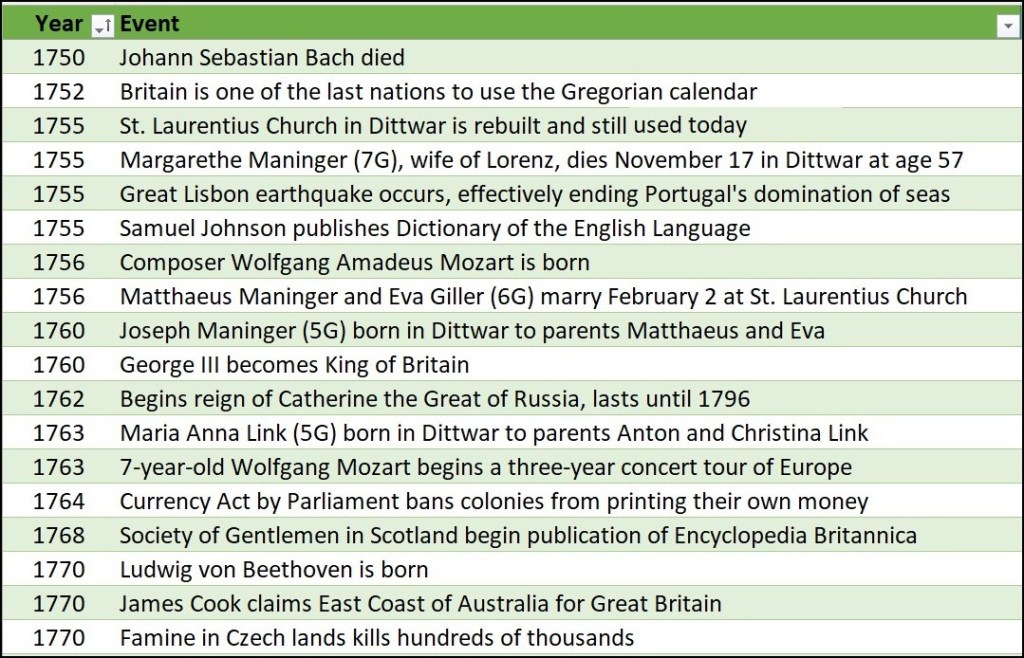
Timeline
Sources:
- Image – Cross overlooking Dittwar – Dittwar Local History and Cultural Association – Dittwar in Transition – Photo Gallery – http://www.hkvdittwar.de/dittwar-im-wandel—bilderschau.html
- Image – Wayside shrine at village entrance- Dittwar Local History and Cultural Association – http://www.hkvdittwar.de/bildstock-am-ortseingang.html
- Image – marriage in St. Laurentius Church – Microsoft Image Creator from Designer
- Image – Dittwar, Germany – Andreas Keller – Own work, CC BY-SA 4.0 – https://commons.wikimedia.org/w/index.php?curid=36260502
- Marriage record – Matthaeus Maninger and Maria Eva Giller – Dittwar – Catholic records from the Archdiocese of Freiburg im Breisgau, Baden, Germany. Baptism, marriage and burial records included – FamilySearch – https://www.familysearch.org/ark:/61903/1:1:QBN5-2JW2
- Image – Dittwar – houses and church – Dittwar Local History and Cultural Association – Dittwar in Transition – Photo Gallery – http://www.hkvdittwar.de/dittwar-im-wandel—bilderschau.html
- Quote – Catholic faith in Dittwar – Chronicle of the community of Dittwar – Manfred Maninger – 1968 – http://www.hkvdittwar.de/chronik-der-gemeinde-dittwar.html
- Quote – Rebuilt church in Dittwar – Chronicle of the community of Dittwar – Manfred Maninger – 1968 – http://www.hkvdittwar.de/chronik-der-gemeinde-dittwar.html
- Quote – Condition of church in 1744 – 300 years of the Kreuzkapelle – Paster Kleeman – 1983 – republished by Dittwar Local History and Cultural Association e. v. – http://www.hkvdittwar.de/300-jahre-kapellenfest.html
- Images – St. Laurentius in Dittwar (Tauberbischofsheim) – Andreas Keller – Wikimedia Commons – https://commons.wikimedia.org/wiki/File:Dittwar_St._Laurentius.JPG
- Image – St. Laurentius in Dittwar (Tauberbischofsheim), erbaut 1748-1752 – Andreas Keller – Wikimedia Commons – https://commons.wikimedia.org/wiki/File:Dittwar_St._Laurentius_innen.JPG
- Image – girl finding icons by a tree – Microsoft Image Creator from Designer
- Quote – Kreuzhölzle story origins – 300 years of the Kreuzkapelle – Dittwarer Heimatfest 9/10. and September 11, 1983, by Pastor Rupert Kleemann – http://www.hkvdittwar.de/wallfahrt-zum-kreuzhoumllzle.html
- Image – Cross Chapel in Dittwar – Wikimedia Commons – Kreuzkapelle (Kreuzhölzle) bei Dittwar (Tauberbischofsheim), eingeweiht 1683 – Andreas Keller – https://en.wikipedia.org/wiki/File:Dittwar_Kreuzh%C3%B6lzle_Chor.JPG
- Image – St. Laurentius Church – Dittwar Local History and Cultural Association – Dittwar in Transition – Photo Gallery – http://www.hkvdittwar.de/dittwar-im-wandel—bilderschau.html
- Death record – Margarethe Maninger – mother and daughter – Dittwar – Catholic records from the Archdiocese of Freiburg im Breisgau, Baden, Germany. Baptism, marriage and burial records included – FamilySearch – https://www.familysearch.org/ark:/61903/1:1:QBN5-2JW2
- Quote – 18th-century history of Germany – Wikipedia – https://en.wikipedia.org/wiki/18th-century_history_of_Germany#Peasants_and_rural_life
- Family Tree diagrams – Ancestry.com and Mark Jarvis
- Music – Bach 08 – Toccata and Fugue in D minor BWV565 – Bach – by Ranjith Daluwatta – Internet Archive – https://archive.org/details/BachCollection/Bach+08+-+Toccata+and+Fugue+in+D+minor+BWV+565.mp3
 Family Nibbles


