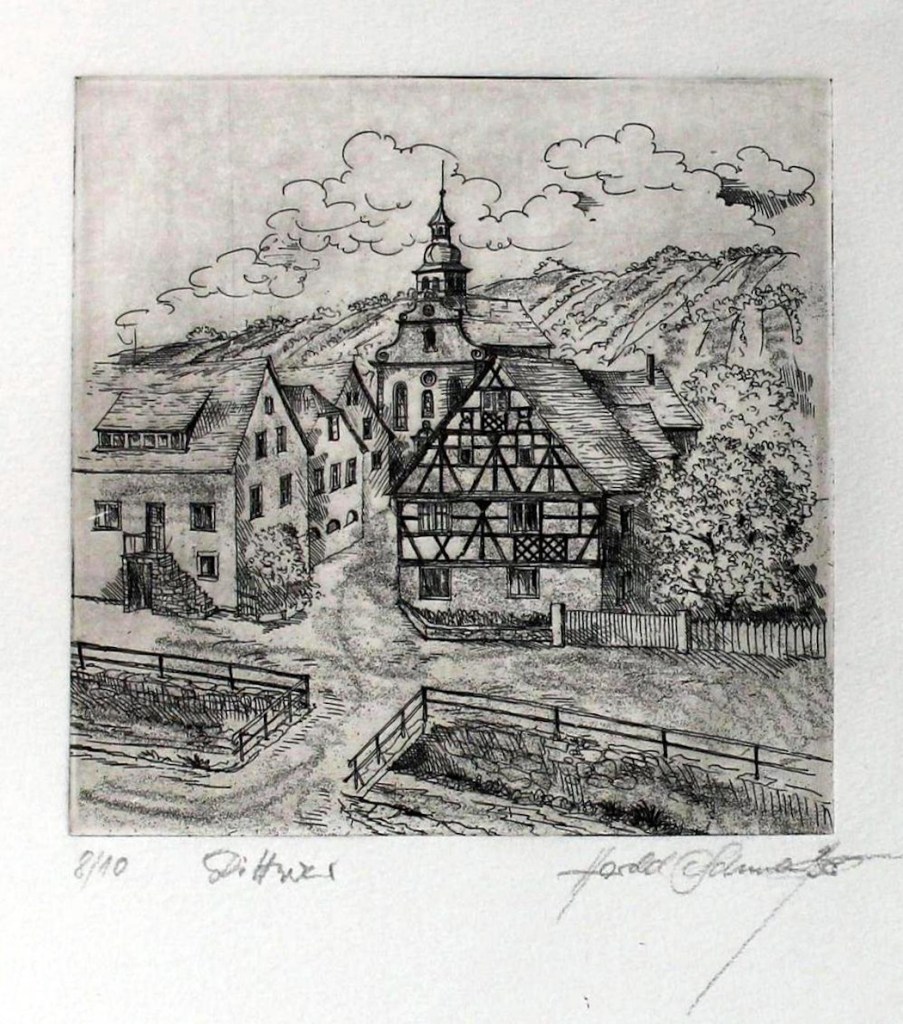
Joseph and Anna Maninger lived in Dittwar in the latter half of the 18th century.
Their world was like that of their parents and grandparents. Their homes, occupations, religion, and traditions were the same as past generations. Political and ecclesiastical rule were centuries old.
The dawn of the 19th century would bring a seismic change.
Joseph Maninger and Maria Anna Link (5G)
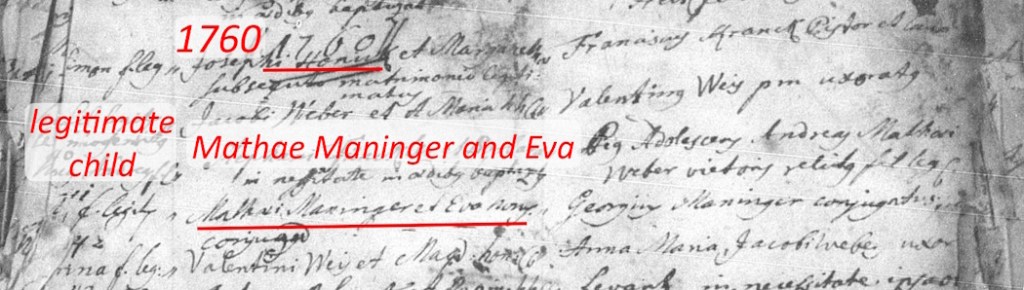
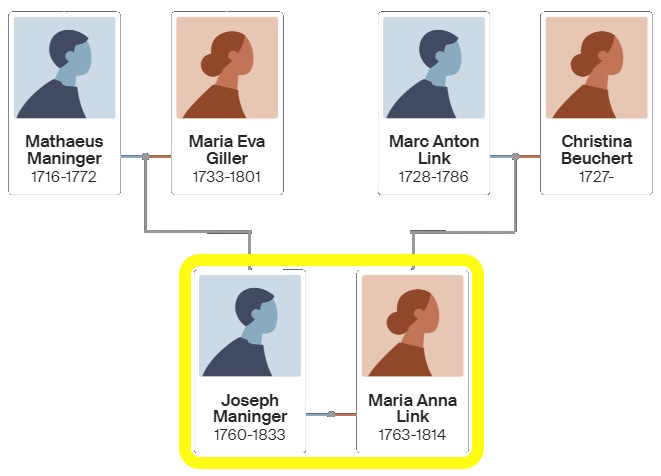
Joseph was the second oldest child of Mathaeus and Eva Maninger, born 1760.
Anna was born in Dittwar in 1763 to Anton and Christina Link. Joseph and Anna are our 5th great-grandparents.
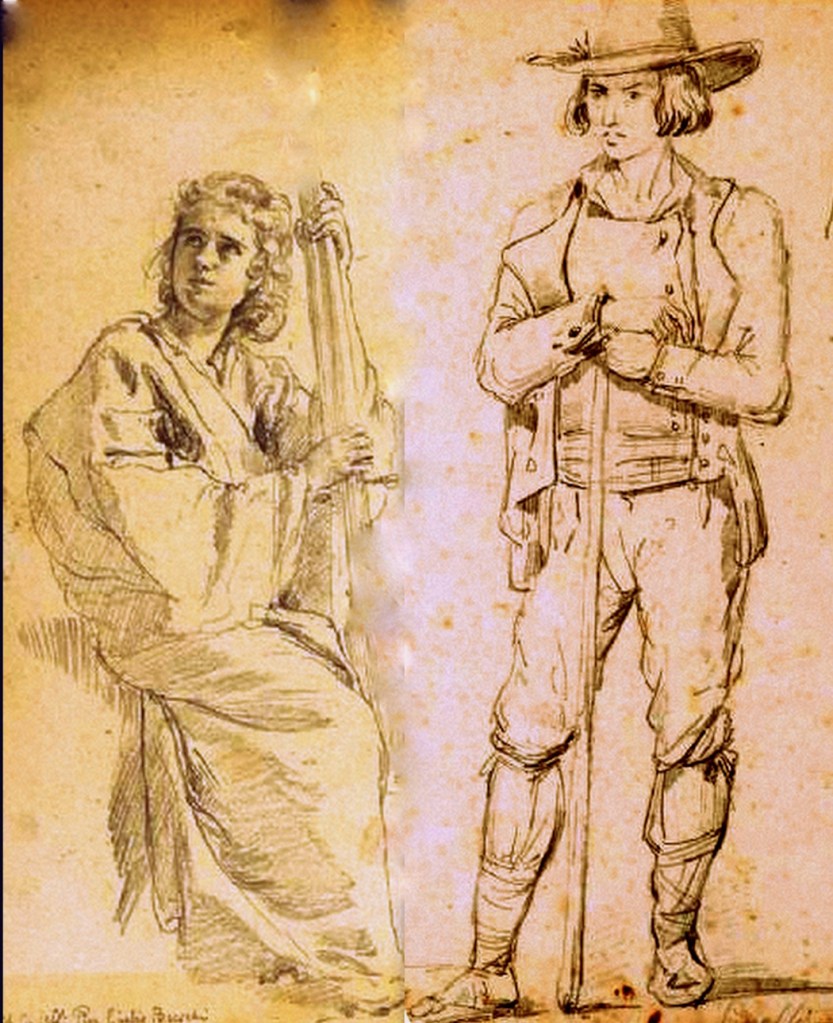
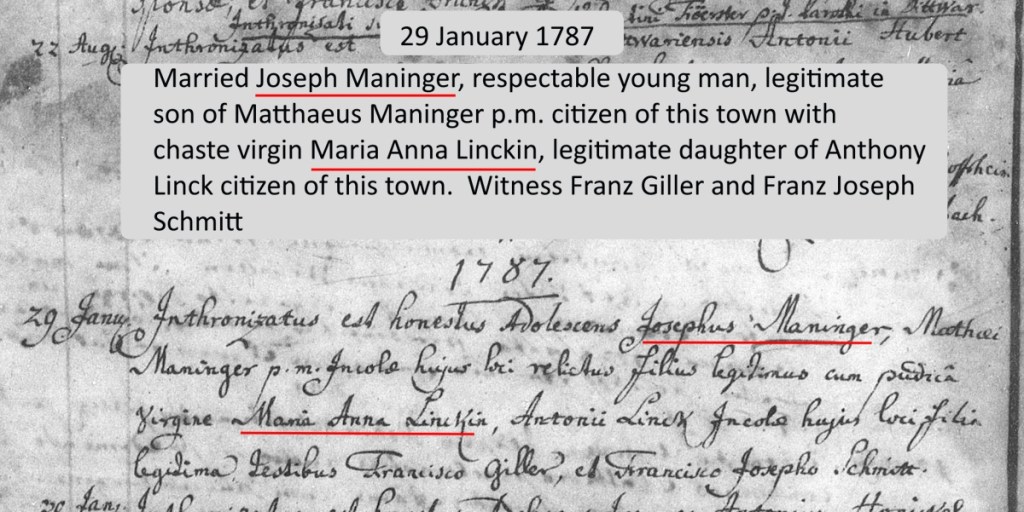
Joseph Maninger and Anna Link were married in St. Laurentius Church on Monday, January 29, 1787.
Joseph and Anna Maninger didn’t live in the modern country of Germany because it didn’t yet exist. Dittwar was part of a territory ruled by the Archbishop of Mainz. Who’s that?
We’ve got to take a minute to talk about the Holy Roman Empire.
The Holy Roman Empire
The classical Roman Empire refers to the period and territories ruled by Rome, and existing from about 31 BC to about 476 AD. That’s the fall of the Roman Empire that we’re familiar with, but that’s not the Holy Roman Empire.
Three centuries after the fall of Rome, in December, 800, the Pope crowned Charlemagne the first emperor of the Holy Roman Empire. Northern Europe consisted of hundreds of territories and states, each with a secular or ecclesiastical ruler. The Holy Roman Empire organized these Germanic territories under an umbrella ruler, the Holy Roman Emperor.


The Holy Roman Empire prevailed in Europe from 700 AD to 1803, more than a thousand years!
From the 13th century onwards, a small group of prince-electors gained the privilege of electing the king. The king would then later be crowned Emperor by the pope.
Prince-elector – Wikipedia
Look at this kaleidoscope of territories. These are the territories and states of the Holy Roman Empire.
Imagine a patchwork quilt of principalities, duchies, bishoprics, and free cities, each with its own ruler, laws, and customs. The empire’s territory encompassed much of modern-day Germany, Austria, Switzerland, and parts of Italy and France.
On the map, clergy rules the purple-shaded territories, the largest by the Archbishop of Mainz.
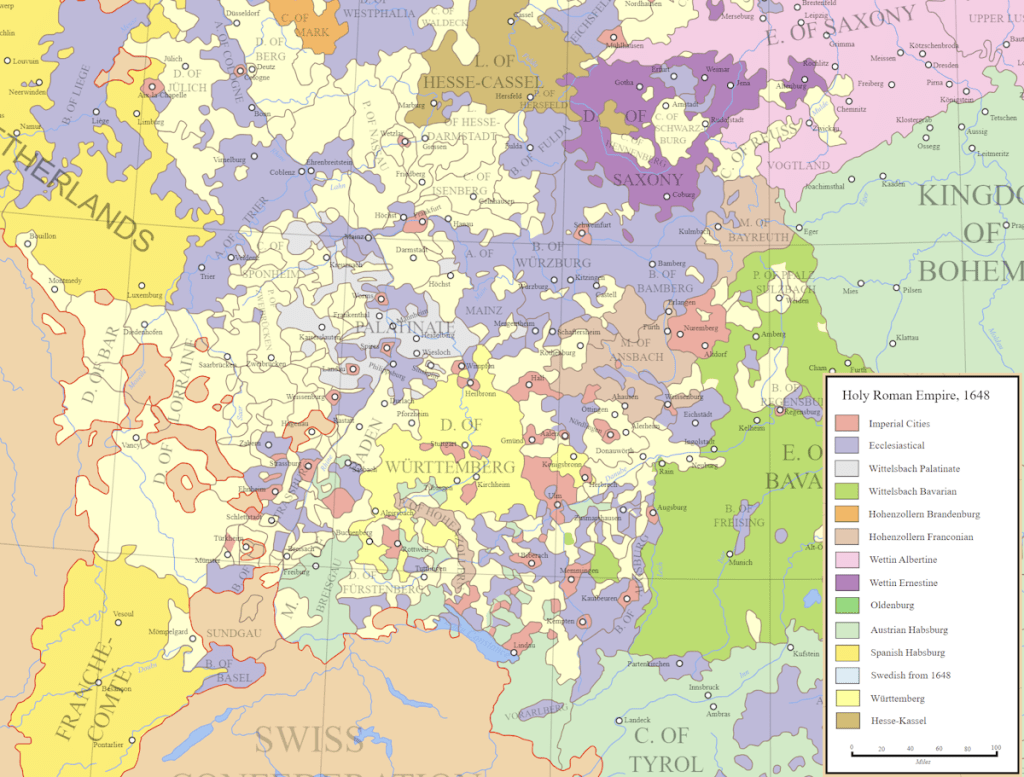
Throughout the 1600s and 1700s, our Maningers lived in a territory controlled by the Archbishop of Mainz. Of the hundreds of territories in the Holy Roman Empire, Mainz was one of the largest and most important.

The Archbishop-Elector of Mainz was also archchancellor of Germany (one of the three component titular kingdoms of the Holy Roman Empire, the other two being Italy and Burgundy) and, as such, ranked first among all ecclesiastical and secular princes of the Empire, and was second only to the Emperor.
Electorate of Mainz – Wikipedia

Maninger next generation…
Joseph and Anna were born as subjects of the Holy Roman Empire, as were their ancestors as far back as anyone could remember. Their children were born as subjects of the Holy Roman Empire.
Joseph and Anna raised five children in Dittwar:
- Maria Genofova b. 1787
- Franz Remulus b. 1790
- Franz Anton b. 1792
- Joseph Amor b. 1797 *
- Lorenz Leonard b. 1799
* Amor is our grandparent
Joseph and Anna are our 5th great-grandparents.

And a passing…
Eva Giller Maninger died November 28, 1801, at age 68. She was the wife of Matthaeus Maninger, and the mother of Joseph Maninger and three other children.

Matthaeus died in 1772. We don’t have a citation.
Matthaeus and Eva probably didn’t think of their family legacy beyond their children’s or grandchildren’s generations. Wouldn’t it be great to tell them that their memories and DNA continued until the 21st Century. We know little about them, yet we feel connected to learn about their lives and times.
The dawn of the 19th century
In 1803, a census in Dittwar recorded 83 houses, 127 families, 15 craftsmen, 112 farmers, around 800 inhabitants. Recall that in the 1668 census there were about 80 houses (hearths) with a population of 357.
So the population had doubled over that span of 135 years, but the number of houses had remained the same. Sounds crowded.
The number of farmers had doubled, though the available land area remained the same. Parcels of arable land had been divided and subdivided in each succeeding generations.
Besides the increased population, Dittwar life was much the same as a century earlier. Same social and religious cultures. Same lifestyles. Same onerous tithes and taxes.
That was all to change.
The end of the Holy Roman Empire
The decline of the Holy Roman Empire was a long and drawn-out process lasting centuries.
The Holy Roman Empire finally began its true terminal decline during and after its involvement in the French Revolutionary Wars and the Napoleonic Wars.
Dissolution of the Holy Roman Empire – Wikipedia
From 1800 through 1805, Napolean scored crushing victories over the Austrian army.
In 1801, Napolean annexed all territories on the west bank of the Rhine River. East of the river, the map of Germany was redrawn, eliminating small and ecclesiastical territories. The larger German states were happy to oblige, swallowing up their smaller neighbors.

The chief victims of the Final Recess were the free cities, the imperial knights, and the ecclesiastical territories. They fell by the dozens. Too weak to be useful allies of Napoleon, they were destroyed by the ambition of their French conquerors and by the greed of their German neighbours.
End of the Holy Roman Empire – Brittanica
In 1805, Napolean founded the Confederation of the Rhine, a French vassal state under Napolean’s protection. Sixteen major German states joined the confederation, and Napolean announced that the Holy Roman Empire of the German Nation no longer existed.
On August 6, 1806, Francis II abdicated his throne as the Holy Roman Emperor, officially ending the Empire.
A new world order
Dittwar would become part of the new country of Baden. The people would become subjects of the Grand Duke of Baden. Some aspects of their lives would get worse.
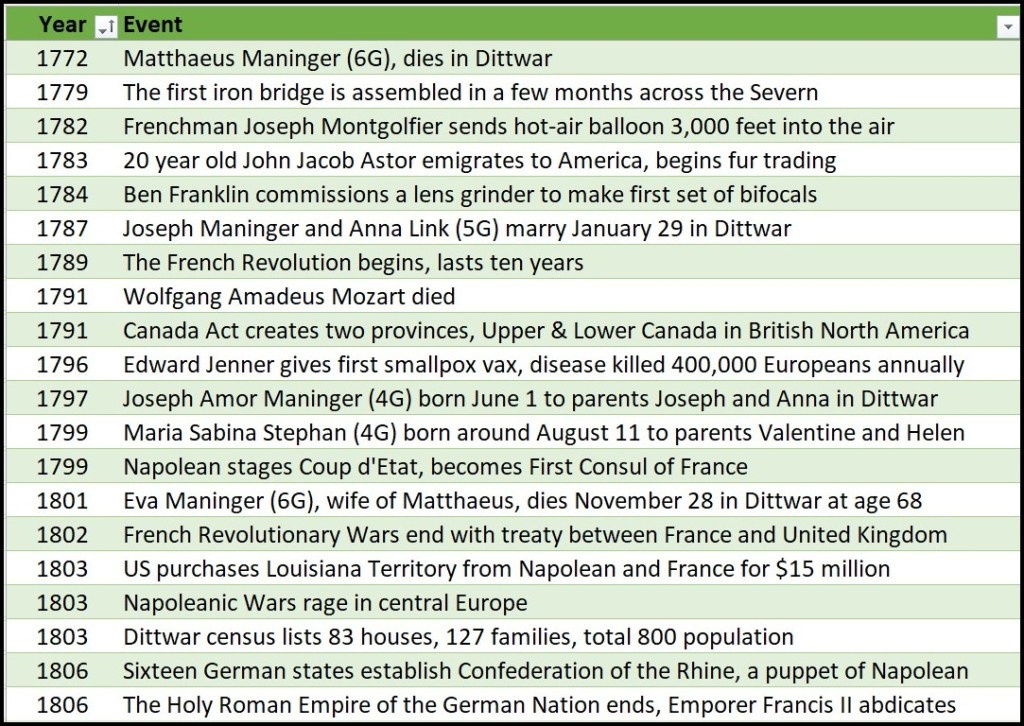
Timeline
Sources:
- Drawing – Dittwar – Harald Schmaußer – Local History and Culture Association Dittwar eV – Pictures from the Dittwar Festival – 2023/Sonntag/Sonntag 28 – https://magentacloud.de/apps/files_sharing/publicpreview/cFGk5ZNm4DKQ7BR?file=/2023/Sonntag/Sonntag_28.jpg&fileId=5030433970&x=3840&y=2160&a=true or https://magentacloud.de/s/cFGk5ZNm4DKQ7BR?path=%2F2023%2FSonntag or http://www.hkvdittwar.de/
- Baptism record – Joseph Maninger – Dittwar – Catholic records from the Archdiocese of Freiburg im Breisgau, Baden, Germany. Baptism, marriage and burial records included – FamilySearch – https://familysearch.org/ark:/61903/1:1:QB6D-88MM
- Marriage record – Joseph Maninger and Maria Anna Link – Dittwar – Catholic records from the Archdiocese of Freiburg im Breisgau, Baden, Germany. Baptism, marriage and burial records included – FamilySearch – https://www.familysearch.org/ark:/61903/1:1:QBFL-TS6Z
- Sketch of man and woman – composite of two sketches by Antoš Frolka
- Quote – Dissolution of the Holy Roman Empire – Wikipedia – https://en.wikipedia.org/wiki/Dissolution_of_the_Holy_Roman_Empire
- Quote – 18th-century history of Germany – Wikipedia – https://en.wikipedia.org/wiki/18th-century_history_of_Germany#Peasants_and_rural_life
- Image – Dittwar – people standing before a house – Dittwar Local History and Cultural Association – Dittwar in Transition – Photo Gallery – http://www.hkvdittwar.de/dittwar-im-wandel—bilderschau.html
- Quote – End of the Holy Roman Empire – Brittanica – https://www.britannica.com/place/Germany/End-of-the-Holy-Roman-Empire
- Map composite – combination of the two following maps:
- Map – Germanic region of Holy Roman Empire – Map of the empire following the Peace of Westphalia in 1648 – Wikimedia – https://en.wikipedia.org/wiki/Germany_in_the_early_modern_period
- Map – Map of the states of the Confederation of the Rhine – Napoleonic Association — https://www.facebook.com/NapoleonicAssociation/photos/a.333001096835106/1957736341028232/?type=3
- Death record – Maria Eva Giller Maninger – Dittwar – Catholic records from the Archdiocese of Freiburg im Breisgau, Baden, Germany. Baptism, marriage and burial records included – FamilySearch – https://www.familysearch.org/search/record/results?count=20&q.deathLikeDate.from=1801&q.deathLikePlace=Dittwar%2C%20Tauberbischofsheim%2C%20Main-Tauber-Kreis%2C%20Baden-W%C3%BCrttemberg%2C%20Germany&q.givenName=Eva&q.recordCountry=Germany&q.surname=maninger
- Family Tree diagrams – Ancestry.com and Mark Jarvis
- Music – German Hoch Soll – Free Internet Music – https://www.free-internet-music.com/german-music.html
 Family Nibbles
