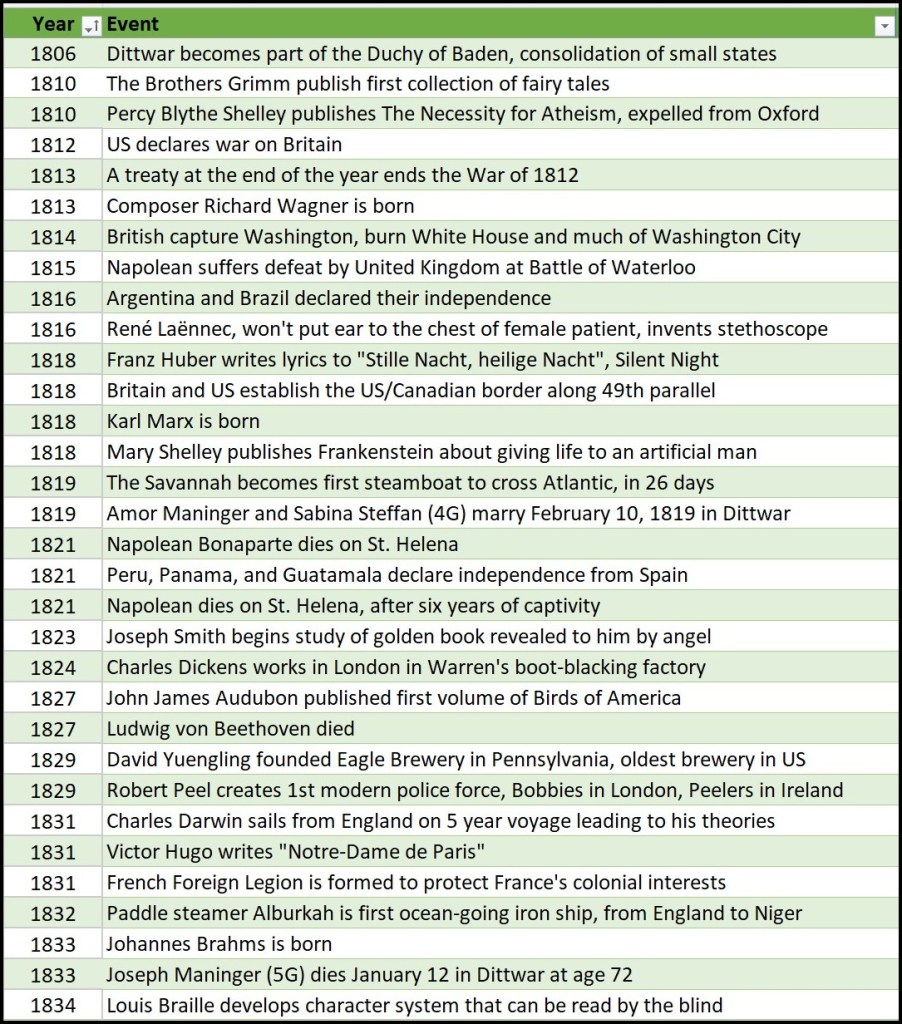
After the fall of the Holy Roman Empire in 1806, Dittwar came under the control of the newly-created Duchy of Baden.

The new rulers were more oppressive than the old.

Excise was paid by the butchers for meat sold and by the innkeepers for the wine served. In addition, the community has to pay the interest on 6,307 guilders of debt, purchaser’s money, counting money, salary (for mayor, local mayor, etc.), rural officer’s salary, sheep money, citizens’ draft money, New Year’s money, woodcutter’s wages.
300 years of the Kreuzkapelle – Pastor Kleemann et al
Amor Maninger and Sabina Steffan (4G)
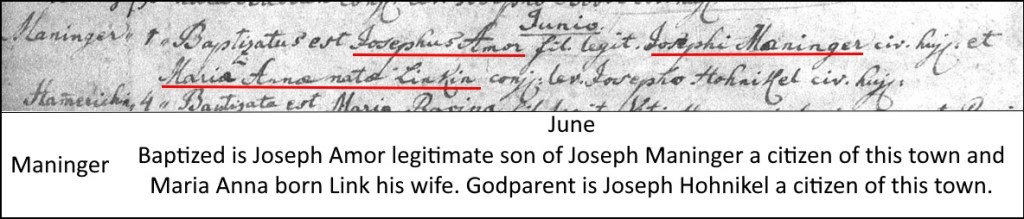
Amor Maninger was the fourth child of Joseph and Maria Anna Maninger. He was born in Dittwar a day or two before being baptized on June 1, 1797. He was 9 years old when the Holy Roman Empire dissolved.
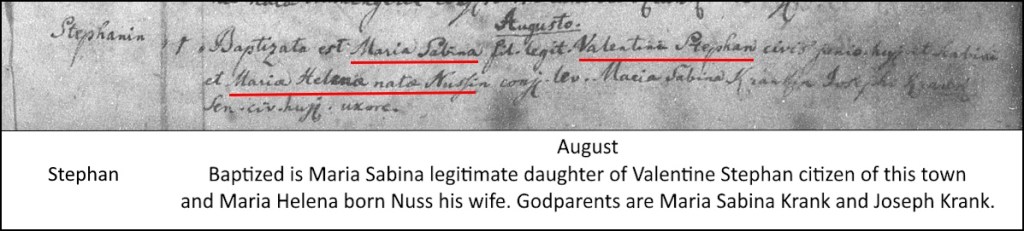
Sabina Steffan was baptized on August 11, 1799, so she was born a day or two earlier.
Amor Maninger and Sabina Steffan were married in St. Laurentius Church on Wednesday, February 10, 1819.


Parish priests good and bad
Amor and Sabina were married by parish priest A. Geiger in 1819. Geiger had come to the church a year earlier, and was disliked by the parishioners.

Around 1809, the government of Baden had ordered the destruction of “unnecessary” chapels, like the Cross Chapel (Kreuzkapelle) in the woods above Dittwar. Authorities were suspicious of people gathering or making pilgrimages to places other than the official village churches.
Pastor Hofer in Dittwar refused to destroy the Cross Chapel. That defiance didn’t sit well with the state church, and they expelled Hofer in 1817.
His successors Schumann and Geiger, who wanted to carry out the sovereign’s decisions, incurred the hatred of the population. As detailed reports from that time tell, there were terrible scenes in the village community. The early death of chaplain Schumann after only a few months in office is terrible proof of this.
300 years of the Kreuzkapelle – Pastor Kleemann et al
Schumann died in 1818. Geiger was pastor from 1818 until 1825.
Even the parish priests suffered the poor economic conditions.
In 1830, Pastor Stiel complained about the privations he had to suffer. The priest is urgently in need of “hay, ohmet, wood, dung, turnips, harvest and autumn transport.”
Bad harvests, especially in the vineyards, led to even greater impoverishment in the second half of the century. No wonder that many residents emigrated to foreign countries.
300 years of the Kreuzkapelle – Pastor Kleeman et al
Maninger next generation…
It was during these years that Amor and Sabina raised ten children in Dittwar:

- Franz Leonard b. 1819
- Joseph b. 1821
- Franziska b. 1823
- Lorenz Bernhard b. 1825
- Emma b. 1827
- Maria Anna b. 1830
- Michael Anton b. 1833
- Valentine Damian b. 1835 *
- Mathias Anton b. 1838
- Maria Ernestina b. 1840
* Valentine is our grandparent.

Citizen’s Register 1837
Based on the first citizen’s register of 1837, there were six Maninger households in Dittwar.
That’s probably a total of 25-30 Maningers living in those six households. We know that Amor and Sabina Maninger had eight children by 1837, so their household numbered 10.


Economically, things weren’t great. Between 1837 and 1850, the population of adult male citizens increased from 137 to 192. Farmland had been divided and subdivided among preceding generations, so that a family’s parcel was small.

The main reasons for the particularly pronounced poverty in our village were the poor soil conditions, the division of the land into tiny plots and the large number of children. Once you got into debt, it was difficult to get out of it. For many there was only one way to escape complete poverty: emigration.
300 years of the Kreuzkapelle – Pastor Kleemann et al
Amor’s parents…
Amor Maninger’s parents, Joseph and Anna, both passed away in the first half of the 1800s. Anna died December 10, 1814, at age 51. Joseph died January 12, 1833, at age 72. They had both experienced a huge change in society and governance during their lives.

What would Joseph and Anna think of their descendants? Wouldn’t it be great to tell them about us, our lives, their legacy.
Timeline
Sources:
- Map composite – combination of the two following maps:
- Map – Central Europe at the Height of Napoleonic Power (1812) – German History in Documents and Images (GHDI) – https://ghdi.ghi-dc.org/map.cfm?map_id=372
Map – Grand Duchy of Baden – Wikipedia – https://en.wikipedia.org/wiki/Grand_Duchy_of_Baden - Image – Peasants paying taxes – Konkordat, Kirche und Geld – Bernhard Anderl
- Baptism record – Joseph Amor Maninger – Dittwar – Catholic records from the Archdiocese of Freiburg im Breisgau, Baden, Germany. Baptism, marriage and burial records included – FamilySearch – https://www.familysearch.org/ark:/61903/1:1:QB66-SDMM
- Baptism record – Maria Sabina Stephan – Dittwar – Catholic records from the Archdiocese of Freiburg im Breisgau, Baden, Germany. Baptism, marriage and burial records included – FamilySearch – https://www.familysearch.org/ark:/61903/1:1:QB6D-QK6Z
- Image – marriage in St. Laurentius Church – Microsoft Image Creator from Designer
- Quotes – Economic conditions for the people – 300 years of the Kreuzkapelle – Paster Kleeman – 1983 – republished by Dittwar Local History and Cultural Association e. v. – http://www.hkvdittwar.de/300-jahre-kapellenfest.html
- Marriage record – Joseph Amor and Maria Sabina Steffan – Dittwar – Catholic records from the Archdiocese of Freiburg im Breisgau, Baden, Germany. Baptism, marriage and burial records included – FamilySearch – https://www.familysearch.org/ark:/61903/1:1:QBFG-S96Z
- Drawing – Kreuzkapelle – Harald Schmaußer – Local History and Culture Association Dittwar eV – Pictures from the Dittwar Festival – 2023/Sonntag/Sonntag 28 – https://magentacloud.de/apps/files_sharing/publicpreview/cFGk5ZNm4DKQ7BR?file=/2023/Sonntag/Sonntag_28.jpg&fileId=5030433970&x=3840&y=2160&a=true or https://magentacloud.de/s/cFGk5ZNm4DKQ7BR?path=%2F2023%2FSonntag or http://www.hkvdittwar.de/
- Quotes – 1837 Citizens Register – 300 years of the Kreuzkapelle – Paster Kleeman – 1983 – republished by Dittwar Local History and Cultural Association e. v. – http://www.hkvdittwar.de/300-jahre-kapellenfest.html
- Images – Dittwar – Dittwar Local History and Cultural Association – Dittwar in Transition – Photo Gallery – http://www.hkvdittwar.de/dittwar-im-wandel—bilderschau.html
- Family Tree diagrams – Ancestry.com and Mark Jarvis
- Death record – Joseph Maninger – Dittwar – Catholic records from the Archdiocese of Freiburg im Breisgau, Baden, Germany. Baptism, marriage and burial records included – FamilySearch – https://www.familysearch.org/ark:/61903/1:1:QB6Z-VD3Z
- Music – BERGFRUEHLING (SCHNEEROSEN), LIED (SPRING IN THE MOUNTAINS (SNOWWHITE ROSES), SONG) – by G. FREUNDORFER – Internet Archive – https://archive.org/details/78_bergfruehling-schneerosen-lied-spring-in-the-mountains-snowwhite-roses-song_gbia0511324a
 Family Nibbles
