
Valentine Maninger made the decision to emigrate by the time he was age 18.
That decision likely meant he wouldn’t see his parents or siblings or neighbors or Dittwar again.
Val had made the decision. Now he had to navigate the difficulties of getting from Dittwar to America.
Valentine had to apply at the mayor’s office for a passport and permission to emigrate. The mayor or city official would have checked if outstanding taxes were due, or if the applicant was trying to evade military service. Sometimes the applicant would have to pay a fee.
The obstacles and red tape caused many to emigrate illegally.
Here’s Valentine’s emigration application date – March 7, 1854.
In the 19th century, many people from Dittwar were drawn to the new world. Here are some of their immigration application dates:
Kraft Andreas 10/29/1835
Weber Veit with family 04/05/1852
Volkert Maria 11/10/1838
Hammerich J. Bonifaz 04/22/1852
Shame Maria Anna 07/17/1839
Hartmann Franziska 02/23/1842
Häfner Franz 02/15/1853
Honikel Ignaz 04/03/1844
Maninger Valentin 03/07/1854
Häfner M. with family 04/18/1850
Hammerich Lorenz 05/16/1854
Mainz Regina 06/23/1851
Schmitt Sebastian 11/16/1854
Rudolf Christophorus 03/02/1852
Weber Josef Anton 02/12/1857
Weber Ambras 04/05/1852
etc.
300 Years of Chapel Festival – Pastor Kleeman et al
Travel to Le Havre
Once he obtained a passport, Val made arrangements for passage. He would travel to Le Havre, France instead of Bremen or Hamburg, Germany. There were ads and agents in Baden for travel to Le Havre and America.

From southern Germany, it was closer to travel to Le Havre, France instead of Bremen, Germany on the North Sea.
German emigrants from Baden to Le Havre in 1854 had to cross the Rhine river, either by boat or by bridge, and then travel through France by wagon, coach, or train.
The development of the French railway system also made passage across France easier (one day’s travel from the border to Paris). A ticket from Mayence (Mainz) to Le Havre in the 1850s cost 40.65 francs, to Antwerp only 12 and to Bremen 15.50.
Le Havre as an Emigration Port – genhist.org
Valentine Maninger had likely never been more than a few miles away from Dittwar. Probably never ridden a train. Almost certainly never been to France. What must he have been thinking?

The cost of emigrating from Baden to America in 1854 varied depending on the mode of transportation, the route, and the season. The average cost for a single adult was about 40-50 gulden (or florins), which was equivalent to about $16-20 at that time. This amount covered the expenses for traveling from Baden to Le Havre, the port fees, and the passage on the ship.
Le Havre was a busy and crowded port, where emigrants had to wait for their ships to be ready. They often stayed in cheap boarding houses or slept on the docks. They also had to undergo medical examinations and passport checks before boarding.

The Ship Mercury
Valentine arranged passage on the ship Mercury of the Havre Second Line, operated by Boyd and Hincken, agents in New York. The company provided packet service between New York and Le Havre, France. Packet service means that there were regularly scheduled sailings.
The line offered scheduled sailings from New York to Le Havre on the 1st of each month, and sailings from Le Havre to New York on the 16th.

The Mercury was a new ship, launched September 3, 1851. It was a 3-masted, square-rigged ship. It had two decks and a draught of 21 feet. The ship was 193 feet long by 31 feet wide.
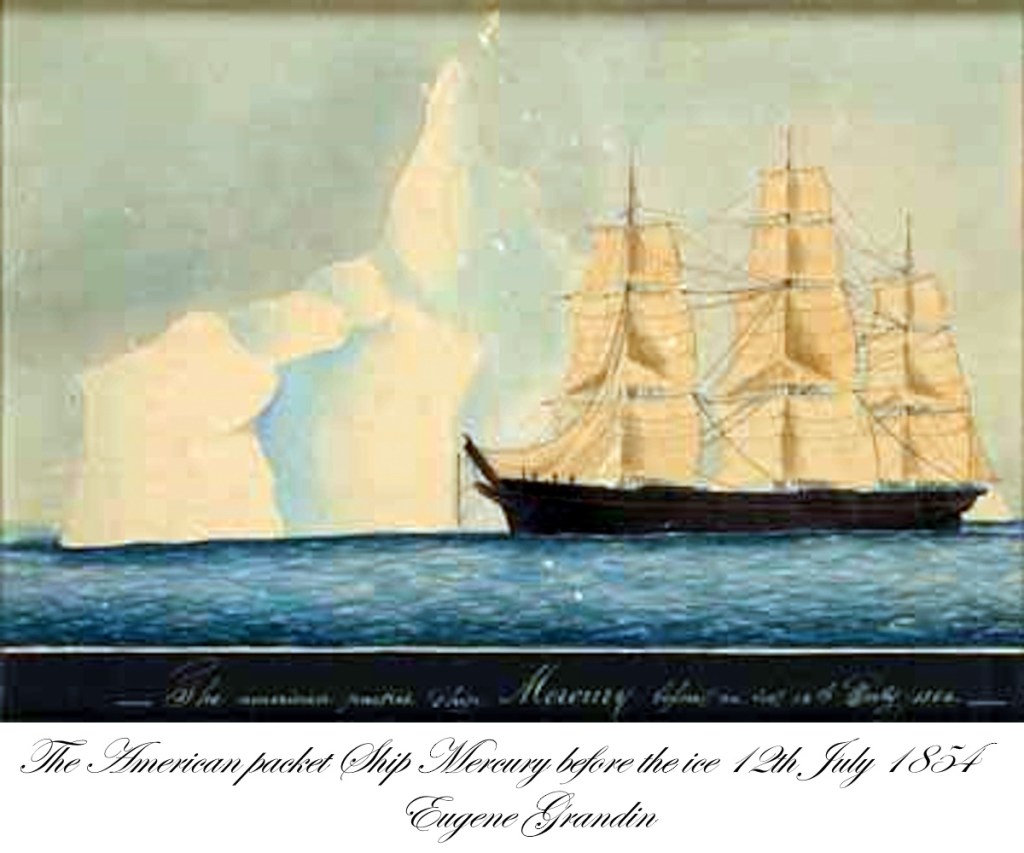
In 1851, Boyd & Hincken contracted with the shipbuilding firm of Westervelt & Mackey to design and construct the Mercury. The fractional owners of this ship included John J. Boyd with 2/16th of a share, Edward Hincken with 1/16th share, the builder Jacob A. Westervelt with 3/16th of a share, and the master of the ship, Captain Richard D. Conn, with 2/16th share. The other half of the shares were distributed among six additional individuals
Havre Second Line – Wikipedia
Mercury was the company’s fastest ship. She averaged 33 days on westbound passages from Le Havre to New York, with a fastest of 23 days and longest of 49 days. The westbound sailing was against prevailing winds and against the Gulf Current, so it took longer. The eastbound trip averaged 28 days.
The Voyage

Valentine boarded the Mercury a day or two before April 16, 1854. He was age 18.
The ship took on more than 530 passengers. The passengers were overwhelmingly from Baden, Bavaria, Wurttemberg, Alsace, and Lorraine. The passenger list classified most everyone as from Bavaria and occupation as farmer.
On April 16, the Mercury slipped away from Le Havre harbor into the open Atlantic. Richard D. Conn was the captain. He was a 2/16th owner of the ship, and had made many previous crossings.
The conditions on the ships were cramped, dirty, and uncomfortable, and many emigrants suffered from seasickness or disease during the voyage. A 41-year-old man died on May 13 and was buried at sea.

The National Line’s steamer ‘Italy’ amidst other vessels at sea, Packet ‘Mercury’ to stern, by James E Butterworth
We don’t know many details of the passage, but after 36 days at sea, Mercury entered New York harbor.
In 1854, there was no Ellis Island (1892) and no Statue of Liberty (1886). Immigrants arriving in New York were processed at Castle Garden.
New York, and Castle Garden

Originally known as Castle Clinton, Castle Garden was a circular fort built on an artificial island some 200 feet off the Battery in lower Manhattan. It was connected to the Battery by a bridge.
Before it became an immigrant depot in 1855, Castle Garden was the center of social, cultural, and political activities. During its life as an immigrant depot (1855-1890), Castle Garden had welcomed 8,280,917 of the total 10,956,910 aliens to arrive in this country during that period.
Castle Garden Immigrant Landing Station – GG Archives
On May 20, 1854, Captain Richard D. Conn submitted the passenger list to Castle Garden officials. Valentine is listed near the bottom of Page 1.


The passengers disembarked. Tenders ferried them to shore and the processing building. They queued in single-file to register.

Here each one is asked his or her name, place of birth, and destination, the replies being entered in an enormous ledger. Then comes the question of departure, trains, boats, etc., and the queries uttered in French, Italian, Irish, Danish, Finnish, Russian, and fifty different dialects, are briefly but courteously responded to.
Those who are compelled to wait for the evening trains for the West and South encamp in the rotunda, gypsy fashion, and sit, sprawl, crouch and lie in every attitude of indolent nonchalance.
The hour at length arrives when it becomes necessary to move towards the train. Then there is a mighty upheaval of human forms and human impedimenta.
An employee musters the various parties, calling out names and destinations, and, still under the protecting aegis of the agents of the Inman Line, our emigrants march to the railway depot, enter the cars, and Go West!
Newspaper article – “The Present Extraordinary Emigration – Scenes In and About Castle Garden,” in Frank Leslie’s Illustrated Newspaper – May 1, 1880
To Illinois
In May 1854, Valentine Maninger was in America. It was just three months since he registered for emigration in Dittwar. Like many others, he would “Go West.”
By 1854, the railroads had reached Bloomington and Peoria in Illinois. We don’t know how Valentine traveled, but by summer 1854 he could have made the journey by train.
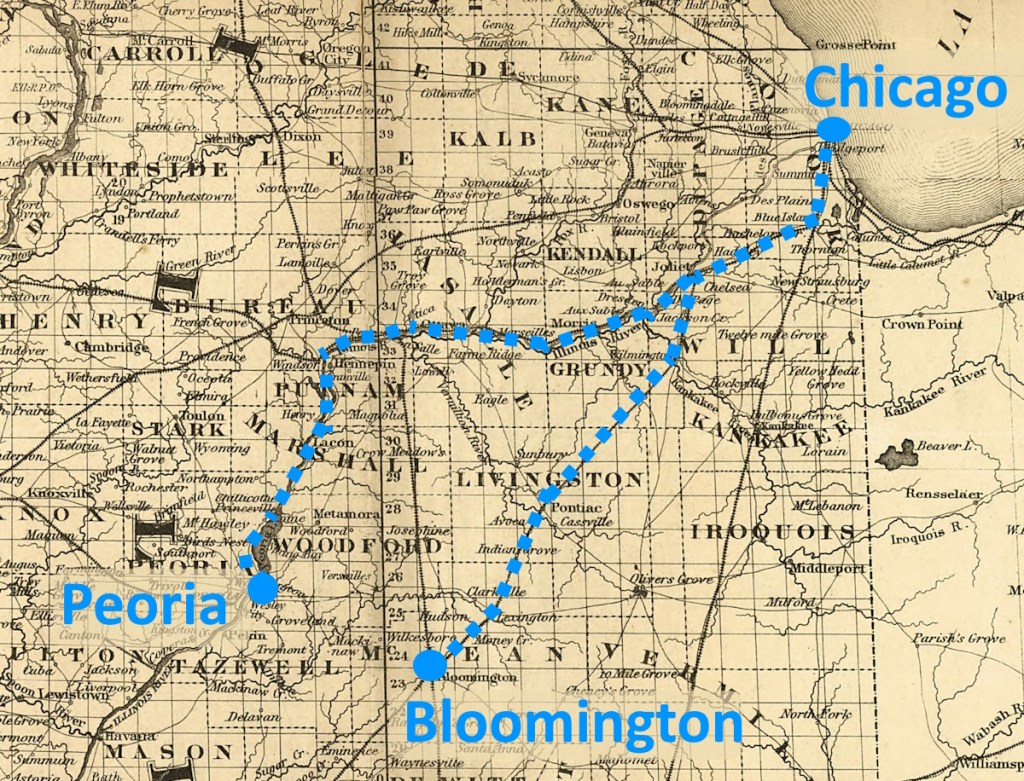
It was summer 1854. Valentine Maninger was in central Illinois.
We know where Val ended up, but why? Did he have a relative or someone from Dittwar who had emigrated earlier? Someone he knew? Why would he pick the area of Bloomington and Peoria in central Illinois?
We’ll explore that question in the next story. The answer is surprising.
Sources:
- Image – Young man leaves home village in Germany – Microsoft Image Creator from Designer
- Map – 1860 Dufour Railroad Map of France – Geographicus Rare Antique Maps – https://www.geographicus.com/P/AntiqueMap/francechemindefer-dufour-1860
- Image – Ad in German newspaper for passage Le Havre to New York – Le Havre as an Immigration Port – genhist – http://www.genhist.org/ghs_Havre_eng.htm
- Quote – Le Havre as an Emigration Port – http://www.genhist.org/ghs_Havre_eng.htm
- Image – View of the port and harbour at Le Havre, early 19th century – Johann Heinreich Luttringshausen – https://www.meisterdrucke.us/fine-art-prints/Johann-Heinrich-(after)-Luttringshausen/1129272/View-of-the-port-and-harbour-at-Le-Havre%2C-early-19th-century-%28colour-engraving%29.html
- News article – Ship Mercury sailing schedule – New York Herald – March 11, 1854 – Library of Congress – https://www.loc.gov/resource/sn83030313/1854-03-11/ed-1/?sp=3&st=text&r=0.216,0.391,0.474,0.751,0
- Image – Passengers boarding ship – From the Old to the New World – Harper’s Weekly, (New York) November 7, 1874 – Wikimedia Commons – https://en.m.wikipedia.org/wiki/File:Germans-emigrate-1874.jpg
- Image – Ship Mercy – part of painting The National Line’s steamer ‘Italy’ amidst other vessels at sea, Packet ‘Mercury’ to stern – James E Butterworth – https://www.artnet.com/artists/james-edward-buttersworth/the-national-lines-steamer-italy-amidst-other-mEU6zB646zV8n3ZFnYwjEA2
- News article – Havre Second Line advertisement – New York Herald – March 11, 1854 – Library of Congress – https://www.loc.gov/resource/sn83030313/1854-03-11/ed-1/?q=Herald&dl=page&sp=3&st=image&r=0.185,0.669,0.457,0.363,0
- Image – painting of The American packet ship Mercury before an ice 12th July 1854 – Eugene Grandin – Invaluable.com – https://www.invaluable.com/auction-lot/eugene-grandin-the-american-packet-ship-mercury-197-c-99487bb06c
- Image – Ship Mercury – cropped from a larger painting The Nations Lines Steamer Italy Amidst Other Vessels At Sea, Packet Mercury To Stern – James E Butterworth – https://www.brushwiz.com/catalog/james-edward-buttersworth-the-national-lines-steamer-italy-amidst-other-vessels-at-sea-packet-mercury-to-stern-oil-painting-reproduction-49877
- Image – Castle Garden Immigrant Depot, NY. circa 1870s. Stereograph by A. J. Fisher, NY. Library of Congress # 2017648898. GGA Image ID # 148286dd3a
- Quote – Castle Garden Immigrant Landing Station – GG Archives – https://www.ggarchives.com/Immigration/CastleGarden/index.html
- Image – Immigrants Landing at Castle Garden. Drawn by A. B. Shults. Harper’s Weekly, 29 May 1880. GGA Image ID # 1482c22ab1
- Image – Examining Emigrants at Castle Garden. Sketch by Clarence O’Dowd. Frank Leslie’s Illustrated Newspaper, 1 May 1880. GGA Image ID # 14bb0922d8
- Newspaper article – “The Present Extraordinary Emigration – Scenes In and About Castle Garden,” in Frank Leslie’s Illustrated Newspaper, Vol. L, No., 1283, New York: Frank Leslie’s Publishing House, 1 May 1880, pp. 139-140 – GG Archives – https://www.ggarchives.com/Immigration/CastleGarden/ThePresentExtraordinaryEmigration-1880.html
- Quote – German Heritage Prevalent in Illinois – My Journal Carrier – https://www.myjournalcourier.com/news/article/German-heritage-prevalent-in-Illinois-17489435.php
- Quote – Railroads connecting New York City and Chicago – Wikipedia – https://en.wikipedia.org/wiki/Railroads_connecting_New_York_City_and_Chicago#:~:text=The%20first%20New%20York%2DChicago,the%20New%20York%20Central%20Railroad.
- Map – Illinois railroad map Chicago to Bloomington – 1854 – Rail road and county map of Illinois showing its internal improvements 1854 – Library of Congress – https://www.loc.gov/resource/g4100.rr002020/?r=-0.003,0.217,0.843,0.668,0
- Family Tree diagrams – Ancestry.com and Mark Jarvis
- Music – Sonata No. 8 Pathétique Op. 13, Ludwig van Beethoven – Internet Archive – https://archive.org/details/SonataNo.8PathetiqueOp.13/PianoSonataNo.8PathetiqueOp.13-Iii.Rondo.Allegro.mp3
 Family Nibbles
