In April 1861, Fort Sumpter in Charleston Harbor was attacked, starting the Civil War. At that time, the United States Army consisted of 16,000 troops, most posted in small forts west of the Mississippi River.

Three days after the Fort Sumpter attack, President Lincoln issued a proclamation calling for state militias to turn out 75,000 troops to serve for 90 days to put down the rebellion. By May, Lincoln was asking for 42,000 more men to serve terms of three years. By July, the call was for 500,000.
The Turner Society (Turnverein)
German immigrants established organizations known as “Turnvereins,” similar to those they had belonged to in Germany. The group’s local societies acted as social, athletic, gymnastic, and political centers for German-Americans in the community, with members known as “Turners.”
German Americans In the War
St. Louis had a large Turner Society. In May 1861, they answered Lincoln’s first call for troops. Their members formed the Western Turner Rifles, serving from May to August in battles in St. Louis, Ste. Genevieve, and the Battle of Wilson’s Creek.

In August 1861, it was decided to form an entire regiment of Turners. It would become the 17th Missouri Volunteer Infantry, nicknamed the Western Turner Regiment.
In addition to these 90 day veterans, the 17th Missouri Volunteer Infantry recruited German-Americans through the Turner Society chapters around the country. Capt. Leser was sent to Chicago, Milwaukee and Detroit on a recruiting tour. The St. Louis Turners were in correspondence with the Turners of Cincinnati and Philadelphia. Through the efforts of the German Turnvereins many recruits arrived in St. Louis over the next few weeks including one whole company from Philadelphia that became “I” Company. The muster-in rolls for the 17th Missouri show that members of the Turner Society came from New York, Pennsylvania, Ohio, Iowa, Wisconsin and Illinois to join their comrades in St. Louis.
The Western Turner Rifles Story
The Turner Societies in Bloomington and Peoria, Illinois recruited for the Turner Regiment. Valentine Maninger answered the call in Bloomington. He committed, and was sent to St. Louis.
Val enlists
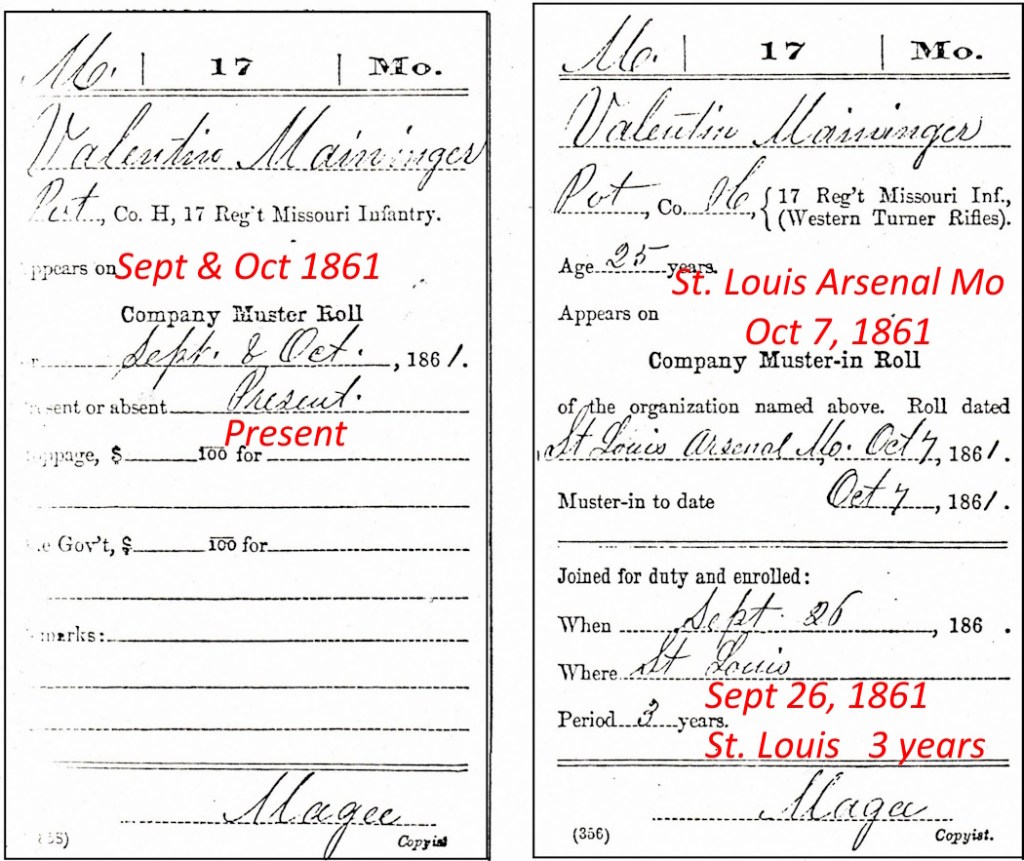
On September 26, 1861, the day after his 26th birthday, Valentine Maninger enlisted in the 17th Missouri Infantry for three years. He was mustered in at the St. Louis arsenal October 7, and assigned to Company H.
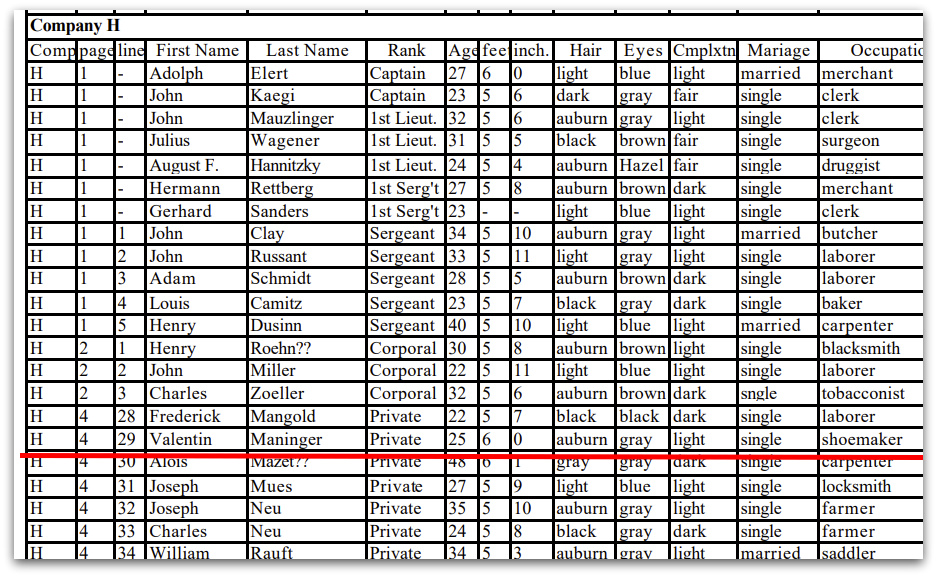
Of approximately 80 on the Company H roster, Val is one of only three that are six feet tall. He’s listed as having auburn hair, gray eyes, and light complexion.
Winter in Rolla
The regiment wintered in Rolla, Missouri. There the new recruits trained and drilled, using German language field manuals.
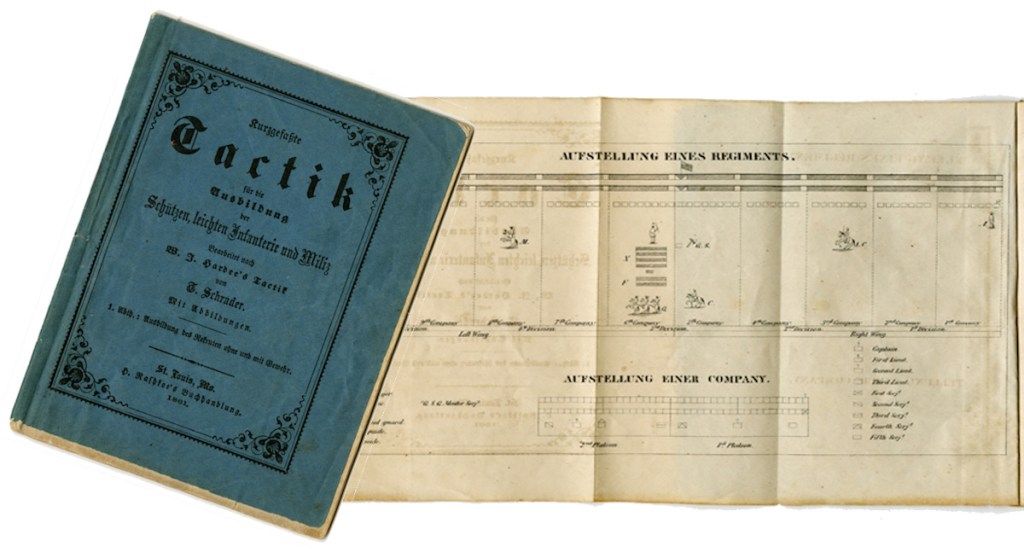
This pocket manual was written in German for Union soldiers of German descent recruited in St. Louis, Missouri in 1861. The manual was written and published in St. Louis, and is a translation of selections from “Hardee’s Tactics,” an American drill manual written in 1855 for the U.S. Army.
German Americans In the War
During that winter, there were sorties into southwest Missouri, a rebel stronghold.
Battle of Pea Ridge
The 17th Missouri probed into northwest Arkansas, just across the Missouri line near Bentonville. The Battle of Pea Ridge on May 7 and 8 pitted 10,000 troops on each side against the other. The bloody and mistake-ridden battle raged over two days. Union casualties were 203 killed, 980 wounded and 201 missing. Confederate losses were 800 dead and 300 prisoners, but it’s thought these estimates are too low.
The Confederate commander Van Dorn had intended for his troops to travel light, hoping to encircle Union troops. When the encirclement didn’t work, Van Dorn’s troops were cut off from their supply lines of ammunition and food. They were forced to retreat.
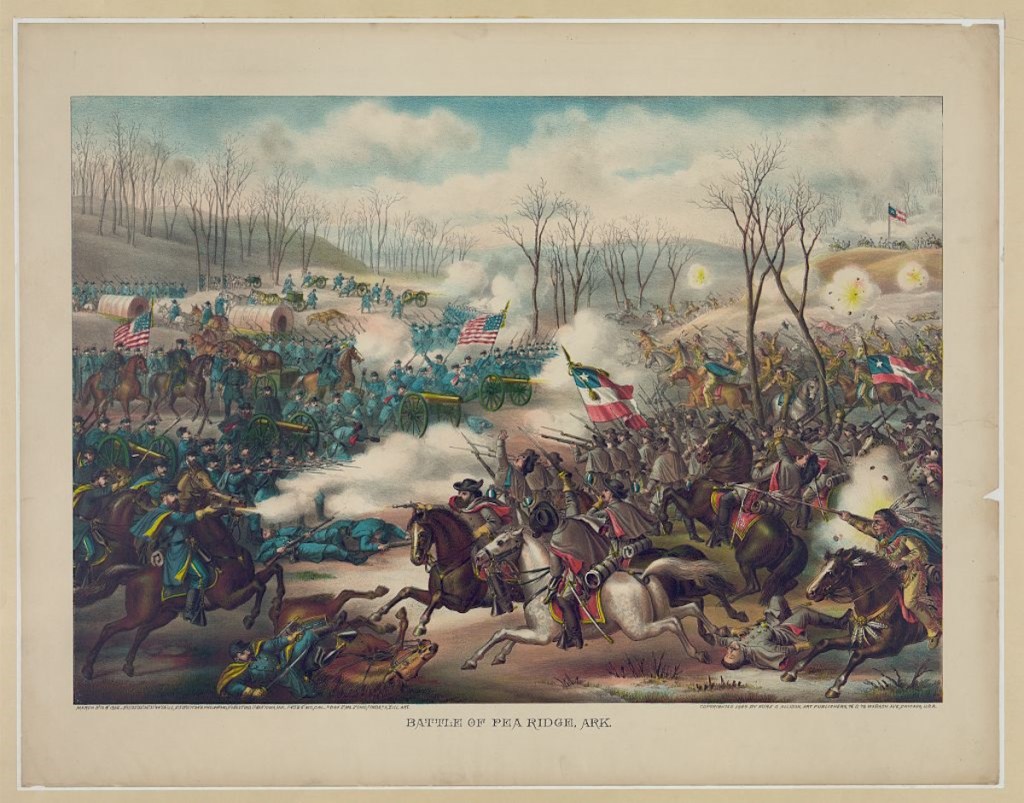
At 10 am on May 8, the second day of the battle, Valentine Maninger and the 17th Missouri made a bayonet charge across Cox’s field and drove the enemy back.
As the 17th Missouri raced across the open ground, Gen. Van Dorn, sensing his army was defeated, ordered a general retreat leaving much of his supply train and artillery behind.
The Western Turner Rifles Story
The Battle of Pea Ridge was a significant early victory for the Union. The Confederates never again threatened to invade Missouri, and left Arkansas mostly undefended.
With his victory, Union General Curtis sent some of his troops east across the Mississippi River, and then set off with the remaining troops south into Arkansas. He hoped to capture Little Rock.

Searcy, Arkansas
General Curtis still had 17,000 troops under command as he turned south into Arkansas. He was assigned an additional 5,000 under General Frederick Steele. Poor weather and rough terrain slowed the progress. Curtis wasn’t able to keep his supply lines caught up.
On the other side, Confederate General Roane began assembling as many fighters as possible to defend Little Rock. He reversed the course of troops that had been sent east of the Mississippi, and he stopped units of the 12th Texas Cavalry that were bound for Tennessee.
On May 10, Roane sent the Texas Cavalry to scout the Union forces. By May 19, the cavalry reached Searcy, and waited for an opportunity to attack.
Battle of Whitney’s Lane
In the morning of May 19, Union General Curtis ordered some foraging parties into the countryside to raid farms for supplies. The parties consisted of seven companies from the 17th and 3rd Missouri, a total of about 200, including 32 men from Val Maninger’s Company H. They took nine wagons to load with forage.
About three miles from camp along the main road, the forage party came across a lane that led to two farms, one owned by G.W. Hopper and the other by Elijah Whitney. Scouts were sent up the lane, and reported that the two farms had enough to fill all the wagons.
Company H remained on the main road to guard the entrance to Whitney’s Lane. The other troops divided into two parties and set out for the two farms.


Major Emory Rogers of the Texas Cavalry learned of the Union foraging parties. Rogers had 150 cavalry and was waiting on 300 more Confederate infantry. He decided to attack immediately, counting on the 300 reinforcements to join him soon.
A Severe and Bloody Fight
Rogers and the 150 cavalry spurred their horses down the main road toward Company H, yelling and shooting. Lt. Henry Neun of Company H ordered his 31 men into a firing line across the main road. But Major Kielmansegge came riding up and ordered the men to get behind the split rail fences in Whitney’s Lane between two cornfields. Kielmansegge then raced off to organize the two foraging parties.
As the rebel cavalry turned into the lane, the men of Company H fired their first volley, causing confusion. Company H fired another volley, and killed the first cavalryman.

After firing their second volley, Company H sought shelter in the lane behind the fences, which had been torn down. In the next twenty minutes, Company H was almost annihilated. Val Maninger and his fellow soldiers were outmanned and outgunned and afoot.
Here’s a deposition made the following day by Pvt. Jacob Wurges of Company H, who survived a blow to the head with a Bowie knife:
After having discharged my piece, I was suddenly surrounded by a body of cavalry to whom I cried out that I would surrender. Those nearest me seemed disposed to take me prisoner, but one from their midst dashed at me, saying “Damn you, we want no prisoners!” Upon this he snapped a revolver at me three times; this missing fire he drew a bowie-knife and cut me across the head, upon which I fell but retained my consciousness. I saw Private Fisch, of Company H, leaning against the fence badly wounded in the shoulder; some of the rebels remarked to the others that that man was not quite dead yet, upon which one of their number cut him down with his saber. I also saw Private John Rosert, of Company H, lying a little farther on in the road badly wounded in the leg and hear him crying out not to shoot him any more. In spite of his cries I distinctly saw one of the secessionists empty the whole contents of his revolver at him, shooting four or five times. I have also seen them shooting at others of our wounded men, but cannot tell who they were.
Deposition of Pvt. Jacob Wurges of Company H – May 20, 1862
Val Maninger was one of those who fell, shot at point-blank range. He was shot in the shoulder and foot.
By 10:50 am, most of the Company H soldiers lay dead or wounded.
Lt. Henry Neun of Company H was shot in the shoulder as he fled. He was saved by reinforcements from Company F arriving and driving off the cavalry. Here’s part of Neun’s deposition:
The treatment which our men received at the hands of the enemy after being wounded was cruel and inhuman in the extreme. Men wounded and helplessly lying on the ground were shot down by the savages without mercy. In some instances the wounded men offered to suffer themselves to be taken prisoners but were nevertheless fired at again and again. I myself after being wounded in my arm, perfectly helpless and alone, the rest of the company being nearly all dead or wounded, was surrounded by fifteen or twenty of the so-called Texas Rangers and fired at until Company F of my regiment came to the rescue and drove the enemy off. I must declare that warfare like the one my company experienced yesterday I believed to belong among the impossibilities among civilized nations.
Deposition of Lt. Henry Neun – May 20, 1862
The battle raged on, with engagements in the surrounding fields and woods.
In one of the last skirmishes of the day, the Texas Cavalry attacked four ambulances that Union Col. Osterhaus had dispatched to pick up Company H’s dead and wounded. The ambulance drivers and escort troops fled. The ambulances were broken, their horses driven away.
…at 11:30 AM, Osterhaus arrived at Searcy Landing with the rest of his division and “found the position entirely secure and the enemy hurrying off, but only after a severe and bloody fight.” The Battle of Whitney’s Lane was over. It had been exactly one hour since the time of Rogers’ initial charge.
A Severe and Bloody Fight, The Battle of Whitney’s Lane and Military Occupation of White County, Arkansas, May & June 1862
Val Maninger lay on the battlefield with his wounds. All around him lay the dead and wounded of Company H.

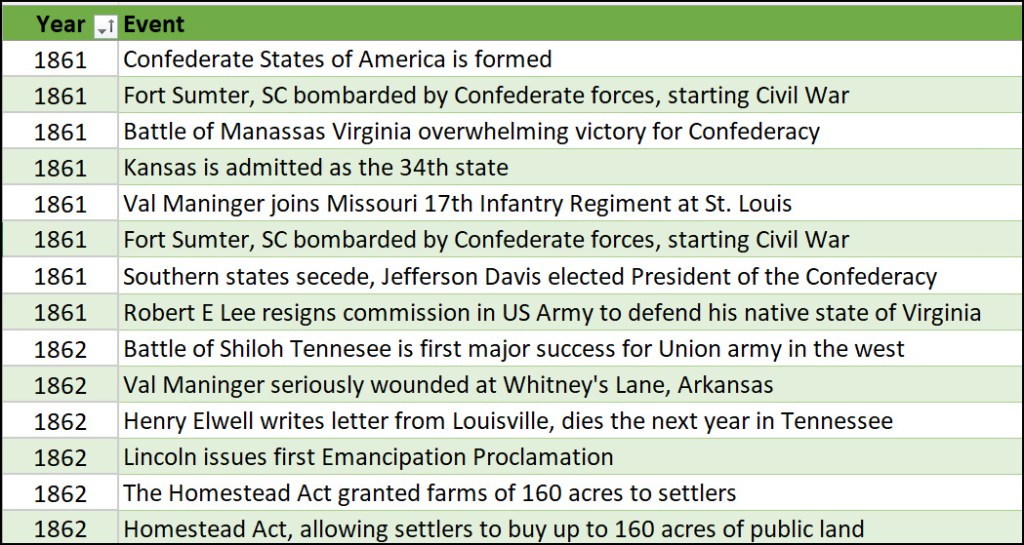
Timeline
Sources:
- Image – Bombardment of Fort Sumter, Charleston Harbor: 12th & 13th of April 1861 – Currier and Ives – Library of Congress – https://www.loc.gov/pictures/resource/ppmsca.19520/
- Image – Group portrait of the St. Louis Turnverein in 1860 – Wikimedia – https://commons.wikimedia.org/wiki/File:St-louis-german-turner-shooting-club-medium.jpg
- Quote – Turnvereins – German Americans In the War – Trans-Mississippi Virtual Theater – Virtual Museum – https://www.civilwarvirtualmuseum.org/1861-1862/german-americans-in-the-war/st-louis-german-turner-shooting-club/
- Quote – Western Turner Rifles recruiting – The Western Turner Rifles Story – http://www.17thmissouri.com/story.html
- Images – Valentine Maninger military records – Form 86 – Compiled Military Service Record – National Archives and Record Administration
- Image – Roster of Company H, 17th Missouri Infantry – http://www.17thmissouri.de/I/schriften/originalroster17thmo.pdf
- Quote – German language training manual – German Americans In the War – Trans-Mississippi Theater – Virtual Museum – https://www.civilwarvirtualmuseum.org/1861-1862/german-americans-in-the-war/tactik-german-field-soldier-book/
- Image – Battle of Pea Ridge – Kurz & Allison, publisher – Library of Congress – https://www.loc.gov/resource/pga.01888/
- Quote – 17th Missouri charge across Cox’s field – The Western Turner Rifles Story – http://www.17thmissouri.com/story.html
- Map – Battle of Whitney’s Lane – A Severe and Bloody Fight, The Battle of Whitney’s Lane and Military Occupation of White County, Arkansas, May & June 1862 – Scott H Akridge & Emmett E. Powers
- Image – Texas Cavalry charges Company H 17th Missouri at Whitney’s Lane – Civil War Doctor Honored – Scott H. Akridge – https://www.argenweb.net/white/wchs/Civil_War_Doctor_Honored_Files/Civil_War_Doctor_Honored.html
- Quote – a severe and bloody fight – A Severe and Bloody Fight, The Battle of Whitney’s Lane and Military Occupation of White County, Arkansas, May & June 1862 – Scott H Akridge & Emmett E. Powers
- Quote – Deposition of Pvt. Jacob Wurges – May 20, 1862 – A Severe and Bloody Fight – above
- Quote – Deposition of Lt. Henry Neun – May 20, 1862 – A Severe and Bloody Fight – above
- Image – Dead and wounded soldiers – AI generated – Copilot Image Creator – Microsoft
- Music – Paddy on the Handcar from the Minstrel and Boy Show – The United States Army Old Guard Fife and Drum Corps – Free Music Archive – https://freemusicarchive.org/music/The_United_States_Army_Old_Guard_Fife_and_Drum_Corps/Celebrating_50_Years/12/
 Family Nibbles
