
Val Maninger lay wounded in a cornfield by Whitney’s Lane. Around him lay the dead and wounded of Company H.
On the morning of May 19th, 1862, the 12th Texas Cavalry had annihilated Company H of the 17th Missouri Infantry in a rural lane near Searcy, Arkansas.
By afternoon, things had settled down enough that Col. Osterhaus ordered four companies and three ambulances back to the battlefield to recover the dead and wounded. They arrived at 2:30, and loaded the dead and wounded into wagons.

Once back at the Union camp, the wounded were triaged and received first level treatment. Five of the wounded died back at camp.
Val Maninger had been shot in the right shoulder and foot. Later reports mention the right forearm and abdomen.

The best estimate of final Union casualty totals is twenty-two killed and thirty-three wounded, for a total of fifty-five casualties. During the entire war, the 17th Missouri Infantry Regiment lost a total of only sixty-eight men killed in action. Thus almost one-third of the total battle deaths in this regiment occurred at Whitney’s Lane.
A Severe and Bloody Fight
Recuperation
Val was eventually transferred to Jefferson Barracks Hospital in St. Louis. He was admitted July 21, with Vulnus sclopetarium (gunshot wound).

Val returned to duty with the 17th Missouri in the fall of 1862. The 17th was in the Battle of Chickasaw Bluff, Mississippi in December 1862, moved to Young’s Point, Louisiana in January 1863, entered the Siege of Vicksburg in May through July 1863, and then the Siege of Jackson, Mississippi in August 1863.
Invalid Corps Veteran’s Reserve Corps
Val continued to be troubled by his wounds. In September 1863, he was transferred to the Invalid Corps. It was created for those who were unfit for active combat because of wounds or disease contracted in the line of duty, but who were still fit for other light duty. The Invalid Corps was renamed the Veterans Reserve Corps in March 1864.

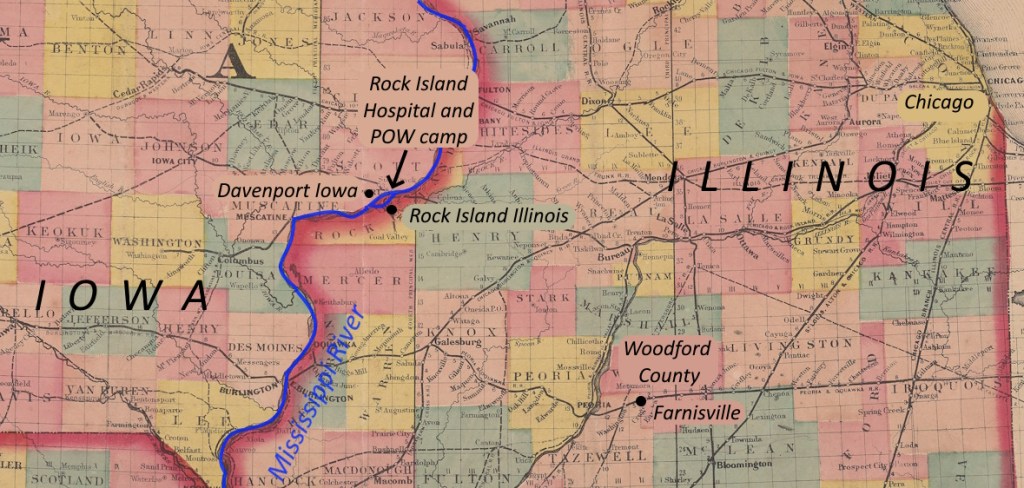
Val was assigned to work at the Rock Island, Illinois Post Hospital. Early in the war, the military complex at Rock Island had been built up as a supply depot. In August 1863, construction began to convert to a POW camp that would house 10,000 prisoners. In December 1863, the first 468 Confederate prisoners arrived from the Battle of Lookout Mountain, Tennessee. Within a month there came 5,000 more.
The camp was on an island in the Mississippi River, between Rock Island, Illinois and Davenport, Iowa. The first bridge across the Mississippi River connected the island and the adjacent shores. The river provided year-round navigable waters and water power.
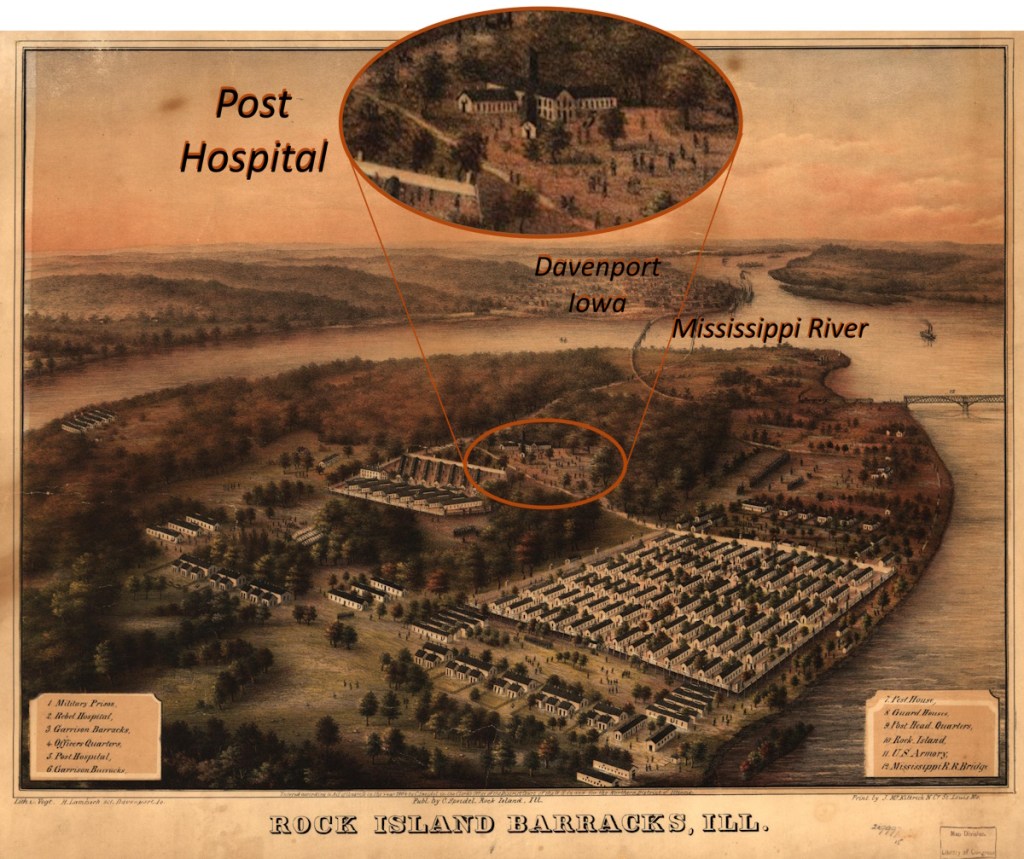
The post hospital where Val worked initially cared for Union and Confederate alike. Diseases were rampant in the camp. By early 1864, smallpox outbreaks had killed 700 soldiers and prisoners. To handle the great numbers, a separate hospital was built for prisoners.

Val was out of the combat zone. He was 120 miles from home, and got several furloughs.
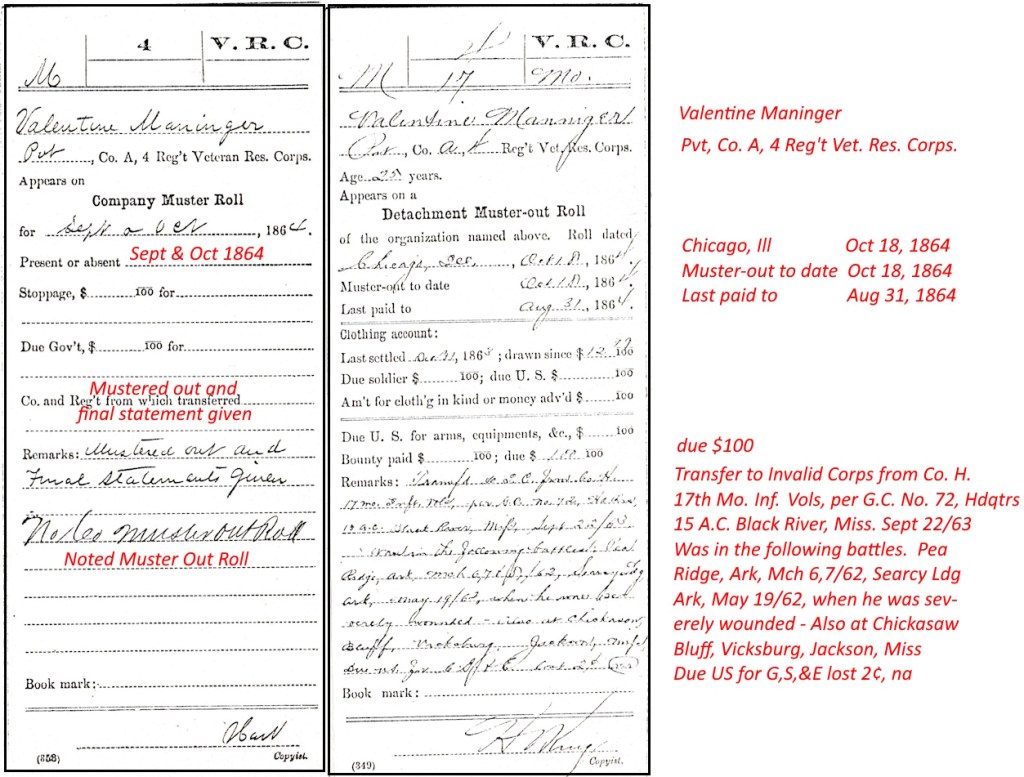
Muster out
Val Maninger’s three year enlistment ended in October 1864. He was age 29. He was mustered out on October 18, 1864, and given back pay of $100. O happy day!
.
A memorial broadside
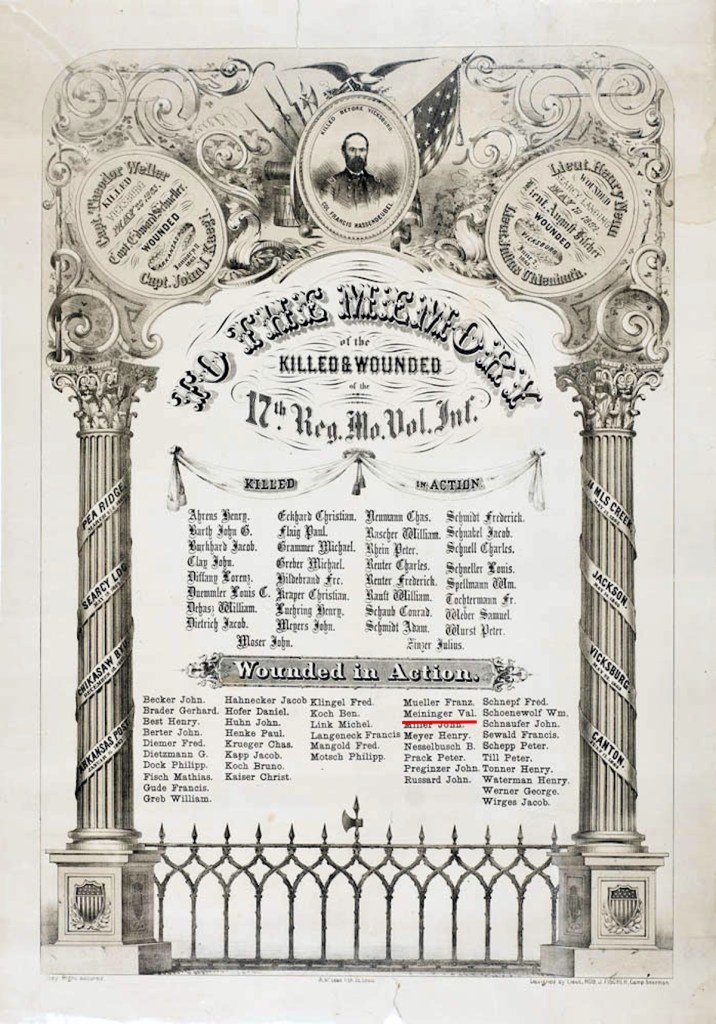
This wartime broadside designed by Lieutenant Rob J. Fischer, at Camp Sherman, Mississippi, during July or August 1863, was dedicated “To the Memory of the Killed & Wounded of the 17th Reg. Mo. Vol. Inf.” The broadside lists the battles in which the regiment took part, and those killed and wounded in action.
17th Missouri Broadside – Trans-Mississippi Photo Archive
Valentine Maninger is listed as Wounded in Action.
Val Maninger had left Farnisville and Slabtown three years ago at age 25 to enlist. He’d left his boot and shoe making trade. Now, at age 29, he’d go back home and start over.
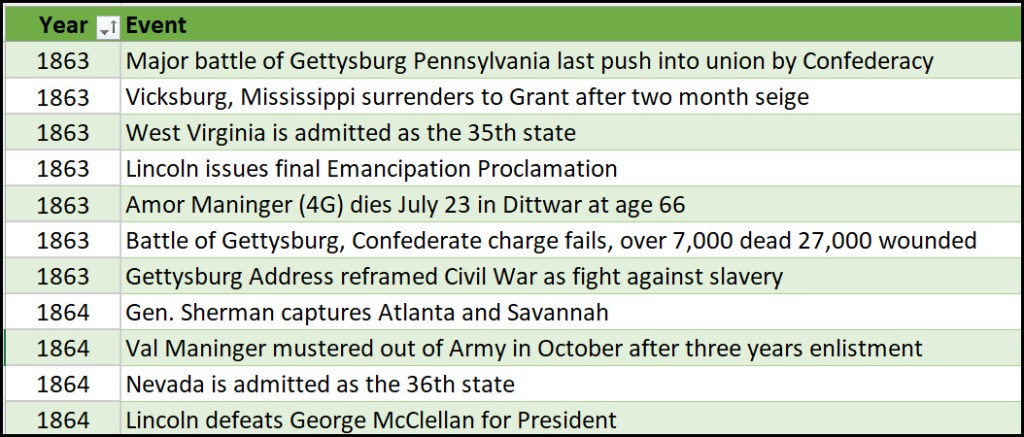
Timeline
Sources:
- Image – Wounded soldiers in cornfield – AI generated – Copilot Designer – Microsoft
- Image – Ambulance loading wounded – Trans-Mississippi Theater – Photo Archive – https://ozarkscivilwar.org/photographs/frank-in-york-with-ambulance/
- Image – Jefferson Barracks Hospital – 1861 – Wikimedia Commons – Missouri History Museum – https://commons.wikimedia.org/wiki/File:%22Hospital_at_Jefferson_Barracks,_Eight_Miles_Below_St._Louis,_Missouri.%22.jpg
- Image – Rock Island Barracks – Rock Island, Ill., C. Speidel, 1864 – Library of Congress – https://www.loc.gov/item/99447349/
- Map – Illinois and Iowa – Colton’s county and township rail road map of Wisconsin, Illinois, Missouri, & Iowa / Drawn, engraved & published by G. Woolworth Colton – 1862 – Yale University Library – https://collections.library.yale.edu/catalog/15604000
- Image – Post Hospital – Rock Island Arsenal – An Illustrated History of the Rock Island Arsenal and Arsenal Island – United States Army Sustainment Command History Office – https://www.aschq.army.mil/Portals/54/Pubs/ria_illustrated-hist-230307.pdf
- Image – 17th Missouri Infantry Broadside – This wartime broadside designed by Lieutenant Rob J. Fischer, at Camp Sherman, Mississippi, during July or August 1863, was dedicated “To the Memory of the Killed & Wounded of the 17th Reg. Mo. Vol. Inf.” The broadside lists the battles in which the regiment took part, and those killed and wounded in action – https://ozarkscivilwar.org/photographs/17th-missouri-infantry-broadside/
- Music – The Lark in the Clear Air – Shake That Little Foot – Free Music Archive – https://freemusicarchive.org/music/Shake_That_Little_Foot/Shake_That_Little_Foot/Mississippi_Sawyer_vbrmp3/
 Family Nibbles
