By late 1864, Val was back in Woodford County, home from the war. But Val didn’t stay in Farnisville and Woodford County. Why?

Val Maninger was discharged from federal service in October 1864. He had just turned 29. Soon after he returned home, Val moved to Gridley, Illinois. Let’s see why.
Waldo Township in Livingston County
In 1860, the area that would become Waldo Township was mostly unbroken prairie. The technology of the self-scouring steel plow made the prairie land desirable, so more tracts were acquired.
Many of those who acquired land in Waldo Township were Amish who moved from Woodford and Tazewell Counties. These were Val’s friends and neighbors from before the war.

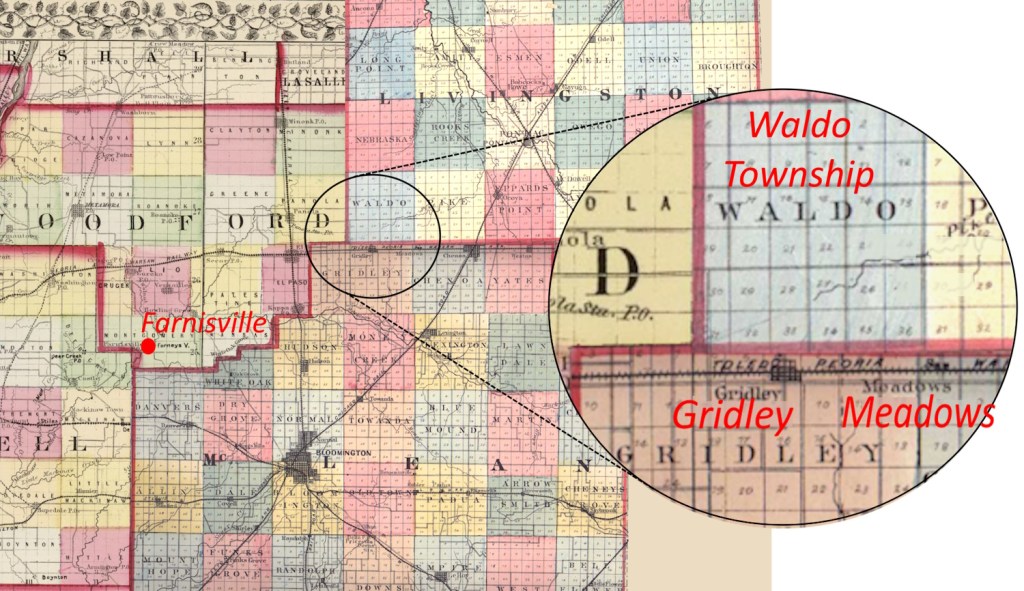
Val Maninger’s neighborhood for the next two decades
Several settlers who had come to central Illinois during the 1830s and 1840s and had previously settled near the Mackinaw River began to move out on the prairie areas, such as at Gridley and Waldo Townships. Gridley benefited, particularly, from farmers who moved here from the Congerville (Slabtown) area.
Marching to Zion: A History of the Apostolic Christian Church of America
Gridley, Illinois
Waldo Township was in Livingston County. The nearest shops and trades and post office were in the village of Gridley, just across the county line in McLean County.
Gridley was an up-and-coming village. It was laid out in 1856 along the Toledo Peoria and Western Railroad line that crossed Illinois east and west.
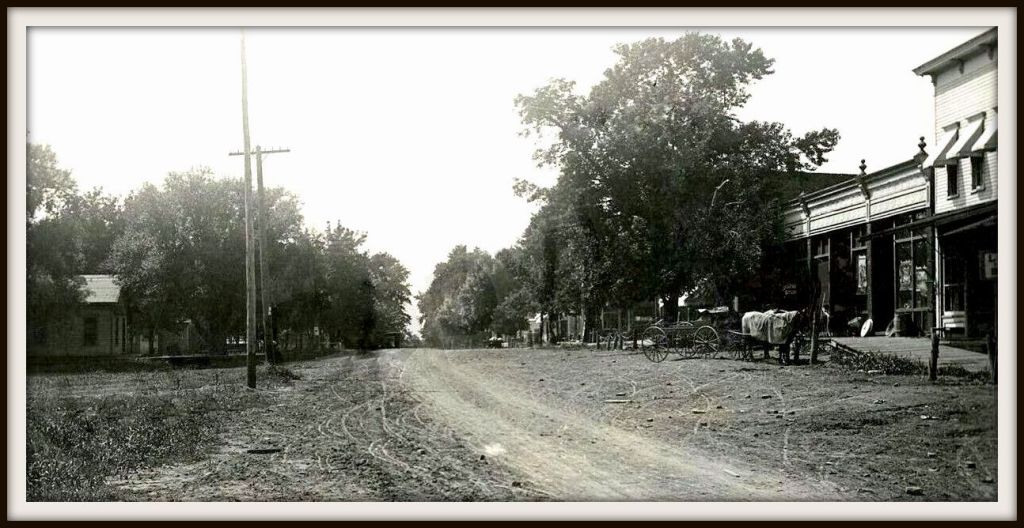
A shop of his own
In early 1865, Val had opened a boot and shoe business in Gridley. On April 2, 1866, Val Maninger bought a building and lot in Gridley from Abram and Sidda Hart. He paid $350. Perhaps it was the building he’d been renting.

Val’s building was adjacent to other shops and trades, we might say “downtown” if Gridley were a larger town. Perhaps Val had been renting the same space earlier for his boot and shoe shop. Whatever the case, he now owned a residence and shop for his business.
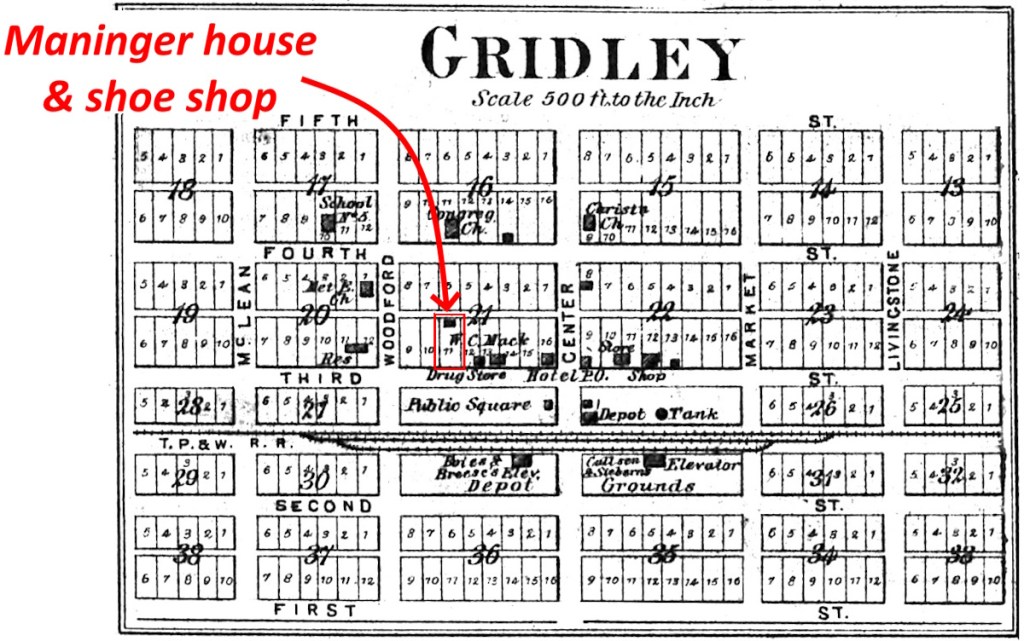
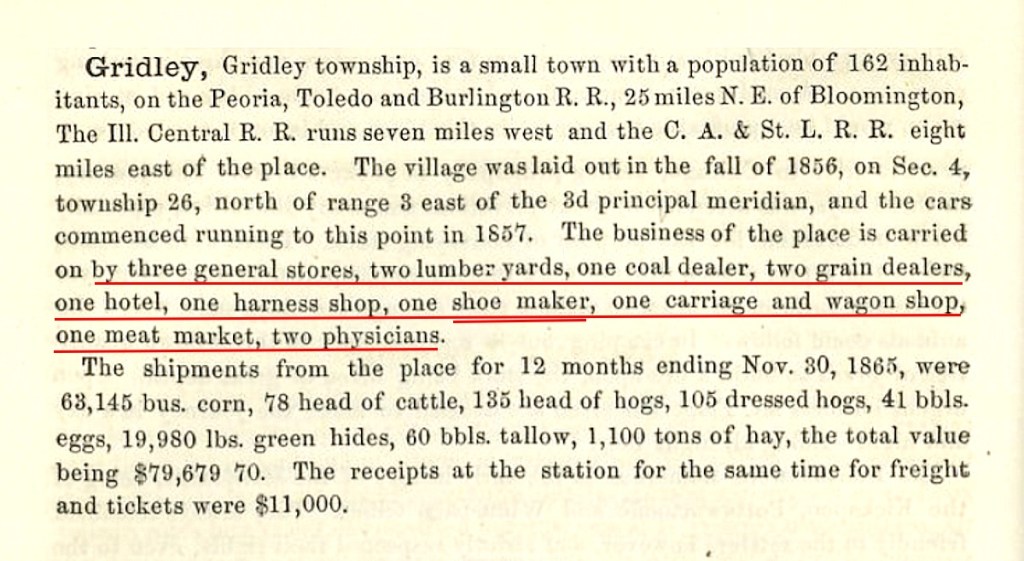

The shoe maker was Valentine Maninger!

OK, Val was all set. He had a residence and a business in Gridley. But why Gridley?
We’ll have to make some assumptions…
Let’s look again at the shops in Gridley.
By 1865, Gridley hosted “three general stores, two lumber yards, one coal dealer, two grain dealers, one hotel, one harness shop, one shoe maker, one carriage and wagon shop, one meat market, two physicians.”
The harness shop was run by Fred Fellrath, who was Val’s old neighbor in Farnisville before the war. Fred’s wife was Mary Smith, older sister of Magdalena Smith Neuhauser.
The wagon shop was run by C.H. Neuhauser, a relative of Magdalena Smith Neuhauser’s husband Peter.
Magdalena Smith Neuhauser’s older brother Peter had married Barbara Neuhauser, Peter Neuhauser’s sister. Peter and Barbara Smith lived on a nearby farm.
These connections are more than coincidence.
Magdalena Smith Neuhauser (3G)
Magdalena Smith had married Peter Neuhauser in October 1860.
Recall the family lore that Magdalena Smith and Val Maninger courted, but that Lena chose Peter Neuhauser because Val wasn’t Amish. True? Who knows?
Peter Neuhauser died
Peter Neuhauser died in 1864, perhaps from lockjaw.
Magdalena had given birth to three children during their four-year marriage. Samuel Neuhauser was born September 16, 1861. Then followed a daughter, Mary Ann, and a son Peter. Sam was the only surviving child by 1866.
I assume after Peter Neuhauser died, Lena and her children were living in Gridley or Waldo Township, perhaps in the household of her brother Peter Smith or sister Mary Fellrath.
Val and Lena marry
Val was home from the war, and single at age 30. Lena was a 25-year-old widow with a 5-year-old son.
Val and Lena decided to marry. They tied the knot at the McLean County Courthouse on Thursday, October 11, 1866, Justice of the Peace Benjamin Gray presiding.
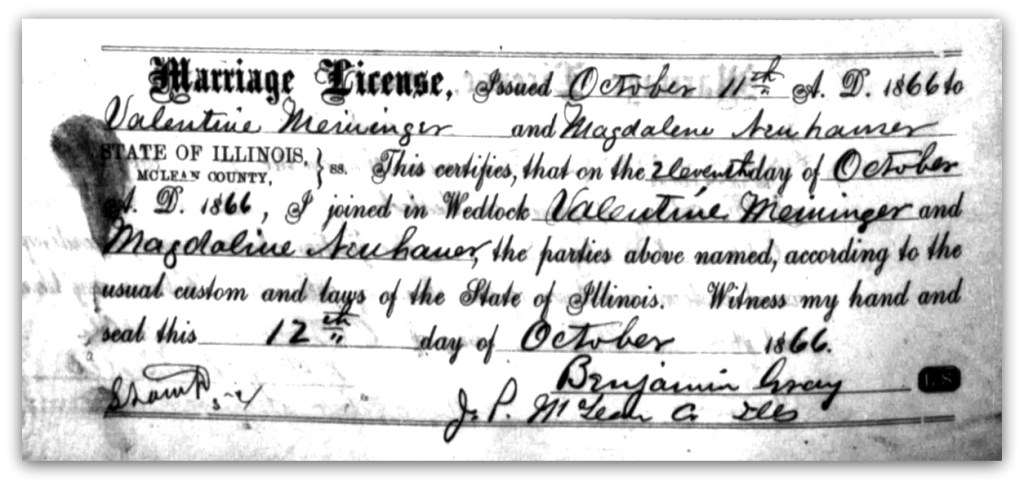
It’s significant that the marriage was performed by the Justice of the Peace at the McLean County courthouse. Lena was Amish, Val wasn’t. Lena was supposed to get married in the church. These were violations of Amish doctrine.
Val and Lena weren’t leaving the Amish community. Conversely, they were soon to change congregations and join the Apostolic Christian Church. It’s another division in Amish history. We’ll talk about that in the next story.
Val and Lena have kids
Magdalena’s son Samuel Neuhauser was in their household. Sam was born in 1861.
John Lewis Maninger
Nine months after Val and Lena married, their first child was born. John Lewis Maninger was born on Sunday, June 2, 1867.
The name John may have been to honor Magdalena’s brother John that died from Cholera at age 7. Val didn’t have any sibling or uncle or grandfather named John or Johann. Lena had an Uncle Johannes Schrock.
I don’t know the origin of the middle name Lewis. I don’t find an ancestor on either side with that name. It’s possible the name honors the first “New Amish” congregation in Lewis, New York, founded by Benedict Weyeneth. More about that later.
Frank Adolph Maninger
Frank Adolph Maninger was born on Sunday, July 4, 1869, in Gridley, Illinois.
I don’t know the origin of either forename or middle name. Some possibilities are Valentine’s eldest brother or uncle, both named Franz. I can’t find Adolph in Maninger or Smith grandparents.
A U.S. Citizen
The decade of the 60s was a big deal in Val Maninger’s life. Serving in the Civil War was a big deal. Getting married and having children was a big deal. So was opening and running a boot and shoe business.
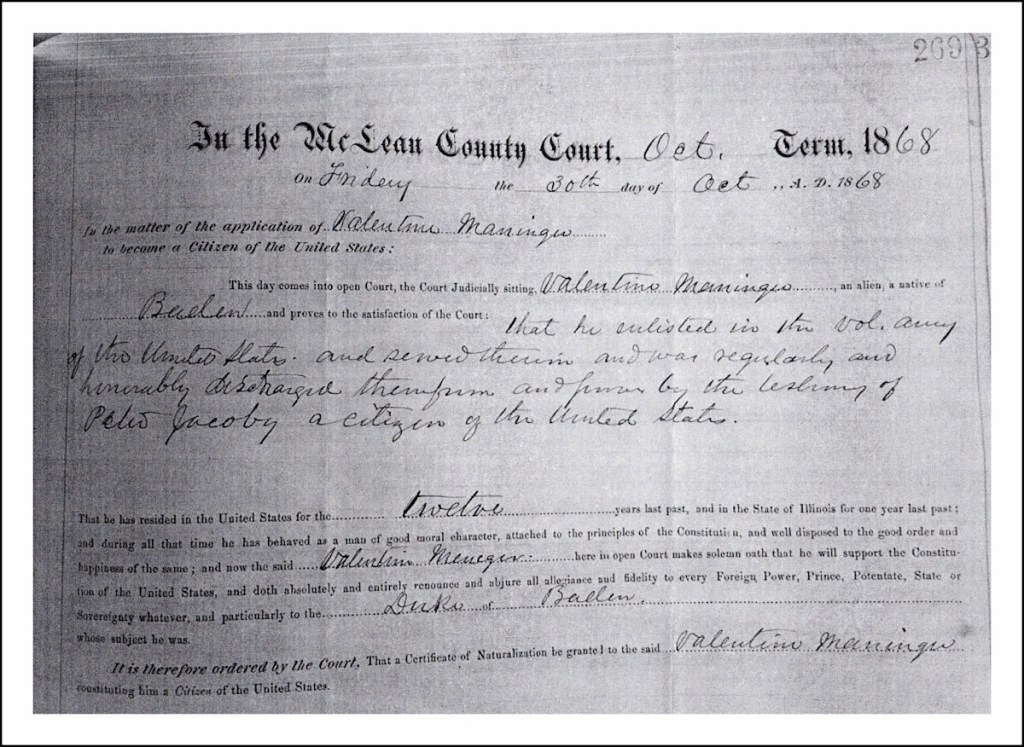
To top it off, Valentine Maninger became a U.S. citizen on October 30, 1868.
The family in 1870
By 1870, the Maninger household consisted of Val, 35, Lena, 31, Samuel Neuhauser, 8, John 3, and Frank, 1. Remember that U.S. Censuses were full of errors – spelling, age, place of birth, etc.

Nibbles Extra Credit – The steel plow
Early settlers had selected land along creeks and wooded areas, so they would have easy access to water and building materials. They didn’t need large expanses of farmland because they couldn’t farm large tracts. They had heavy cast iron or wooden plows that clogged with sticky prairie mud.
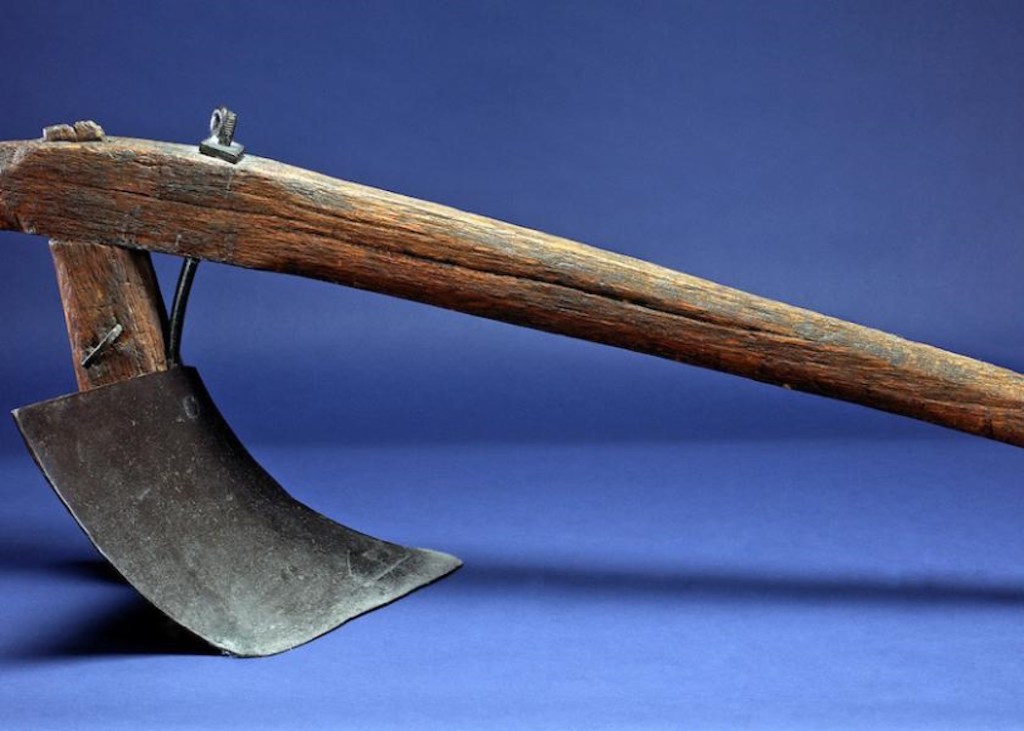
Some blacksmiths began making steel plows in the 1840s. They were expensive and were made one at a time, but they were a wondrous improvement. They turned the prairie, cutting through the tough web of roots, and reduced clogging with mud.
John Deere was a blacksmith in Moline, Illinois. He did for the steel plow what Henry Ford did for the automobile. Deere began to produce plows in quantity. In 1848, he sold 2,000 plows. In 1856, 13,000.
Farmers were able to break native prairie and cultivate much larger tracts of land. The steel plow helped attract Amish settlers to the native prairies of Waldo Township in Livingston County, Illinois.

Timeline

Sources:
- Quote – German Mennonites inhabit Waldo Township – The History of Livingston County Illinois – Wm Le Baron Jr & C0 – 1878 – https://archive.org/details/historyoflivings00chic/mode/2up
- Map – Johnson’s Illinois By Johnson & Browning. No. 40. – A.J. Johnson – 1860 – David Rumsey Map Collection – https://www.davidrumsey.com/luna/servlet/detail/RUMSEY~8~1~2513~310025:Johnson-s-Illinois-By-Johnson-&-Bro
- Quote – Settlers moving to Gridley and Waldo – Marching to Zion – A History of the Apostolic Christian Church of America 1847-2007 – Perry A. Klopfenstein – 2008
- Image – Gridley history – McLean County Gazetteer – 1865 –
- Image – Buildings and street – Gridley, Illinois – Gridley Centennial Book – 1856-1956
- Deed – Valentine Maninger from Abram and Sidda Hart – Lot 11 Block 12 Gridley – 1866 – McLean County Recorder – Bloomington, Illinois – Book 61, Page 113 – https://recorder.mcleancountyil.gov/External/HTML5Viewer/ImageViewer.aspx?OIB=true
- Map – Gridley Town – McLean County, Illinois 1874 – Historic Map Works – https://historicmapworks.com/Map/US/1608911/Gridley+Township++Towanda++Belle+Flower++Priceville++Delta++Mackinaw+River/McLean+County+1874/Illinois/
- Image – Augsburger Dry Goods store, business district, Gridley, IL, 1890s – Illinois Digital Archives – https://www.idaillinois.org/digital/collection/p16614coll66/id/3284/rec/3
- Image – Buildings and street – Store interior – Gridley, Illinois – Gridley Centennial Book – 1856-1956
- Image – TPW Depot Gridley, Illinois – CardCow – https://www.cardcow.com/846935/gridley-illinois-tpw-depot/
- Marriage License – Valentine Maninger and Magdalena Smith Neuhauser – McLean County, Illinois – 1866 – McLean County, Illinois – County Clerk
- Image – Valentine Maninger Naturalization Record – McLean County Circuit Clerk, Bloomington, Illinois
- Census – Val and Lena Maninger – Gridley, Illinois – 1870 – ancestry.com – https://www.ancestry.com/imageviewer/collections/7163/images/4263697_00334?pId=16813239
- Image – John Deere’s second plow – National Museum of American History
- Image – The Original Steel Plow” and John Deere, 1882 – State Historical Society of Iowa – https://history.iowa.gov/history/education/educator-resources/primary-source-sets/iowas-corn-and-agriculture-industry/original-steel
- Family Tree diagrams – Ancestry.com and Mark Jarvis
- Music – Willow Tree – Brendon Wood – Free Music Archive – https://freemusicarchive.org/music/Brendon_Wood/Mine_Folk_1/Willow_Tree/
 Family Nibbles