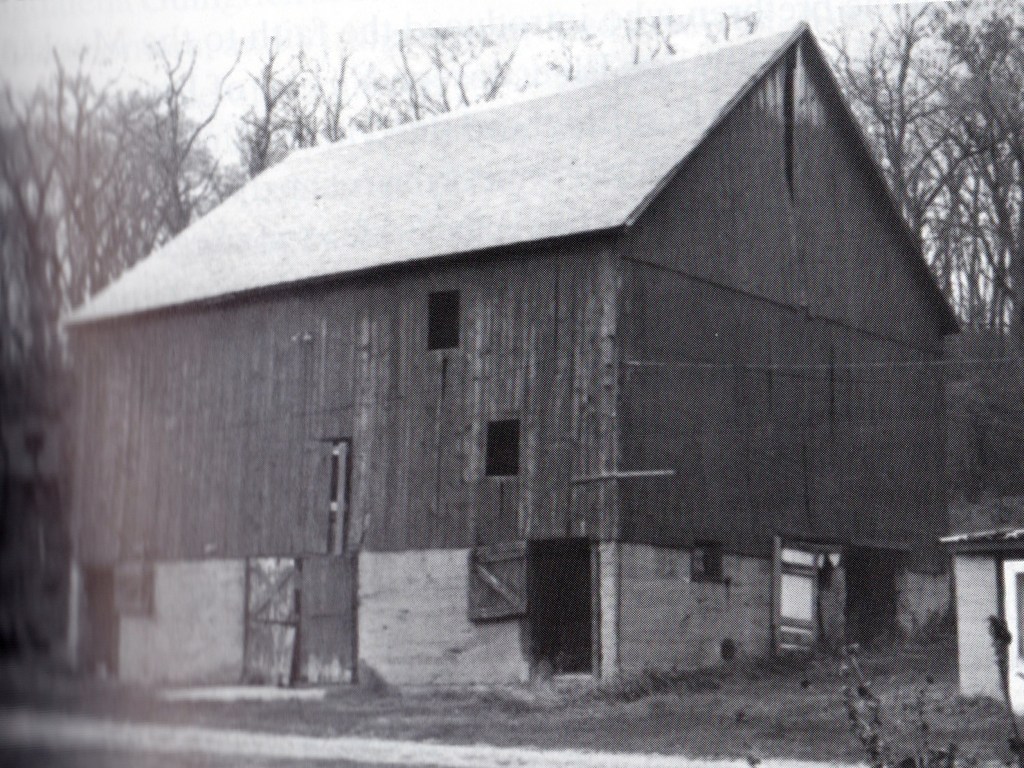
People in Slabtown and Gridley and Tazewell were leaving their Amish and Mennonite churches to follow a “New Amish” way, one that was more conservative, yet more dynamic and emotional.
These new congregations met in houses and barns until they could build a church.
Val and Lena Maninger would convert too.
Val Maninger grew up Catholic. We don’t know if he was a devout church attendee in Germany, but since he had arrived in Illinois he probably didn’t attend. There was no Catholic Church near Farnisville. We don’t have any information that he attended another denomination.
Magdalena Smith Neuhauser grew up in the Amish religion. It has strict doctrine about attending meetings, so it’s likely Magdalena was a regular. Even after her parents died of cholera in 1855, she likely attended Sunday meeting with whichever relatives she lived with. Magdalena had married Peter Neuhauser, who was also Amish.
In 1866, when they agreed to marry, Val and Lena committed to a new church. They joined others who were converting to the teachings of Benedict Weyeneth and other leaders of the “New Amish,” or “Evangelical Baptists.”
Samuel Froehlich
Switzerland had been a crucible for new religious movements. We’ve written about the Swiss Reformed Church, the Anabaptists, the Mennonites, and the Amish.
Samuel Froehlich had studied for the clergy growing up in Solothurn, Switzerland. He was ordained as a priest in the Swiss Protestant Church.
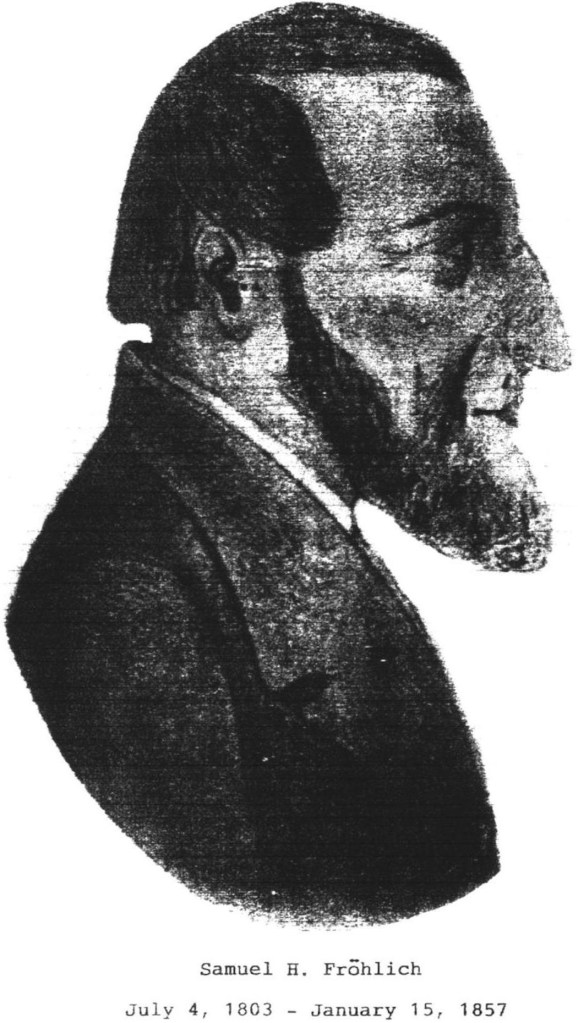
As he began his pastoral duties, he could not help but preach passionately about the need for a radical rebirth. This created a great awakening in his congregation at Leutwil, and spread to neighboring Swiss villages, much to the displeasure of state church authorities.
By 1831, his spiritual fervor provoked the Swiss state church to such a point that they banned him from its pulpits.
Apostolic Christian Church – History
Froehlich’s spiritual beliefs were similar to those of Anabaptists. They believed in the literal word of the Bible, and in reborn baptism as an adult. Froehlich approached these beliefs not just as obligations, but with zeal and enthusiasm.
By the mid-1850s, there were 110 congregations of Evangelical Baptists in Europe.
Amish in Lewis, New York need help
In 1847, an Amish congregation in Lewis, New York was experiencing some spiritual problems and divisiveness. One of the members had been a follower of Samuel Froehlich in Europe, and he urged Elder Joseph Virkler to write to Froehlich for advice and help.
In response, Froehlich ordained a young follower, 28-year-old Benedict Weyeneth. Froehlich assigned Weyeneth to travel to New York to help the congregation with its problems. Joseph Virkler and others were so taken with Weyeneth’s teachings they decided to leave the Amish Church and start their own. This was the first “Evangelical Baptist” church in America.
Roanoke, Illinois
After brief stops in Ohio and Iowa, Benedict Weyeneth and his family landed in Roanoke, Woodford County, Illinois in 1853. There he began farming, but spent much of his time preaching and traveling. He gathered new followers and baptized them.
His location in the center of Woodford County put him in the heart of the Amish Mennonite communities that had immigrated in the 1830s through 1850s. Numerous of those families left their churches and began to follow the “New Amish” teachings.

The Weyeneth name
As you’ve probably figured out, the Weyeneth name figures in our Maninger family history.
Benedict Weyeneth’s parents are our 4th great-grandparents. We descend from them through Benedict’s brother Jacob Weyeneth. Jacob and Elizabeth Weyeneth and their children immigrated to Roanoke in 1869.
Jacob and Elizabeth Weyeneth’s daughter Priscilla will later marry John Maninger.

Val and Lena join
During the 1850s and early 1860s, more and more families in Woodford and surrounding counties left their Amish and Mennonite congregations to start meeting as New Amish, followers of Benedict Weyeneth and other new leaders.
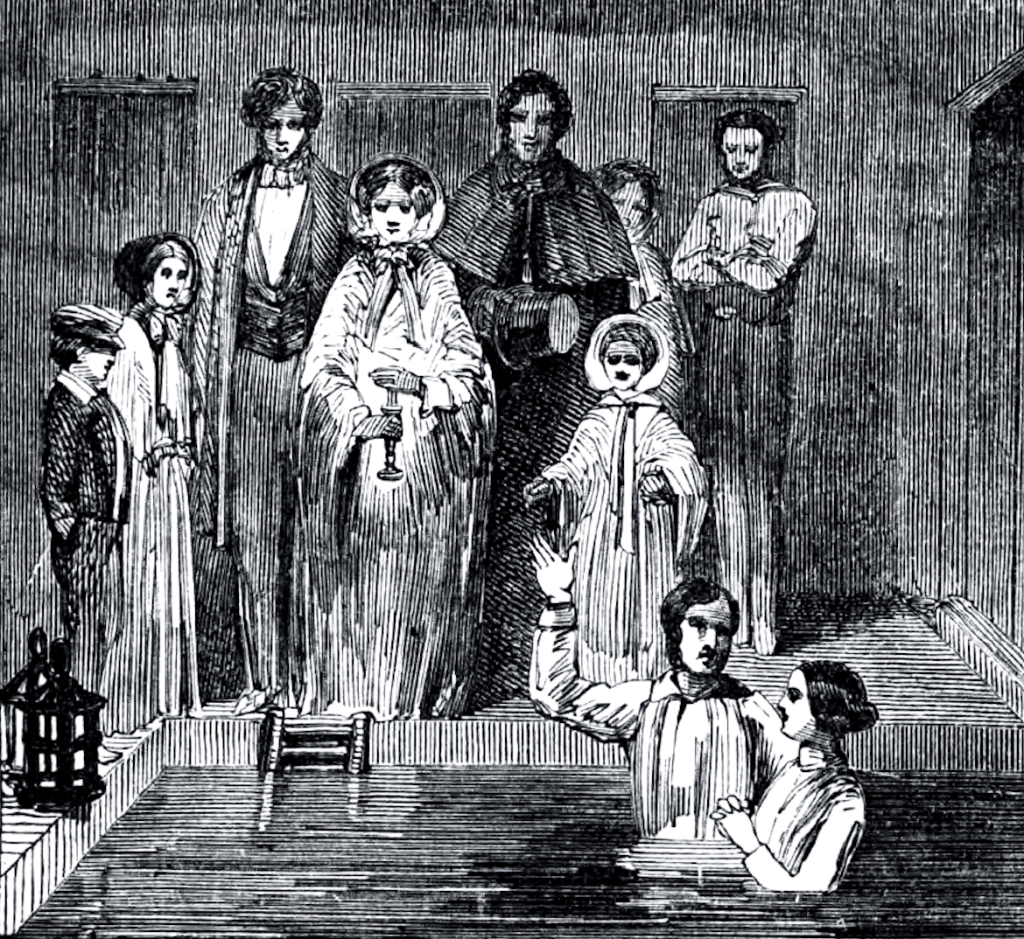
Families from Gridley would travel to Roanoke to Sunday meetings. That was Weyeneth’s home church, but other leaders emerged. Some would travel to Gridley and Slabtown and other neighboring communities to preach.
After they married, Val and Lena Maninger vowed repentance and were baptized into the church. They would remain devout followers throughout their lives.
The Gridley Church
The New Amish congregation in Gridley grew during the late 1860s.
In 1870, infrequent services began in the home of Matthew Kaupp in the middle of East Second Street, just south of the local grain elevator. Ministers rode via horseback from the prairie church south of Roanoke to conduct worship services.
The church’s first resident minister was Joel Herman, only 21 and a single man. He was chosen from within the congregation to be a minister. This was in keeping with the denomination’s recognition of the “priesthood of all believers.”
Apostolic Christian Church – Gridley History
In 1874, Asahel Gridley donated land for a church building – “to be used as a church and none other but to worship the Almighty God.” The site was on the southeast side of Gridley, at 208 East Gridley Road.
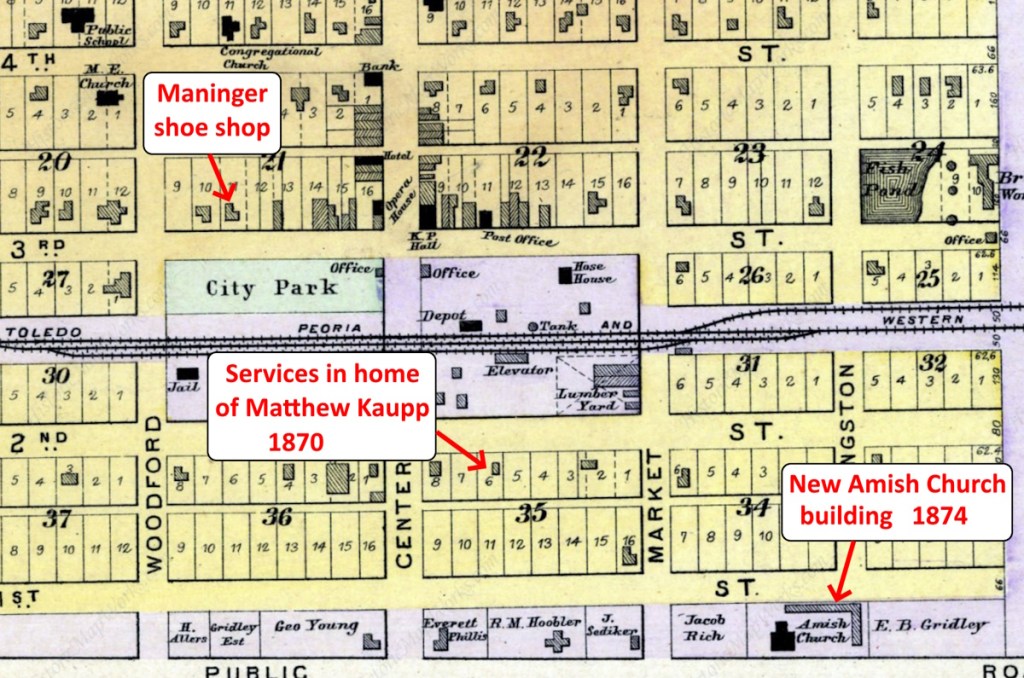
A church building was built, along with horse barns on three sides, outdoor bathrooms, and a coal house.
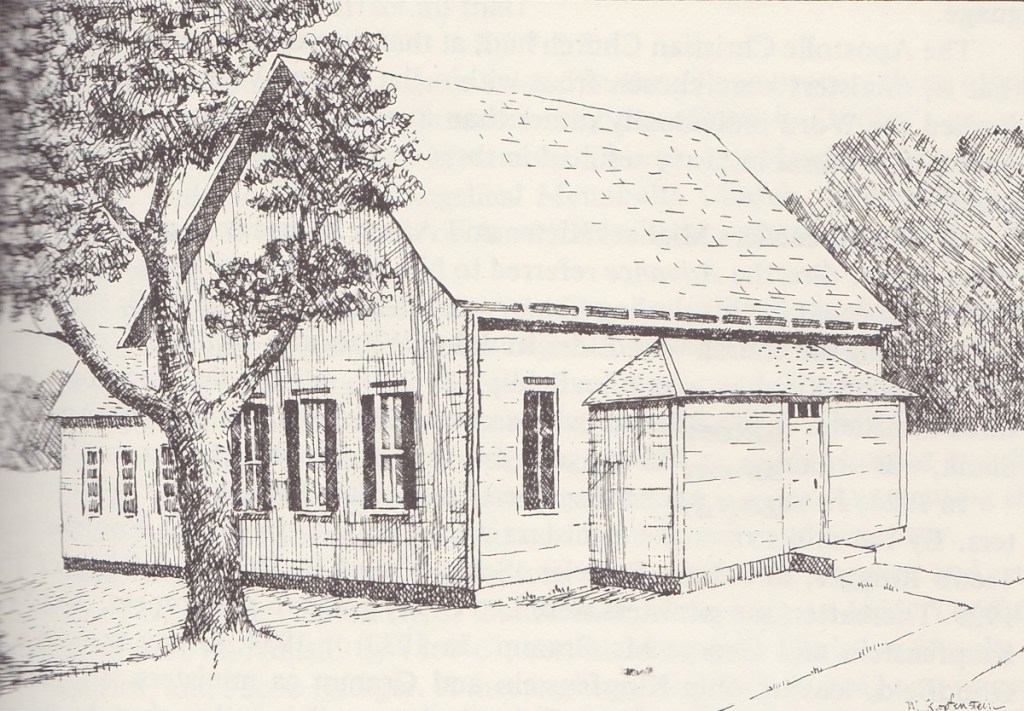
They have erected thirty sheds, with doors on them, for their teams, as most of them come from their farms in the surrounding country, and every team is carefully housed before its owner commences his religious services.
Marching to Zion – A History of the Apostolic Christian Church in America

Sunday meeting
Parishioners arose early on Sunday to prepare for the meeting. In the early years, they might travel up to twenty miles to get to the place of worship. After the 1860s, some could take the railroad to a neighboring town with a church.
The church buildings were simple. A small platform was at the front, the rest of the room filled with rows of simple benches or pews. Men enter one door and sit on one side, women on the other, with a partition between them. The women wear head coverings.
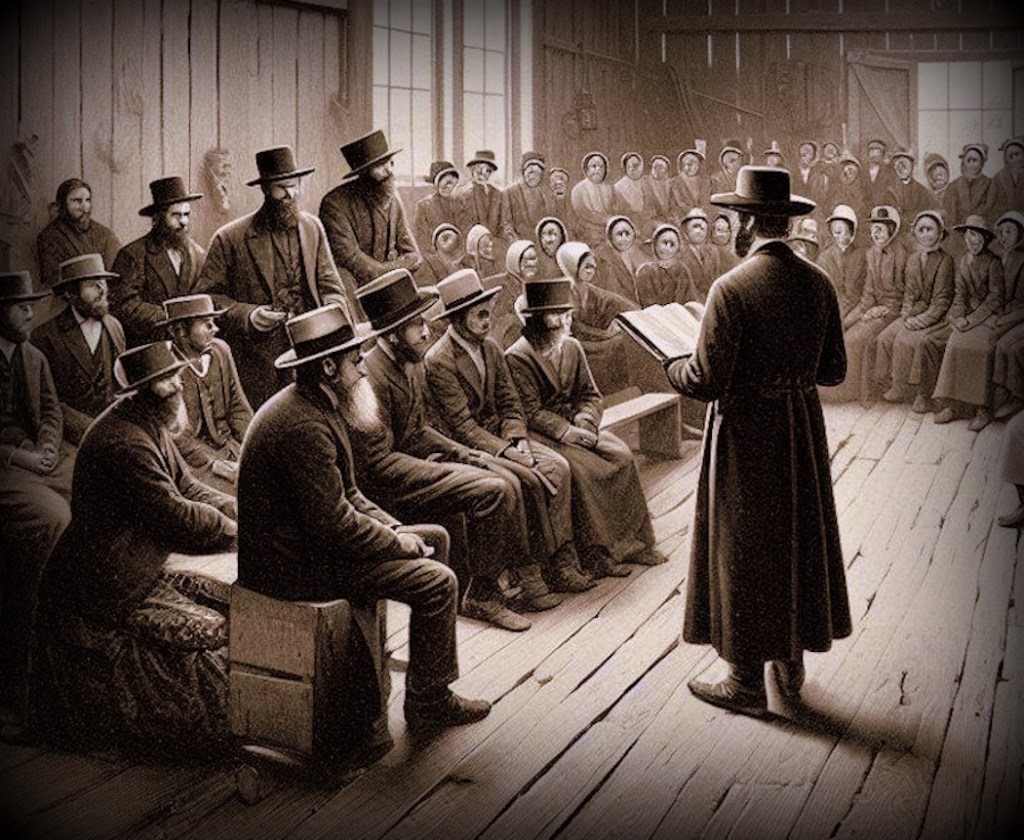
There’s no full-time minister. Instead, one of the brothers is treated as a learner or teacher.
The meeting opens with the singing of a hymn. Some congregations have piano accompaniment, others are a capella.
Prayer follows, with parishioners kneeling on the floor.
There’s no prepared sermon. Instead, the Bible is opened to a random page, and the reading begins there.
The service consists of singing, Bible reading, prayer, and exhortation
The service lasts an hour or two. Then the women serve the prepared food they brought, while the men look after the horses. Children play in the yard. After the noon break, there might be more worship service or Sunday School. There was much socialization.
Activities conclude in the afternoon, and families begin the journey home.
John Maninger and Priscilla Weyeneth
John Maninger attended Sunday meetings with his parents, and Priscilla Weyeneth attended meetings with hers. It seems obvious that John and Priscilla met at these meetings.
Twenty years after Val and Lena Maninger joined the church, their son John would marry Priscilla Weyeneth.
Changing the name
In Europe, the church was called “Evangelical Baptist.” In America, some churches used the name “New Amish.” The names were confusing, as the church was neither Amish nor Baptist.
Some churches used “Christian Apostolic, while others used “Apostolic Christian. Sometimes the church was called the “German Apostolic Christian Church.”
It was also called German Evangelical, German Mennonites, Dutch, and other names. At the time of World War I, it was necessary to list a consistent denominational name for the many young men of the church registering for the draft.
Marching to Zion: A History of the Apostolic Christian Church of America
In 1918, church leaders officially adopted the name “Apostolic Christian Church.” That’s the name used today.
Changing the language
Also during World War I, the church changed the worship service language from German to English because of the anti-German sentiment.
The change to English language was difficult. The German language was cherished in the church. German language was taught in Sunday School, and many churches conducted “German School” during the winter months.
Sources:
- Image – Klopfenstein barn – Marching to Zion: A History of the Apostolic Christian Church of America – Perry A. Klopfenstein – 2008 – p. 141
- Quote – Samuel Froehlich teachings in Switzerland – Apostolic Christian Church – History – https://www.apostolicchristian.org/history
- Quote – Gridley Church History – Apostolic Christian Church – History – https://www.gridleyacchurch.org/history
- Image – Samuel Froehlich – Wikimedia Commons – https://commons.wikimedia.org/wiki/File:SamuelFroehlich.jpg
- Map – excerpt of Johnson’s Illinois – Johnson and Browning No. 40 – 1860 – Internet Archive – https://archive.org/details/dr_johnsons-illinois-by-johnson–browning-no-40-00314025
- Image – Drawing of a Mormon baptism ceremony, circa the 1850s – Frederick Hawkins Piercy (1830-1891), a Mormon artist – Wikimedia Commons – https://en.wikipedia.org/wiki/File:Mormon_baptism_circa_1850s.png
- Family Tree diagrams – Ancestry.com and Mark Jarvis
- Map – excerpt of Gridley – Historic Map Works – https://historicmapworks.com/Map/US/24819/Gridley+1/McLean+County+1895/Illinois/
- Image – Gridley “New Amish” Church – Marty Klopfenstein – Foundations Strong – A History of Gridley, Illinois 1856-1990 – Perry A. Klopfenstein – p. 215
- Quote – Amish in Gridley – The Pantagraph – August 10, 1874 – newspapers.com
- Quote – Gridley church constructed barns – Marching to Zion – A History of the Apostolic Christian Church in America – 1847-2007 – Perry A. Klopfenstein
- Image – Sunday meeting in a barn – AI generated – Copilot Designer – Microsoft
- Quote – Official name changed to Apostolic Christian Church – Marching to Zion: A History of the Apostolic Christian Church of America – Perry A. Klopfenstein – 2008 – p. 382
- Music – Praise Ye the Lord – Zion’s Harp – Author: Georges Michel Mangold (1822-1894)
Composer: Philipp Nicolai, 1599 (1556-1608) – https://www.zionsharp.info/1-praise-ye-the-lord.html
 Family Nibbles

