The 1880s dawned clear and bright for Val and Lena Maninger. Things seemed to be going their way. But there was a fever in the air. Kansas fever.
Val and Lena Maninger were doing well. The shoe shop was doing a lively trade. They had a farm hand helping work on their farm.
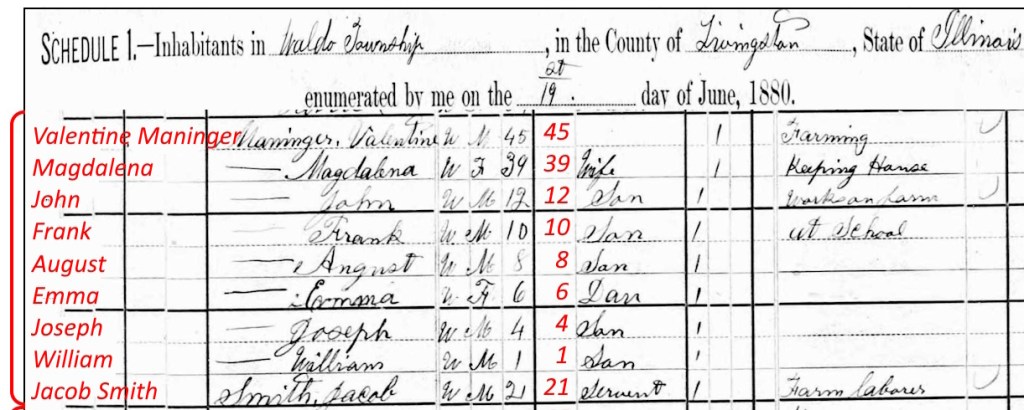
In 1880, there were six Maninger children. The older ones were helping on the farm and attending school. Edward Jennings Maninger was born Thursday, April 28, 1881. Now there were seven.
They lived in a German-speaking community, and were active in their German-speaking church.
You’d think they were set. Why mess with success?
Kansas Fever
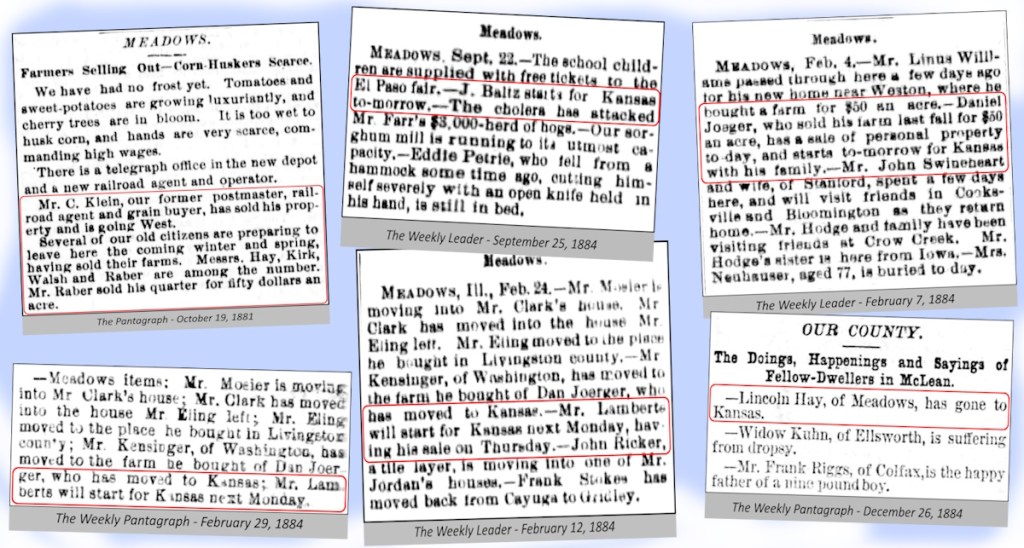
It seemed like everyone was talking about moving to Kansas.

Next thing you know, it seemed like everyone was actually moving to Kansas.
Why Kansas?

In 1854 the newly created territory of Kansas was opened for white settlement. It was not until after the Civil War, however, that Kansas experienced a significant increase in population. Free and cheap land provided by the Homestead Act and the railroads attracted many settlers.
By the end of the 1800s, German-speaking people formed the largest group of new immigrants to Kansas.
Settlement in Kansas – Kansas Historical Society
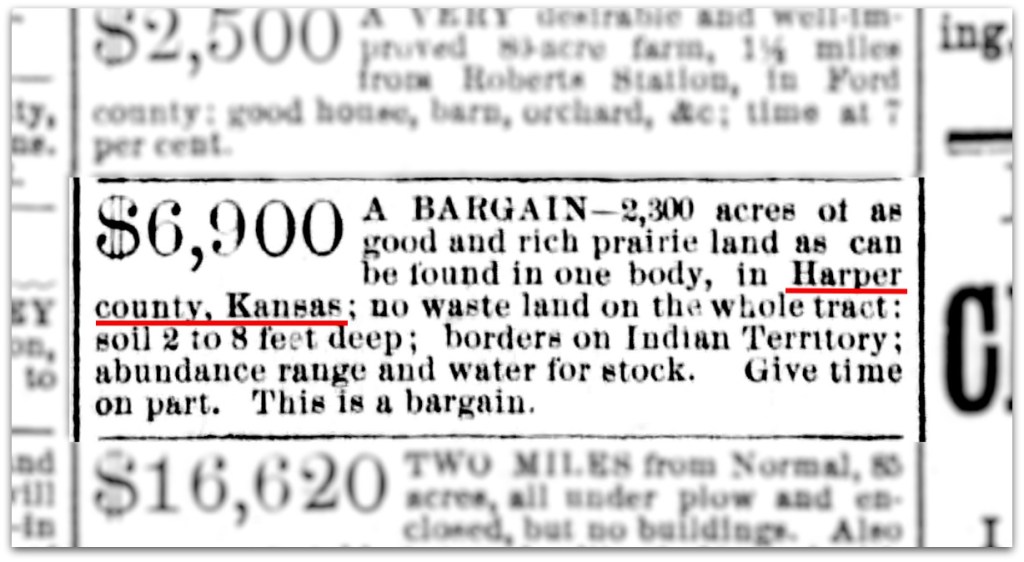
The newly opened land offered beautiful and productive farmland – lots of it. And it was free or at least inexpensive.
Word came back from those who had moved to Kansas, extolling the virtues of the vast prairie available for the taking. Like a “Christmas Letter,” the new residents may have sugar-coated a bit.
Populations skyrocketed. The state of Kansas grew from a population of just under 365,000 to nearly a million people during the 1870s.
Farmers’ Alliance – Wikipedia
A Plan
There was lots of conversation among friends, relatives, and neighbors. Several families from the church decided they would go together, Val and Lena included.
Families moving together would provide lots of advantages. They would have each other to count on in times of need. They could work together to build housing. And they committed to starting a “New Amish” church together.
One or two families would move first. They would be an advance party, scouting and buying land, preparing housing, etc.
Joseph and Barbara Smith
Joseph and Barbara Smith would be one of the “advance” families.
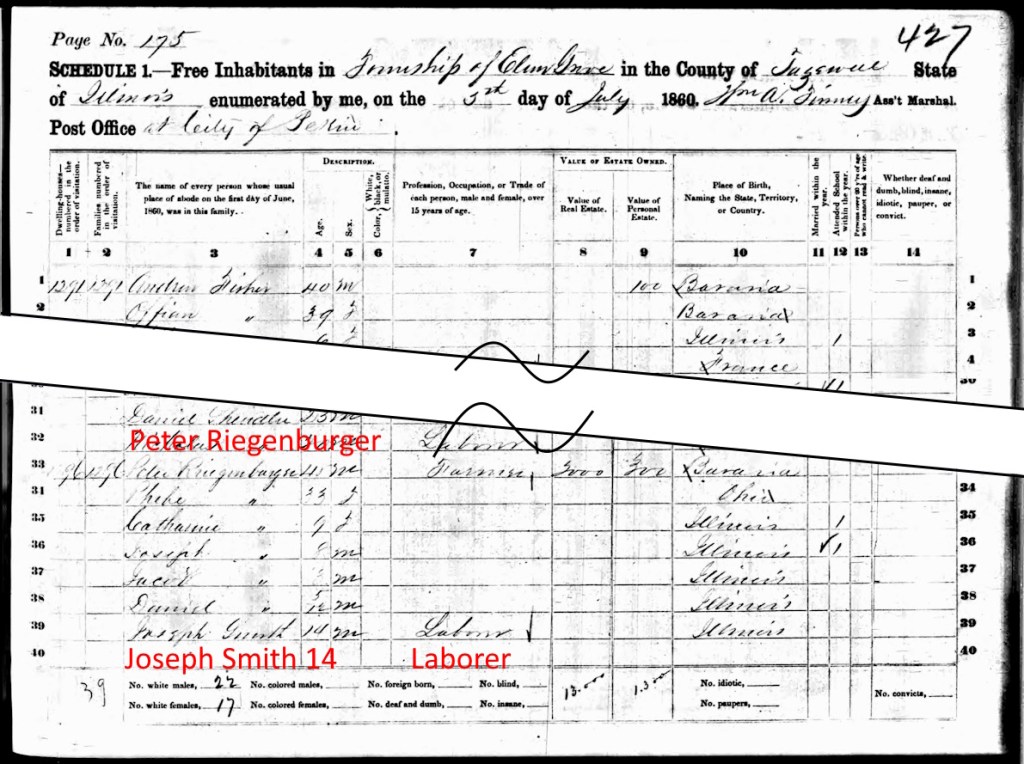
Joseph Smith was Magdalena Maninger’s younger brother. Joe was 12 when their parents and siblings died from cholera. After his parents died, Joe lived with the Peter Riegenburger family in Elm Grove, Tazewell County, three miles west of Farnisville.
Peter Riegenburger’s wife Seba Garber was related to the Smiths.
In 1863, Joe married Barbara Roth. Joseph and Barbara Smith farmed in Morton, Tazewell County.
By 1880, there were four surviving Smith siblings – Mary Smith Fellrath, Magdalena Smith Maninger, Joseph Smith, and Christian Smith. Three of the four would move to Kansas.
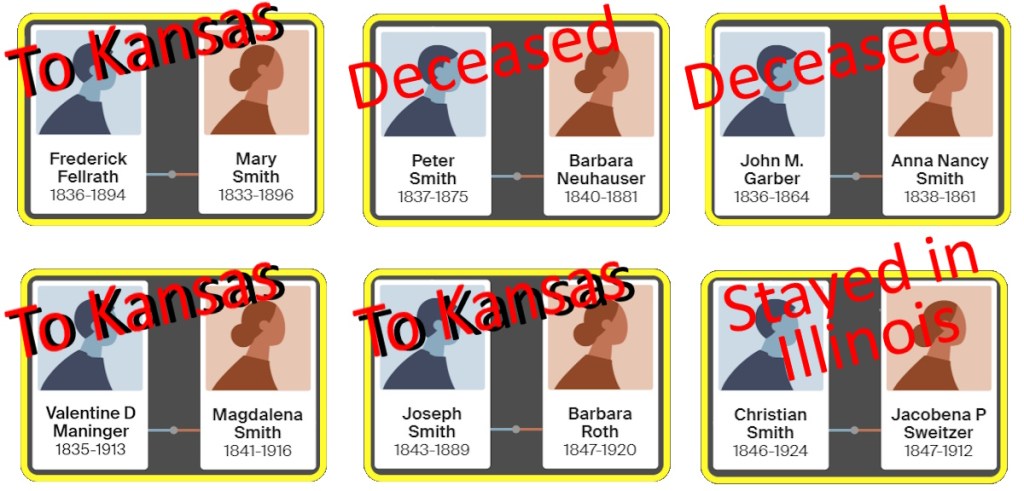
Joseph and Barbara Smith arrived in Harper, Kansas in March 1883. Within a month of arrival, Barbara Smith began the process of buying some farms and lots in Harper.
Here’s a deed in which Barbara Smith bought a farm one mile south of Harper. It’s the northeast quarter of Section 18, Township 36, Range 6 West. The purchase price is $2,500 and the purchase date is April 4, 1883.
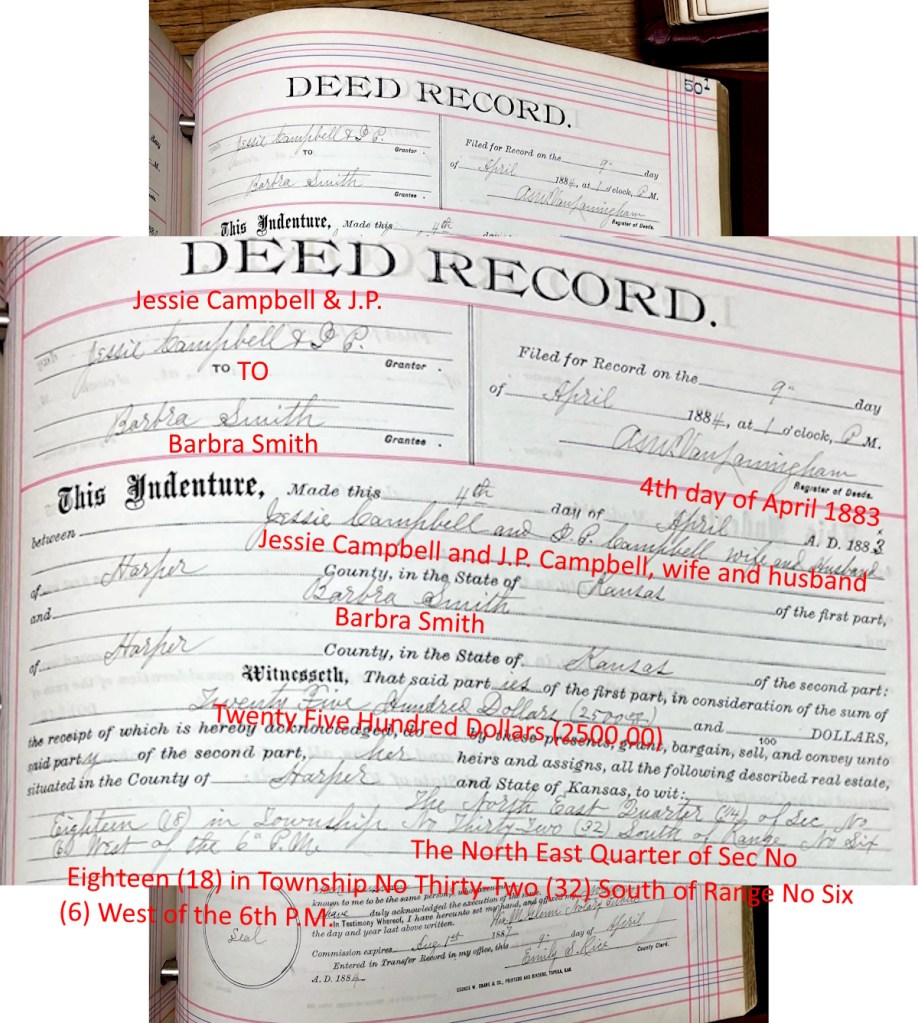
This is the same parcel that Val and Lena Maninger will buy from Barbara Smith two years later when they arrive in Harper. Has Barbara purchased the farm on their behalf? Or has she purchased it for Joseph and herself, then decided later to sell it? I’m guessing she’s buying it for Val and Lena.
Most of Joseph and Barbara Smith’s real estate transactions are in Barbara Smith’s name. Maybe Barbara was better educated, and they thought it better for her to handle legal documents. Whatever the reason, it was customary for the husband to be signatory on deeds.
Harper County, Kansas
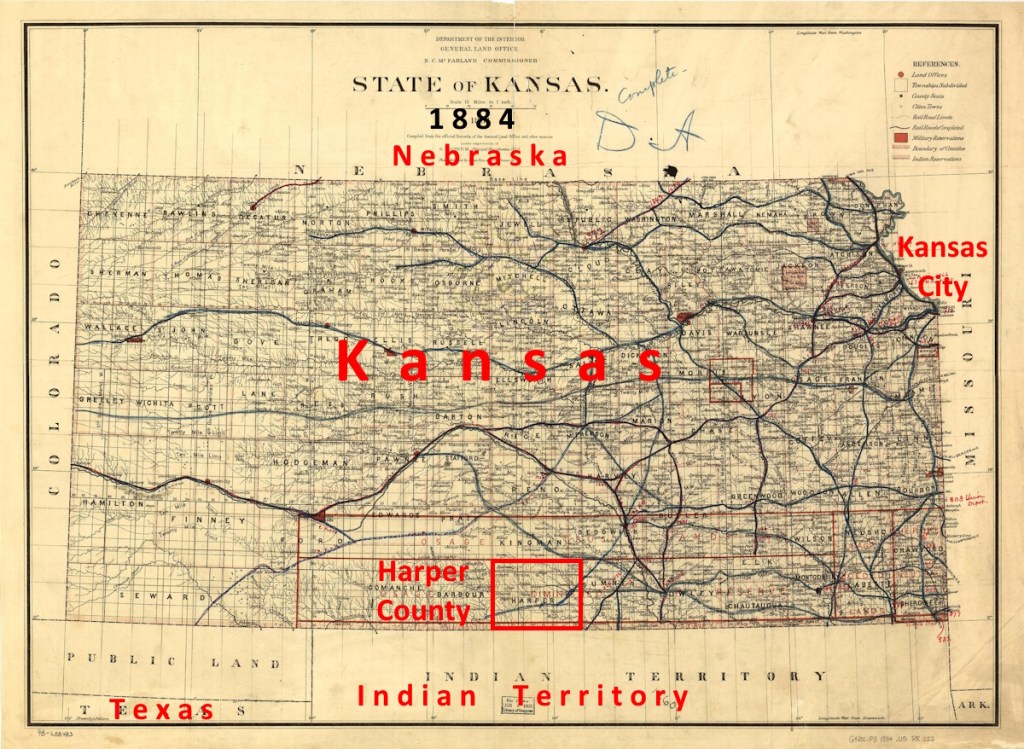
Harper County is in south central Kansas, about 50 miles southwest of Wichita. The county borders Indian Territory on the south, later to become Oklahoma.
In 1873, Harper County was founded on a fraud. Four men submitted a petition to the Kansas governor, requesting that Harper County be formed. The petition had 40 names, all copied from a Cincinnati directory. A census accompanied the petition, listing 641 residents. These were also false names.
The governor granted the petition, and Harper County was organized.
The next winter an investigating committee appointed by the legislature visited Harper county and found that it had not a single resident, that it had been bonded for $25,000 and had a funded indebtedness of $15,000.
Harper County, Kansas Genealogy and History
By 1878, the fraudulent scheme was unraveled, and Harper County was reorganized. By then, a few settlers had arrived, and a few fledgling towns were formed. Harper was the first and largest, followed by the county seat Anthony.
Val and Lena sell out
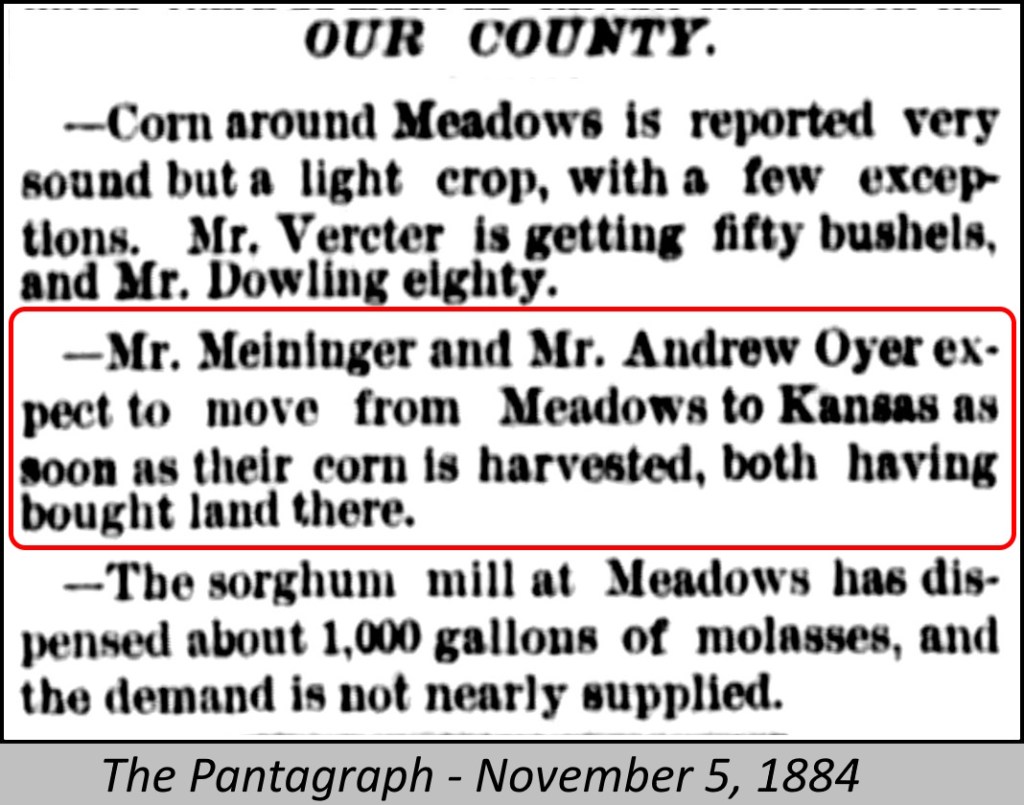
Val and Lena set about preparations for the move. There were a lot of details to work out.
The shoe shop building in Gridley
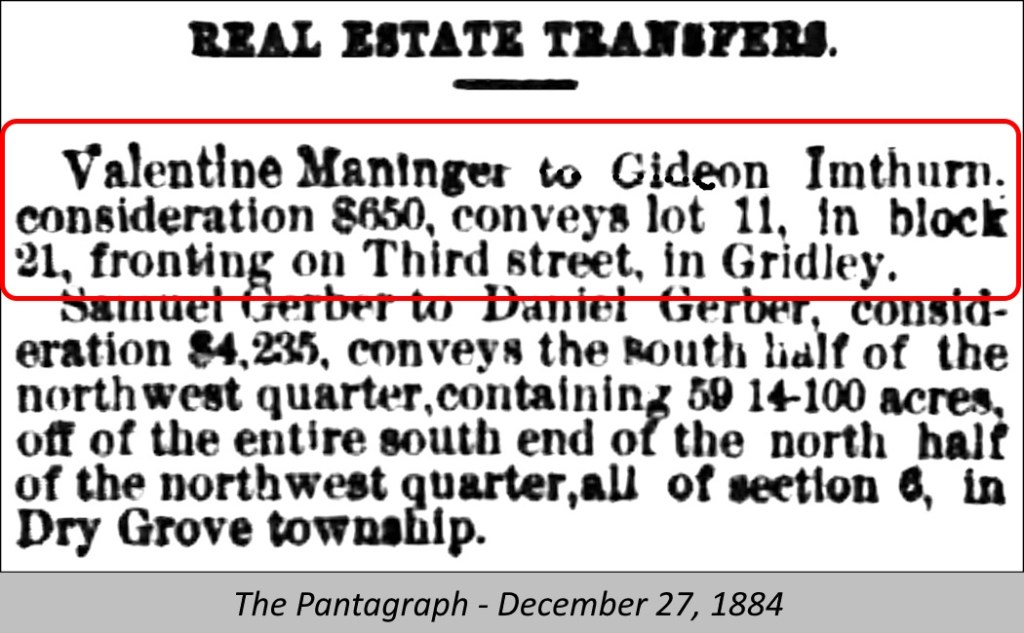
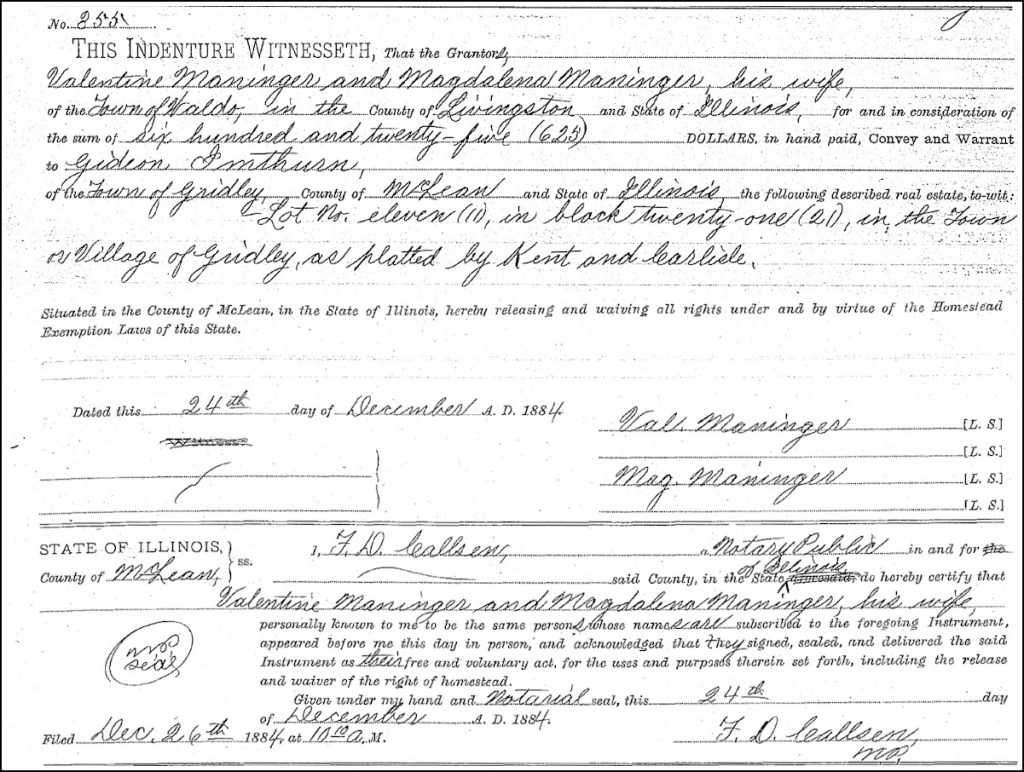
On Christmas Eve, 1884, Val and Lena closed a deal to sell their shop in Gridley to Gideon Imthurn for $625.
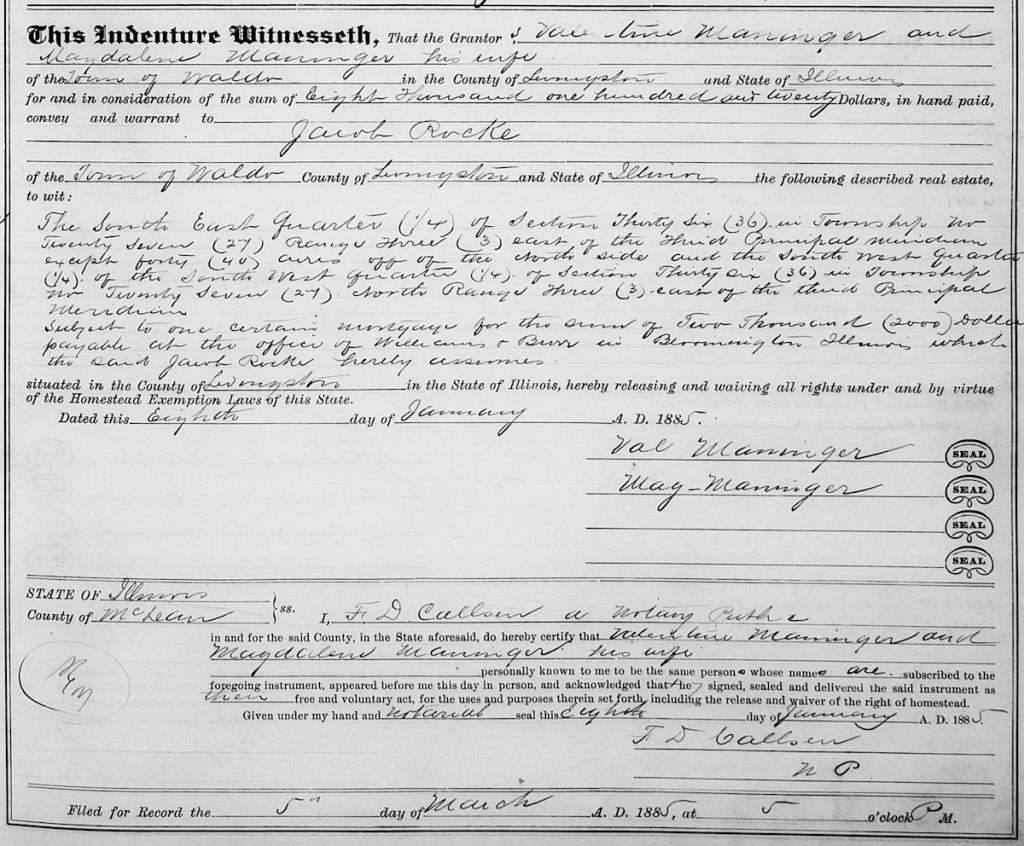
The farm in Waldo Township
Just two weeks after selling the shoe shop, on January 8, 1885, Val and Mag closed a deal to sell their farm to Jacob Rocke for $8,120. Rocke assumed their $2,000 mortgage.
They were free and clear in Gridley and Waldo. Now they had to get ready to move.
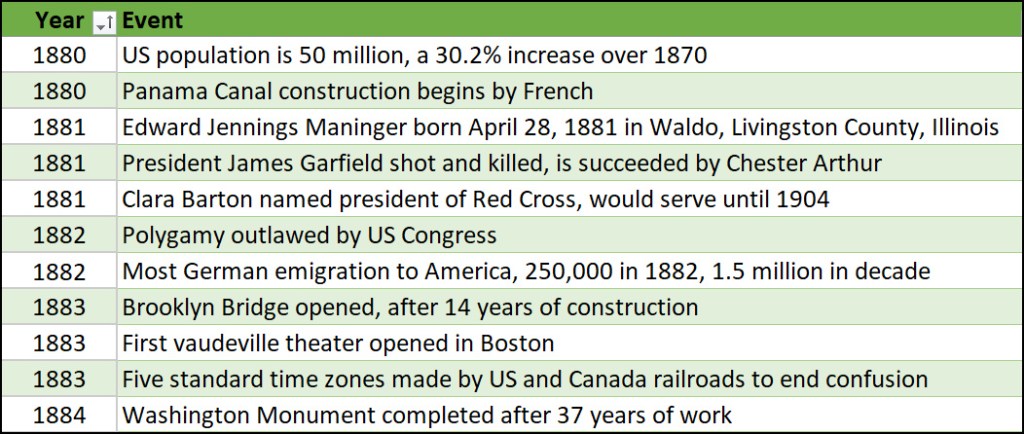
Timeline
Sources:
- News – Ad for Kansas farmland – The Pantagraph – August 30, 1880 – newspapers.com
- Census – Valentine and Magdalena Maninger – Livingston County, Illinois – 1880 – ancestry.com – https://www.ancestry.com/imageviewer/collections/6742/images/4240502-00664?pId=46810887
- Census – Peter Riegenberger – showing Joseph Smith – Tazewell County, Illinois – 1860 – Ancestry.com
- News – Kansas fever – The Pantagraph – August 23, 1878 – newspapers.com
- News – Various people planning to go to Kansas – The Pantagraph – various dates – newspapers.com
- News – Maninger and Oyer planning to go to Kansas – The Pantagraph – November 5, 1884 – newspapers.com
- Map – Kansas – 1884 – General Land Office – Library of Congress – https://tile.loc.gov/image-services/iiif/service:gmd:gmd420:g4201:g4201p:rr002220/full/pct:25/0/default.jpg
- Quote – Settlement in Kansas – Kansas Historical Society – Settlement in Kansas – Kansapedia – Kansas Historical Society (kshs.org)
- Image – ATSF poster – Kansas Historical Society – m41card02.pdf (kshs.org)
- Quote – Soaring Kansas population – Farmers’ Alliance – Wikipedia – https://en.wikipedia.org/wiki/Farmers%27_Alliance
- Quote – Harper County fraudulent organization – Harper County, Kansas Genealogy and History – https://genealogytrails.com/kan/harper/history1.html#:~:text=It%20was%20first%20organized%20in,passed%20the%20legislature%20in%201879
- Deed – Barbara Smith from Jessie and J.P. Campbell – NE 1/4 Sec 18 Twp 32 Range 6W – 1883 – Harper County Register of Deeds – Anthony, Kansas
- News – Valentine and Magdalena Maninger sell lot in Gridley to Gideon Imthurn – The Pantagraph – December 27, 1884 – newspapers.com
- Deed – Valentine and Magdalena Maninger to Gideon Imthurn – Lot No. 11 in Block 21 in the Town of Gridley – December 24, 1884 – McLean County Clerk – Bloomington, Illinois
- Deed – Valentine and Magdalena Maninger to Jacob Rocke – SE 1/4 Sec 36 Twp 27 Range 3E except 40 acres and SW 1/4 of SW 1/4 Sec 36 Twp 27 Range 3E – January 8, 1885 – Livingston County Clerk – Pontiac, Illinois
- Family Tree diagrams – Ancestry.com and Mark Jarvis
- Music – Come With Us – Nat Keele and Hot Buttered Rum – YouTube – https://www.youtube.com/watch?v=-VEpcaq_oD4
 Family Nibbles
