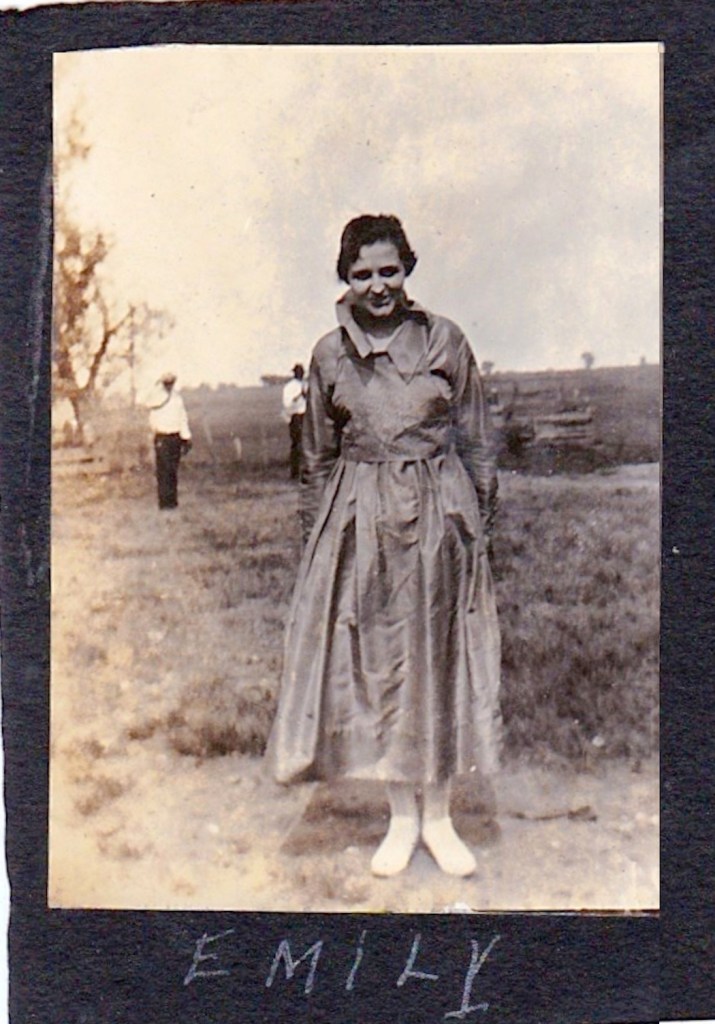
Emily Maninger enrolled in Wichita Hospital Training School for Nurses in 1917. She hoped to go to the front to care for the troops in World War I.
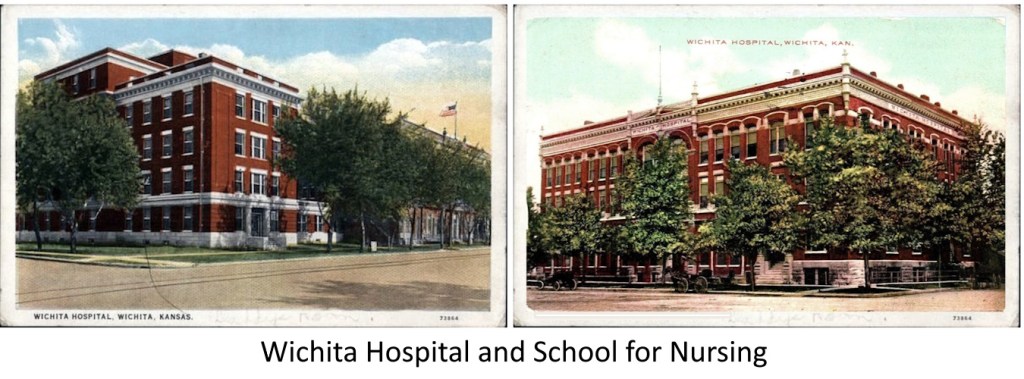
Wichita Hospital had a good nursing program, and it was close to Harper.
Wichita Hospital
The Wichita Hospital was founded in 1879 by a group of women, because there was no hospital in Wichita.
A group of Wichita women, who founded the Wichita Hospital in 1879, calling it the Ladies’ Benevolent Home for the sick and needy, were looking for a larger facility since their original hospital at Lincoln and Market Streets, just south of downtown Wichita, was getting crowded for their charitable work. So it was arranged for them to move into the Martinson Block building, then remodeled in 1898, to serve as their new hospital. A west wing was added to the structure in 1916.
Sisters of St. Joseph took over the former Martinson Block after hospital renovation – Catholic Diocese of Wichita
By 1917, the Wichita Hospital was a large and modern facility.
Training school for nurses

In 1896, the Wichita Hospital added the Training School for Nurses.
1918 Spanish Flu pandemic

Emily began nurses’ training in 1917. Just a year later, the 1918 Spanish Flu pandemic ravaged the world. It’s thought the outbreak started at Camp Funston, Kansas.
All the nurses and trainees were pressed into service.
During the recent Influenza epidemic, the Wichita Hospital took care of between 800 and 900 patients and also furnished its quota of nurses for the Red Cross Influenza hospital.
The Wichita Eagle – September 28, 1919
Sadly, one of the Wichita Hospital nurses died from the flu while treating patients. Inez Hopkins was a 1917 graduate. She died December 26, 1918, just a few months after the outbreak began.
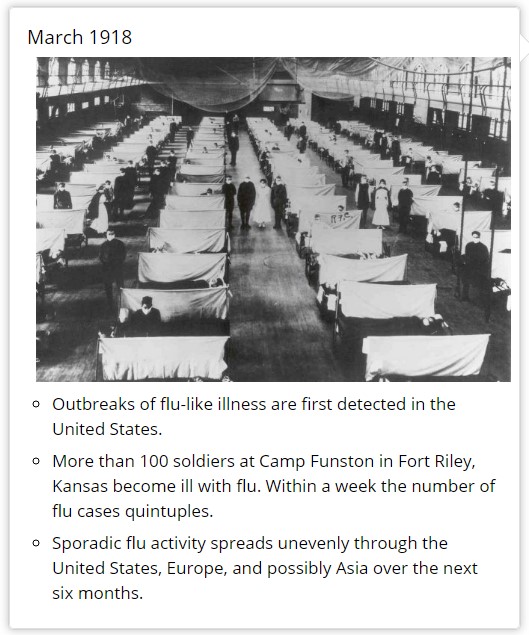
Half of all American soldier deaths from disease were due to influenza, many in training camps in the United States. Did the war cause the flu epidemic? Perhaps so. Certainly, it created the conditions in which the epidemic began and spread. The question has been debated ever since.
Whatever its cause, the flu epidemic killed 50 million people worldwide, and 675,000 in the United States. That’s more deaths than caused by World War I.
Happy times
There were good times too. Emily made many friends during her training. One classmate, Pauline Everitt, would be the witness at Emily’s wedding.
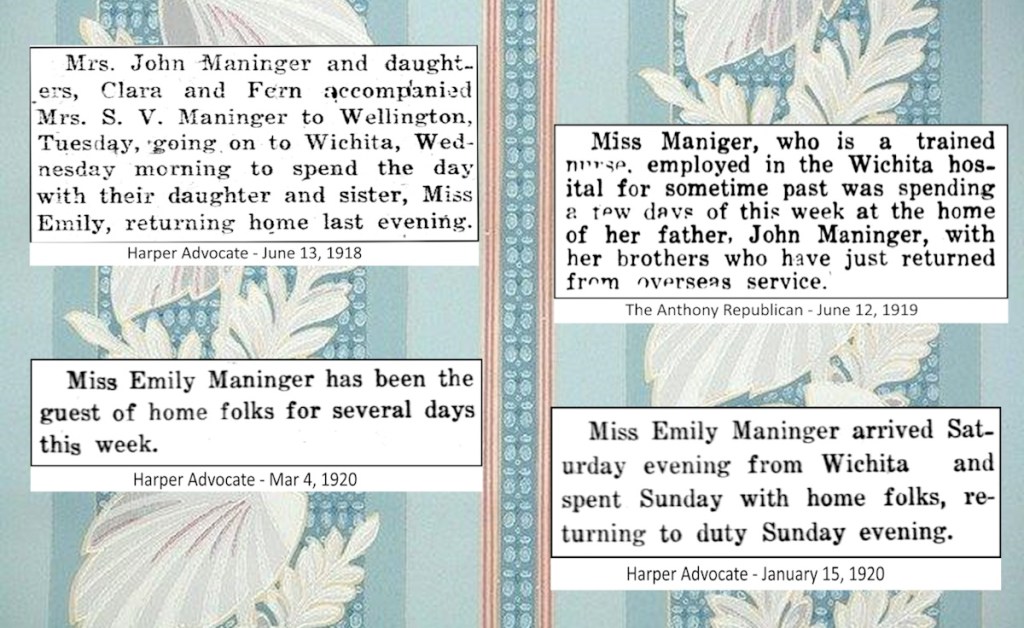
Wichita was only fifty miles from Harper, so there were often visitors from home. Whenever Emily had vacation breaks, she visited Harper.

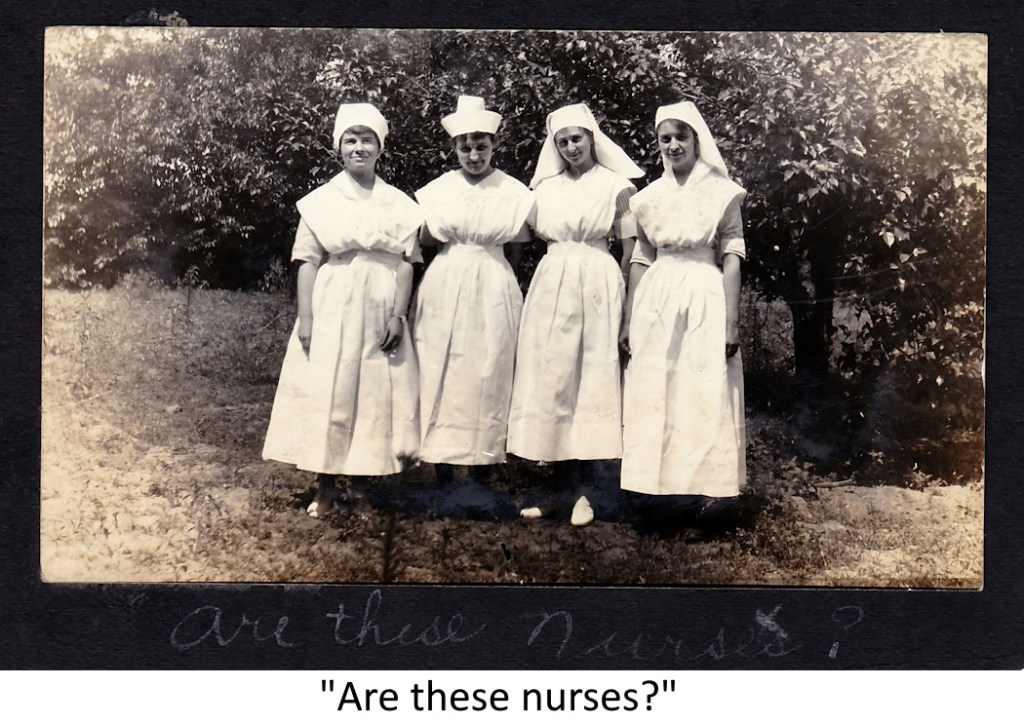
No, they’re not all nurses. In this photo from Eunice’s album, I think the girls are Magdalena, Emily, Elsie, and Eunice Maninger. Emily is the only nurse. I’m guessing that the other girls may have had the uniform of aides or helpers, like Candy Stripers or Red Cross aides.
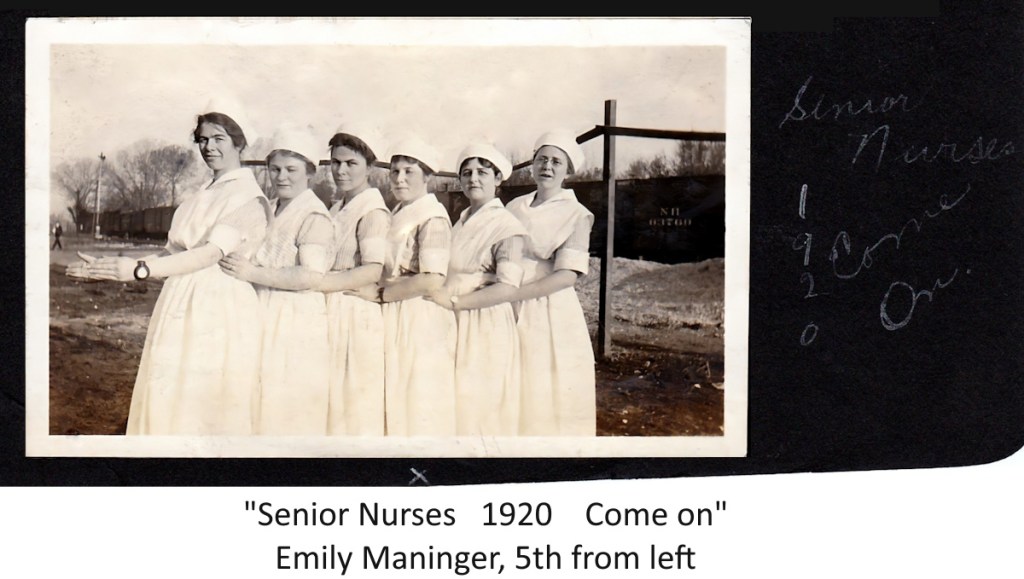
Emily sometimes invited her classmates to Harper. Here are some of the 1920 seniors. Luckily, Eunice had her Brownie camera ready.
A graduate nurse

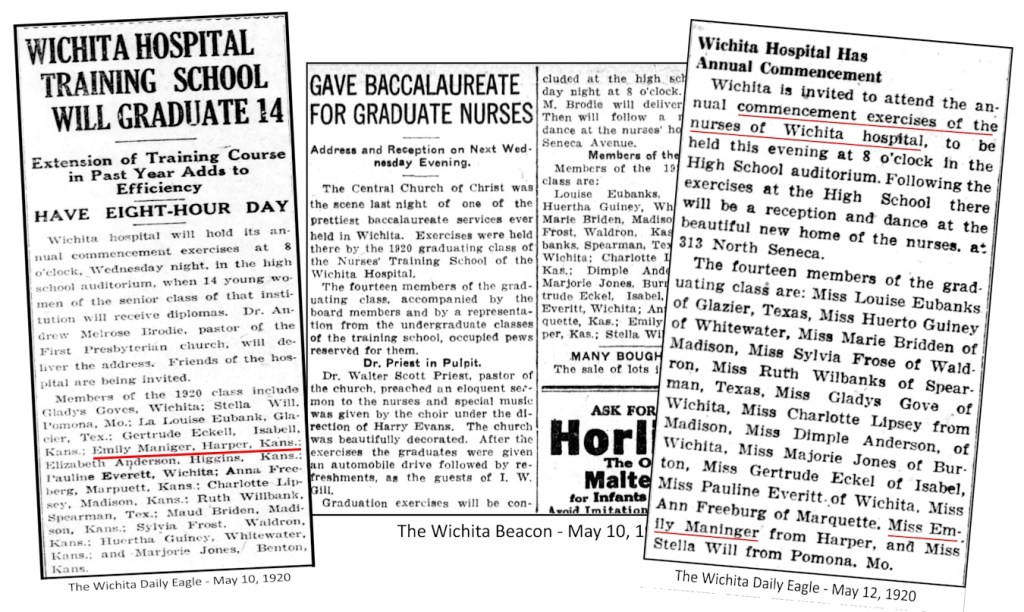

Emily Maninger received her diploma as a graduate nurse on May 12, 1920.
A registered nurse
Two weeks later, on May 27, 1920, Emily Maninger received her certificate as a Registered Nurse.

Nibbles Extra Credit – A mystery solved
One of the rewards of genealogy research is when a trail of clues leads to a new discovery. It may be a previously unknown story or confirmation of family lore. Sometimes it’s a solution to a mystery.
Emily Maninger and Ned Cheney
Emily Maninger married Ned Cheney early in 1921. Ned was a student at Saint Louis University School of Medicine. Emily had graduated from Wichita Hospital School of Nurses. They married in Waterloo, Illinois, near St. Louis.
I had always assumed they met at a St. Louis Hospital. I had no idea why Emily would have been in St. Louis. It was a mystery.
While researching Emily’s time at nursing school in Wichita, several clues revealed the answer.
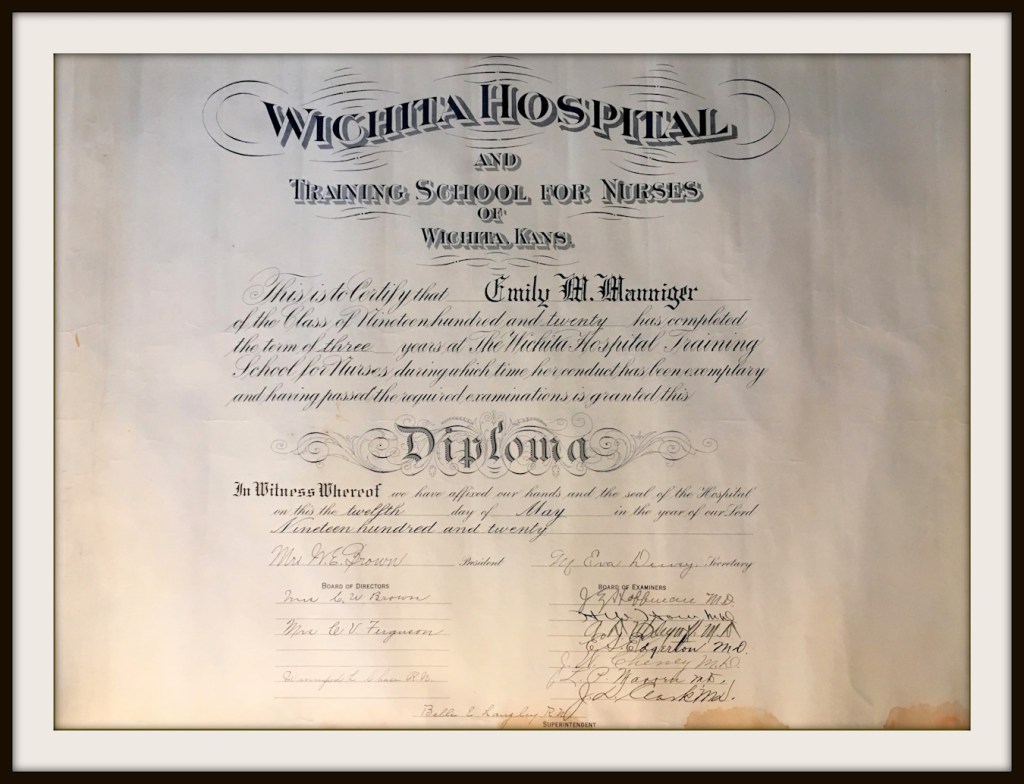
The first clue is on Emily’s Wichita Hospital diploma. One of the signatures was J. W. Cheney, M.D.

Dr. J.W. Cheney was on the Board of Examiners of the Wichita Hospital School of Nurses. He was Ned Cheney’s uncle. That’s quite a coincidence.
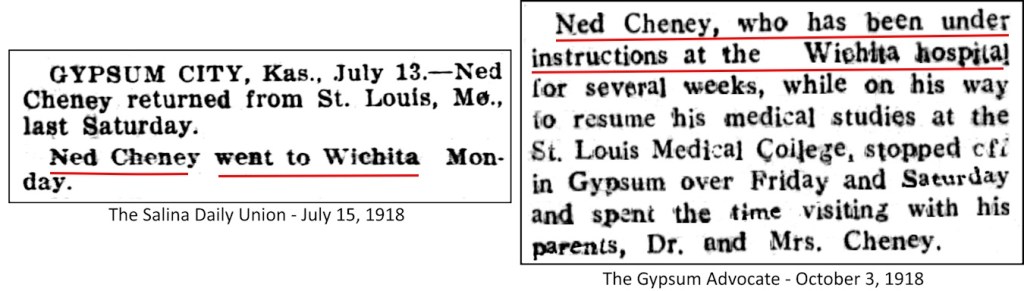
Next, let’s check out a few news articles. In summer 1918, Ned Cheney spent time “under instructions at the Wichita Hospital.”
In summer 1919, Ned retuned to Wichita, where he was “taking intern work at the Wichita Hospital.” He probably stayed with his uncle’s family during his time in Wichita.
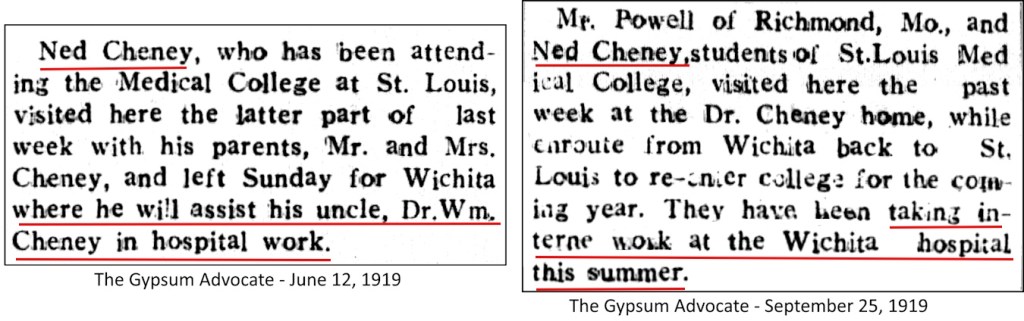
It became obvious that Emily Maninger met Ned Cheney at Wichita Hospital in the summer of 1918 or 1919. They must have made plans to marry when Ned graduated.
Notice that George Powell of Richmond, Missouri also spent the summer doing intern work in Wichita. George and Ned were friends at medical school. George would be a witness at Ned’s wedding.
And another question answered
Ned Cheney became an ophthalmologist, an eye, ear, nose, and throat specialist. Why?

We find that one of the specialties of the Wichita Hospital was treatment of the eye, ear, nose, and throat.
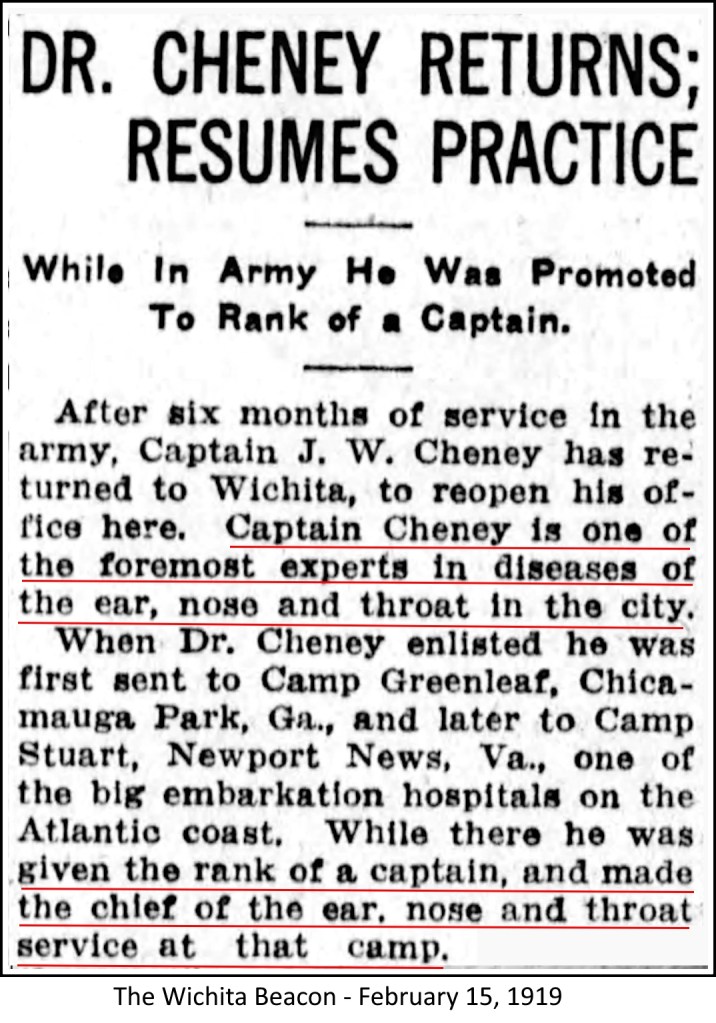
And we find that Ned’s uncle, Dr. James Cheney, was an eye, ear, nose, and throat specialist.
Ned Cheney almost certainly made the decision to pursue the specialty of eye, ear, nose, and throat during his two summers of internship with his uncle in Wichita.
Our Nurse

In 1920, Emily Maninger was age 22. She was a registered nurse.
Emily had worked in the Wichita Hospital during the 1918 Spanish Flu pandemic.
Emily had hoped to serve as a nurse near the front lines in Europe, but the war ended before she graduated.
She and Ned Cheney had plans to marry when Ned finished school.
Emily was a long way from a farm yard in Harper.
Sources:
- Quote – Sisters of St. Joseph took over the former Martinson Block after hospital renovation – Catholic Diocese of Wichita – https://catholicdioceseofwichita.org/sisters-of-st-joseph-took-over-the-former-martinson-block-after-hospital-renovation/
- Image – Wichita Hospital and School for Nursing – A view of the Wichita Hospital – in 1910 – https://www.ebay.com/itm/126095307420
- Image – Wichita Hospital and School for Nursing – CardCow – https://www.cardcow.com/951173/wichita-kansas-hospital/
- News – Wichita Hospital starts a nurse training program – The Wichita Daily Eagle – October 3, 1920
- Quote – Wichita treatment of influenza patients – The Wichita Eagle – September 28, 1919 – newspapers.com
- News – Nurse dead from flu – The Wichita Beacon – December 26, 1918 – newspapers.com
- 1918 Flu Pandemic – CDC – Centers for Disease Control and Prevention – https://www.cdc.gov/flu/pandemic-resources/1918-commemoration/pandemic-timeline-1918.htm
- News – Articles about visits to Emily in Wichita and her visits home – Harper Advocate and The Anthony Republican – various dates 1917-1920 – newspapers.com
- News – Emily Maninger graduates – Harper Advocate – May 13, 1920 – newspapers.com
- News – Articles about Wichita Hospital graduation – The Wichita Daily Eagle and The Wichita Beacon – various dates in May 1920 – newspapers.com
- Diploma – Emily Maninger – Wichita Hospital and Training School for Nurses – 1920 – Maninger family documents – Emily Maninger Cheney collection
- Certificate – Emily Maninger – Registered Nurse – 1920 – Maninger family documents – Emily Maninger Cheney collection
- News – Ned Cheney to Wichita and returns – The Salina Daily Union – July 15, 1918, and The Gypsum Advocate – October 3, 1918 – newspapers.com
- News – Ned Cheney to Wichita and returns – The Gypsum Advocate – June 12, 1919, and September 25, 1919 – newspapers.com
- News – Wichita Hospital specializes in eye, ear, nose, throat – Wichita Daily Eagle – October 3, 1920 – newspapers.com
- News – Dr. J.W. Cheney resumes practice – The Wichita Beacon – February 15, 1919 – newspapers.com
- Image – Photos from Eunice Maninger’s album – Maninger family documents – Emily Maninger Cheney collection
- Family Tree diagrams – Ancestry.com and Mark Jarvis
- Music – Pomp and Circumstance – Sir Edward Edgar – 1901 – Boston “Pops” Orchestra; Sir Edward Elgar; Arthur Fiedler – Internet Archive – https://archive.org/details/78_pomp-and-circumstance_boston-pops-orchestra-sir-edward-elgar-arthur-fiedler_gbia0115117b
 Family Nibbles