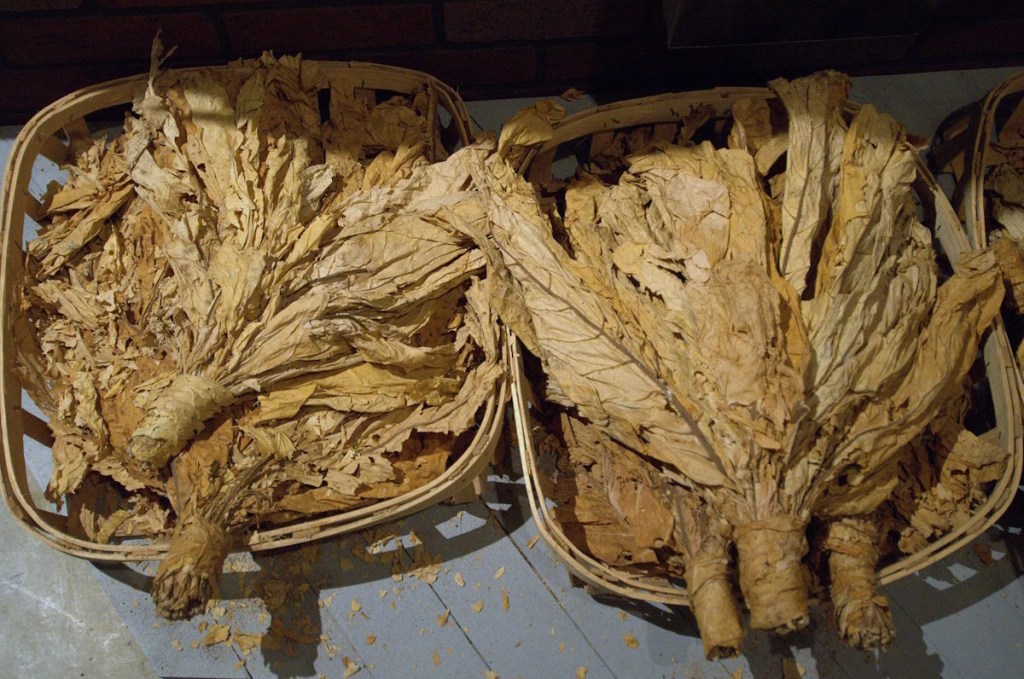
Charles Cheney and his family were second generation tobacco planters.
In 1700, tobacco was Maryland’s dominant cash crop, particularly in Southern Maryland, which was ideal for its growth with its suitable soil, ample rain, and river access for transportation.
The crop was so central to Maryland’s society that it was used as currency to pay taxes, debts, and even official salaries.
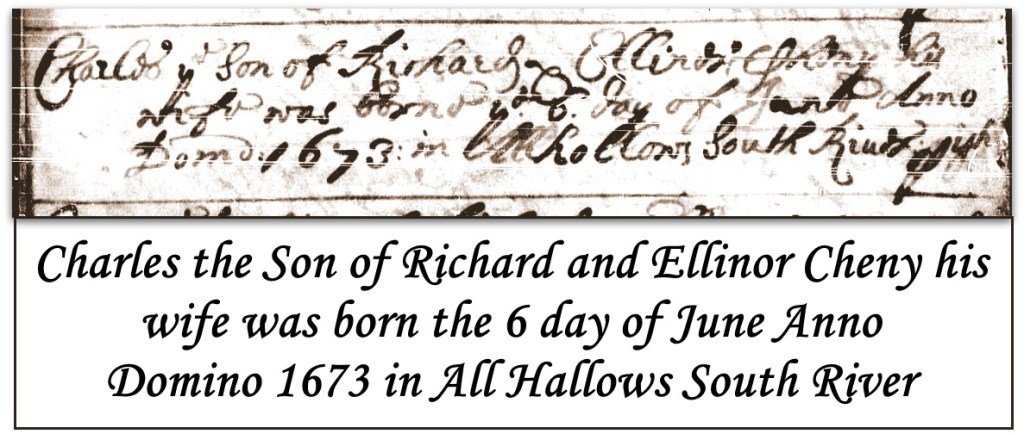
Charles Cheney was born Friday, June 6, 1673. He was the second of seven children of Richard and Eleanor Cheney. Richard also had four children from his first wife Charity. Charles Cheney is our 7th great grandfather.
Charles and his siblings grew up on a working tobacco plantation, although the word “plantation” didn’t have the grand vision that we think of like 19th century southern plantations.
Charles’ father Richard Cheney had amassed a sizeable acreage by 1673, more than a thousand acres. Most was still virgin woodlands, but fields were cleared and planted as labor permitted.
Charles inherited
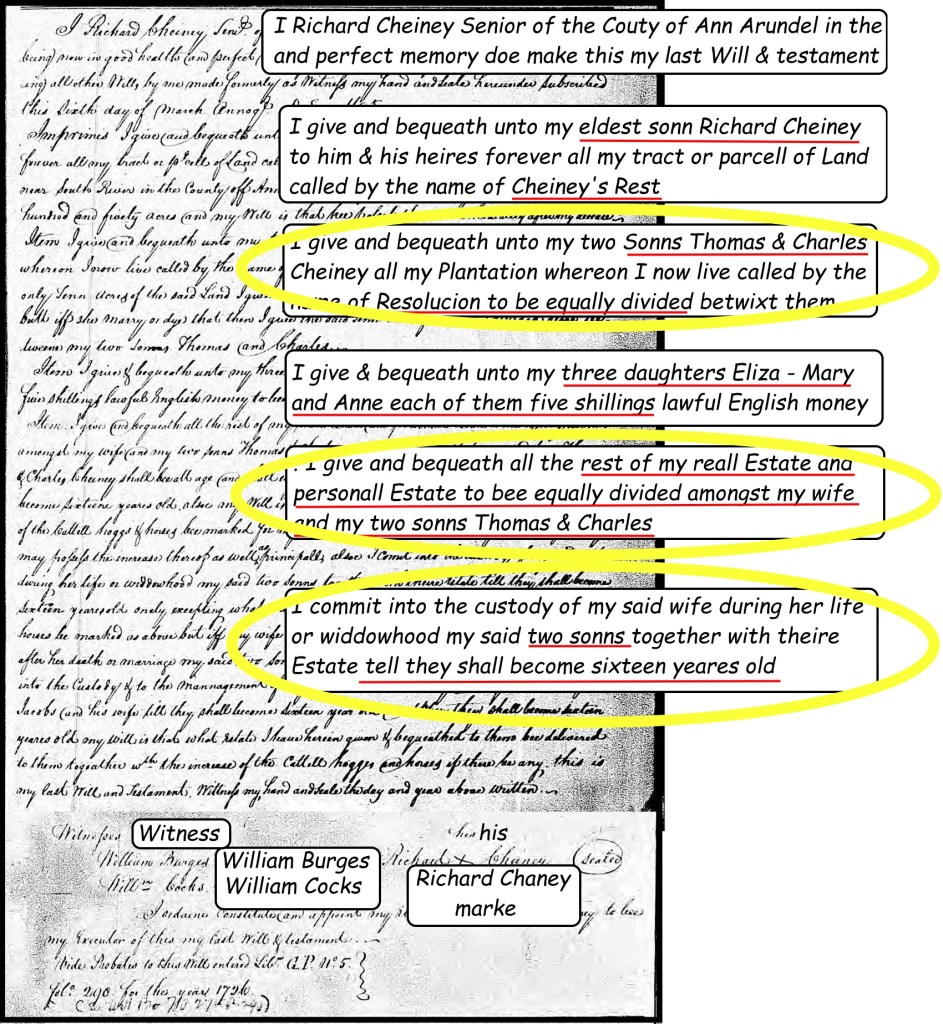
Charles Cheney was age 12 when his father Richard died in 1685.
Richard had already given each of his daughters Elizabeth and Mary 100 acres of Cheney’s Resolution before he died. In his will, he gave his eldest son Richard 250 acres of the patent Cheney’s Rest.
Charles and his sibling Thomas were to inherit when they became age 16, until then subject to their mother and elder sibling Richard as guardians. At age 16, Charles and Thomas would inherit parts of Cheney’s Resolution, about 50 acres each. They would also inherit the remainder of Richard’s estate, his belongings and livestock and finances.
Subdivision
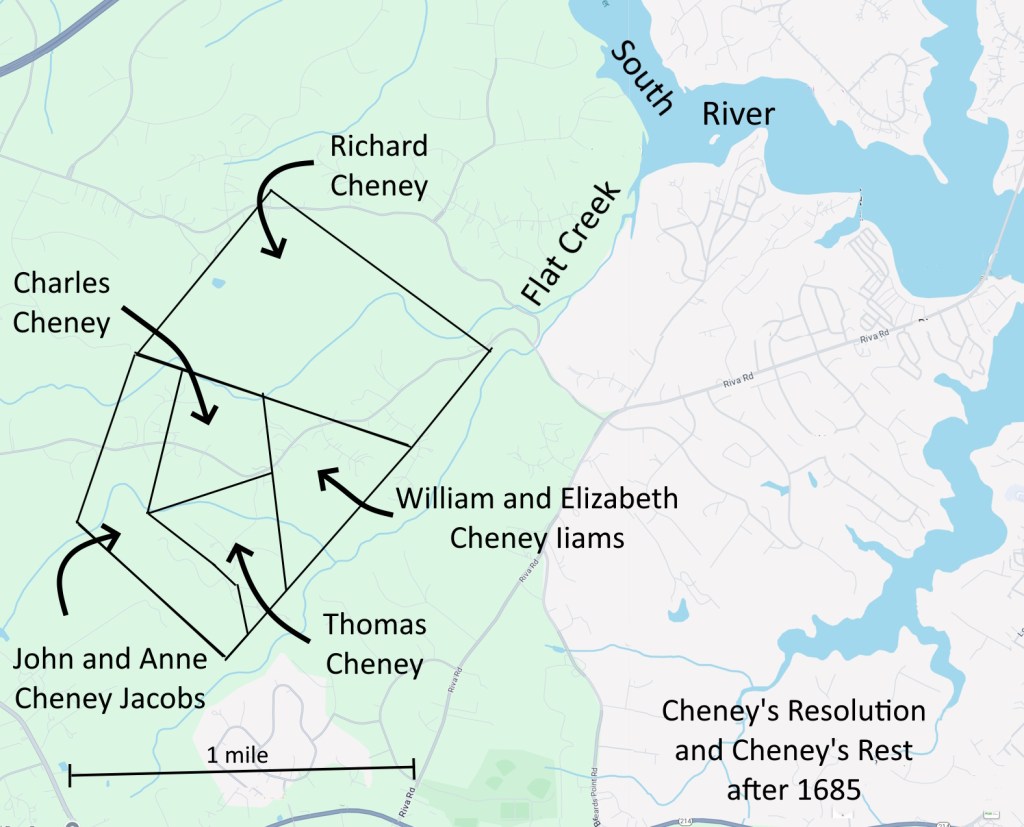
Richard Cheney’s will and earlier gifts to his daughters divided his land holdings. His largest holdings, Cheney’s Resolution and Cheney’s Rest consisted of 700 acres. These two patents were divided among five children.
Inheritance or migration
Richard Cheney’s children were the first generation since the offer of free land in Maryland in 1650. By 1680, almost all the land had been taken. Many of the first generation of children of the original settlers were able to inherit subdivided plots from their parents, but some of the children did not. There was no more land from them to acquire, other than outright purchase. That spurred migration to western Maryland and western Pennsylvania where homestead land was still available.
Anne Jones Pattison
Anne Jones was the daughter of William Jones, a near neighbor of Charles Cheney. She was born around 1676.
Anne married Gilbert Pattison in 1692. They has one son Gilbert, Jr., in 1696. Gilbert Pattison, Sr. died in 1699.

Charles and Anne Cheney
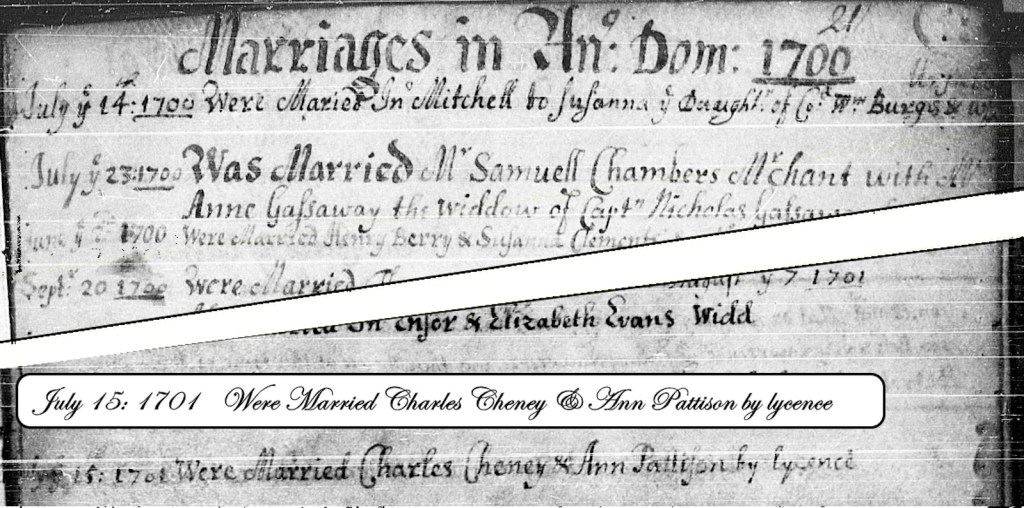
On July 17, 1701, Charles Cheney married Anne Jones Pattison. Charles was age 28, Anne a few years younger. Charles and Anne are our 7th great-grandparents.
Charles and Anne were set
Charles Cheney was fortunate to inherit a plantation, albeit a small one. As he came of age, he acquired more land. By the early 1700s, Charles and Anne held several hundred acres.
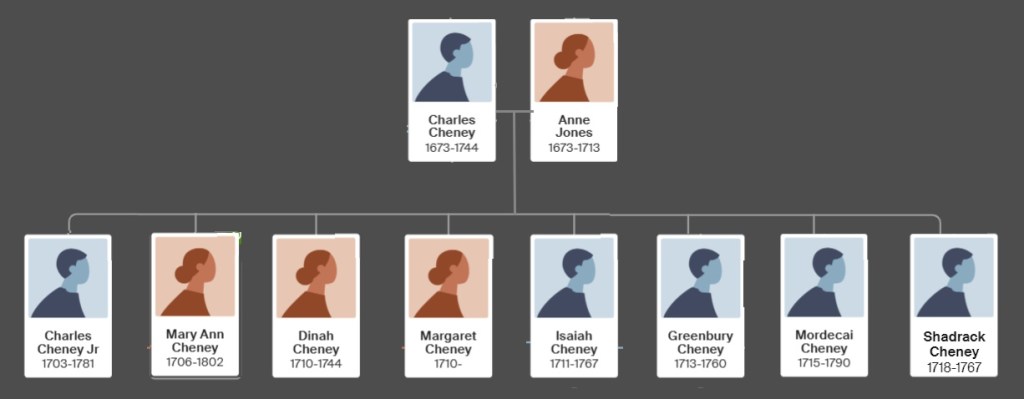
In the ensuing years they had eight children.
Growing Tobacco
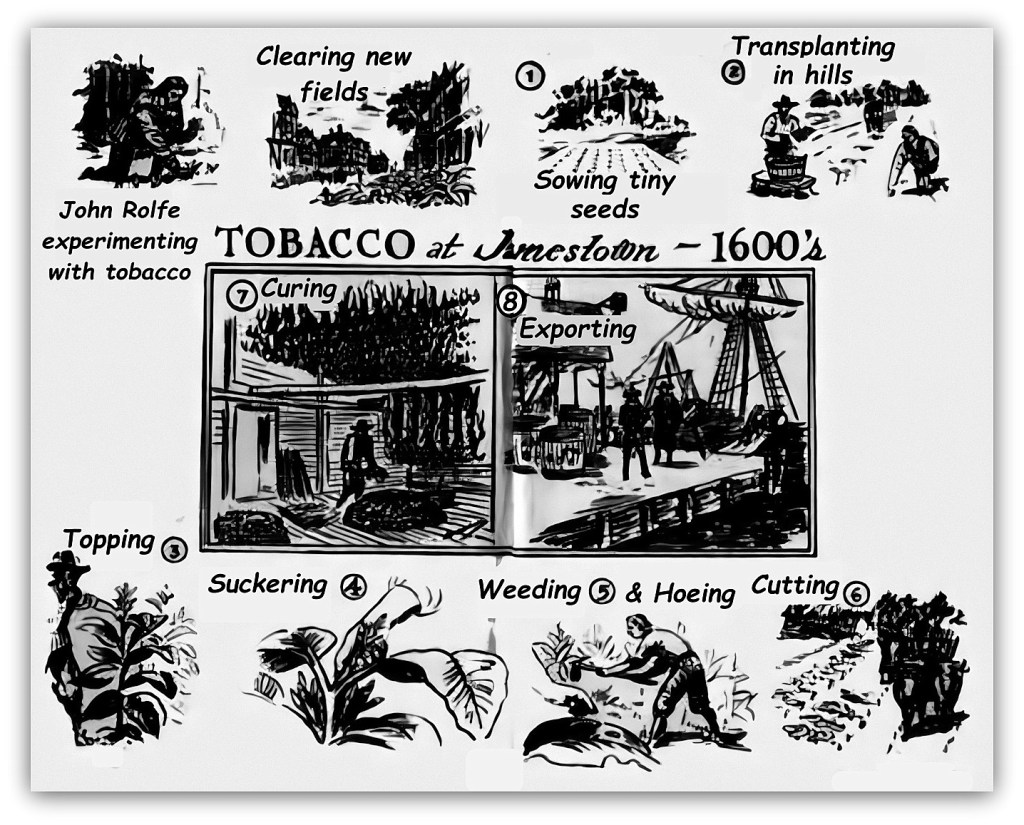
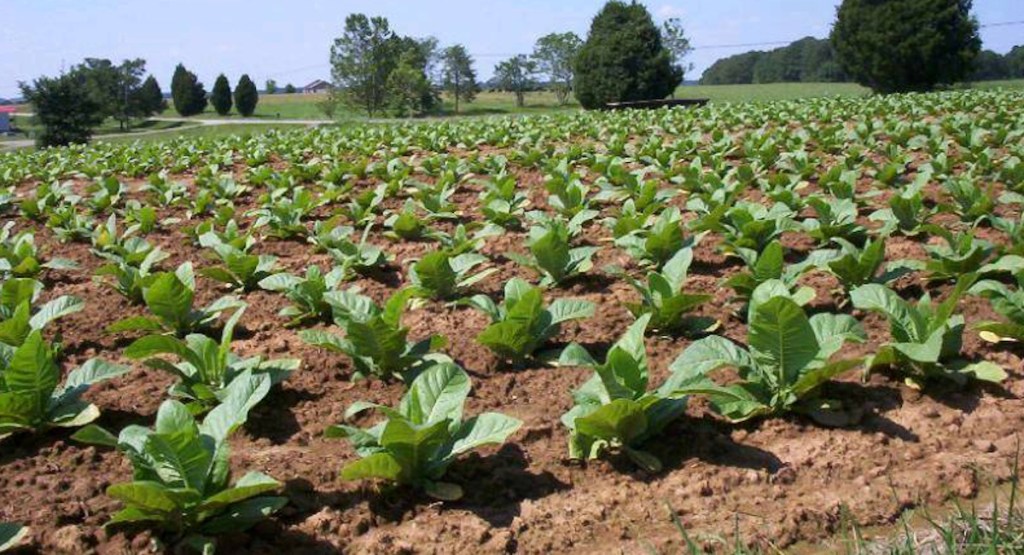
Tobacco farming was incredibly labor-intensive, with the entire colonial economy revolving around its cultivation.
- Clearing a field for the year’s crop
- New fields were cleared, because tobacco depletes the soil.
- After two or three years, the field won’t recover for 20 years.
- Seedbed Preparation
- Tiny tobacco seeds were sown in early March in beds that were raked and then covered with pine boughs to protect the fragile seedlings.
- Transplanting
- After about a month, the seedlings, then about 6 to 8 inches tall, were transplanted to the main field to hills.
- Each hill was home to a single plant.
- Tending the Plants
- Once mature, plants were inspected daily for pests like hornworms and for the removal of small leaves at the base (“priming”) and offshoot stalks (“suckering”).
- The tops of the plants were also cut off to direct more nutrients to the leaves.
- Plants were weeded.
- Tobacco worms and other pests were picked off.
- Harvesting
- When leaves showed a yellow, modeled appearance, it was a sign that they were ready to harvest.
- The entire plant was then cut down and left to wilt for a short time.
- Curing
- The wilted plants were transported to tobacco barns.
- A cut was made along the stalk, and four or five plants were placed on a single tobacco stick.
- The sticks were hung in the rafters of the barn for air-curing, a process that could take several weeks depending on the weather.
- Final Product
- Fully cured tobacco was brownish in color and had the consistency of tanned leather.
- Sorting and Packing
- The cured tobacco was sorted and packed into barrels or hogsheads for export to England.
Labor
While there were some enslaved people who worked the plantations in Maryland from the very beginning, slavery was not widespread until after 1700. Until that time, most of the work on the tobacco plantations was done by indentured servants.
Tobacco Colonies – Wikipedia
While fewer than one thousand Africans arrived in Maryland between 1619 and 1697, nearly 100,000 disembarked during the three quarters of a century prior to the American Revolution. By 1755, about one third of Maryland’s population—in some places as much as one half—was derived from Africa.
A Guide to the History of Slavery in Maryland
By the early 1700s, slavery had ballooned in Maryland. It’s hard to imagine that Charles Cheney didn’t have slaves, but I can’t find the evidence. Sometimes the wills of contemporary Maryland farmers mention servants or slaves, but Charles’ will does not.
His land holdings were small, so maybe he and his wife and children supplied the necessary labor.
There were still many moderate and small-sized farms that had neither servants nor slaves, their owners having diversified into other crops. Tobacco was labor-intensive, difficult to produce without an army of workers. The plant did best in virgin soil, and while it could be grown in previously cultivated areas, size and quality were often diminished. A field that grew tobacco for three consecutive years would need another twenty to recover. This drove planters to clear out forests in search of rich soil. By the mid-18th century, Maryland farmers were running out of land.
Remains of a Bygone Way of Life in Southern Maryland – Tobacco’s Legacy
Trade and Shipping
England controlled the tobacco trade from the colonies. The Orinoco tobacco grown in Maryland was preferred by other European countries, so England was both importer and exporter. When England was at war with France or another European country, Maryland tobacco demand dropped significantly.
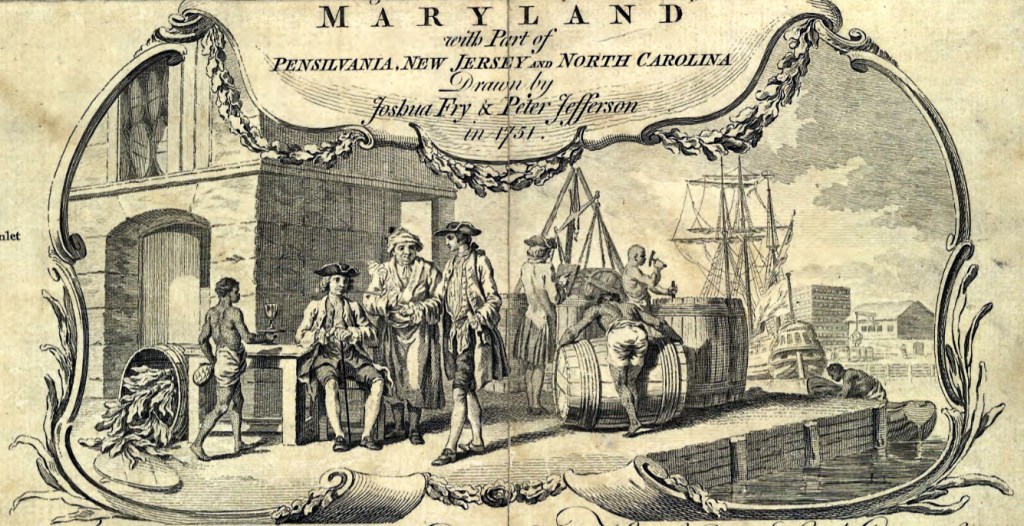
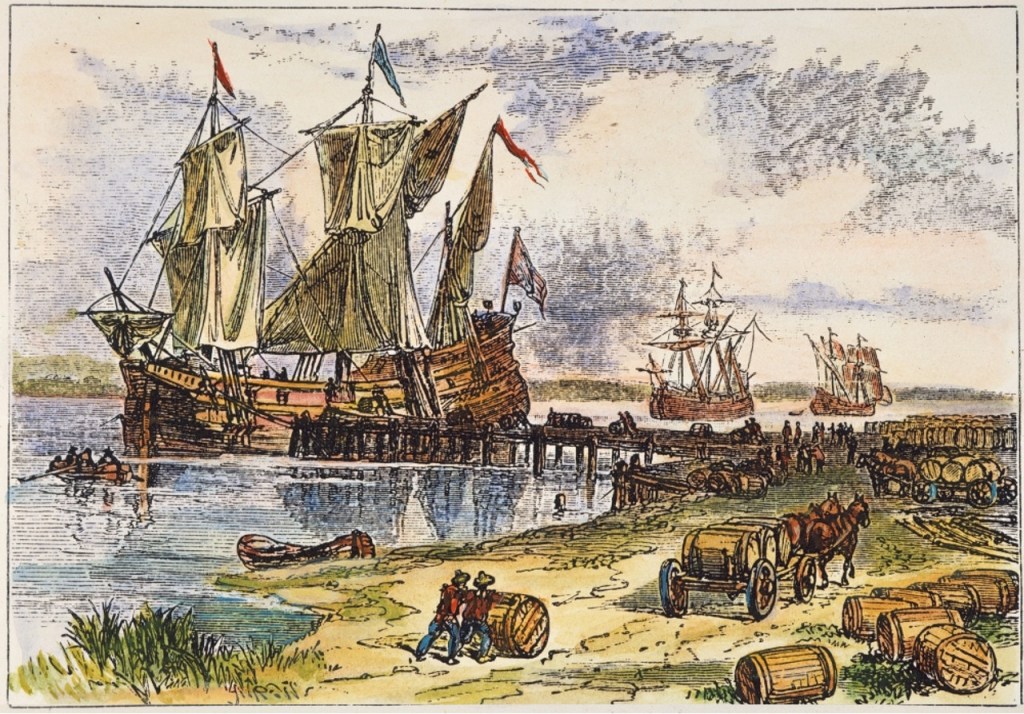
The abundance of tobacco plantations in Maryland resulted in a lack of towns. Due to the geography of the Chesapeake Bay, there was no need for ports and roads. The inlets, creeks, coves, and river mouths allowed for ships to come directly to plantation wharves.
Tobacco Colonies – Wikipedia
These were prime years for the growth of the tobacco trade in Maryland. Charles and Anne Cheney would prosper. But, as always, fate would intervene.
Timeline

Sources:
- Family Tree diagrams – Ancestry.com
- Image – Dried tobacco – World History Encyclopedia – https://www.worldhistory.org/image/13410/dried-tobacco/
- Birth – Charles Cheney’s birth – All Hallows Parish Register – Maryland State Archives – https://msa.maryland.gov/megafile/msa/speccolm/scm200/scm221/000001/000001/pdf/msa_scm221.pdf
- Image – Richard Cheney Will – Maryland, U.S., Wills and Probate Records, 1635-1777 – Wills, Vol 4-10, 1670, 1676-1679, 1682-1700 – page 311 – Ancestry.com – https://www.ancestry.com/imageviewer/collections/9068/images/007737515_00161?pId=461346
- Quote – Labor for cultivating tobacco, and no need for roads or towns – Tobacco Colonies – Wikipedia – https://en.wikipedia.org/wiki/Tobacco_colonies
- Quote – Expansion of Slavery – A Guide to the History of Slavery in Maryland – Maryland State Archives – https://msa.maryland.gov/msa/intromsa/pdf/slavery_pamphlet.pdf
- Quote – Trade in Colonial Anne Arundel county: The Tobacco Port of London Town – Mechelle L. Kerns-Nocerito – Maryland Historical Magazine – 2003 – Volume 98 – Issue No. 3. – https://msa.maryland.gov/megafile/msa/speccol/sc5800/sc5881/000001/000000/000392/pdf/msa_sc_5881_1_392.pdf
- Map collage – Martenet’s map of Anne Arundel County, Maryland : shore lines, soundings, &c. &c. from U.S. surveys – 1860 – Wikimedia Commons – https://www.loc.gov/item/2002624035/
- Death – Gilbert Pattison – 1699 – All Hallows Parish – Maryland State Archives – page 10 – Image 39 – https://msa.maryland.gov/megafile/msa/speccolm/scm200/scm221/000001/000001/pdf/msa_scm221.pdf
- Marriage – Charles Cheney and Anne Pattison – 1701 – Maryland State Archives – page 21 – Image 34 – https://msa.maryland.gov/megafile/msa/speccolm/scm200/scm221/000001/000001/pdf/msa_scm221.pdf
- Image – Tobacco growing stages – Tobacco in Colonial Virginia – G. Melvin Herndon – 2008 – Project Gutenberg – https://www.gutenberg.org/cache/epub/27117/pg27117-images.html
- Image – Artist Sydney King depicts settlers loading hogsheads of tobacco aboard a ship bound for England – National Park Service – https://www.nps.gov/jame/tobacco-and-the-atlantic-world-panel-four-of-the-chesapeake-bay-gateways-network-exhibit.htm
- Image – Map cartouche showing a ship loading tobacco – A map of the most inhabited part of Virginia containing the whole province of Maryland with part of Pensilvania, New Jersey and North Carolina – Library of Congress – https://www.loc.gov/resource/g3880.ct000370/?r=0.709,0.424,0.279,0.234,0
- Quote – Small farmers – Remains of a Bygone Way of Life in Southern Maryland – Tobacco’s Legacy – New Magazine – National Park Service – Spring 2011 – https://www.nps.gov/crps/commonground/Spring2011/fea1.pdf
- Image – Ship loading tobacco in the James River – The Washington Post – March 10, 2022
- Audio – Sonata IV In D Major – Allegro Moderato, Andante, Allegro Moderato – Instrumental Music In Colonial America – Raynor Taylor (Robertson) – https://archive.org/details/lp_instrumental-music-in-colonial-america_raynor-taylor-robertson/disc1/02.01.+Sonata+IV+In+D+Major+-+Allegro+Moderato%2C+Andante%2C+Allegro+Moderato.mp3
 Family Nibbles