By 1870, the Cheney family had established themselves in Christian County, Illinois. Over the previous decade, several of the children had married and started farms of their own, many within a few miles of the original homestead. The family was closely connected—parents, siblings, and in-laws living nearby and working the land.
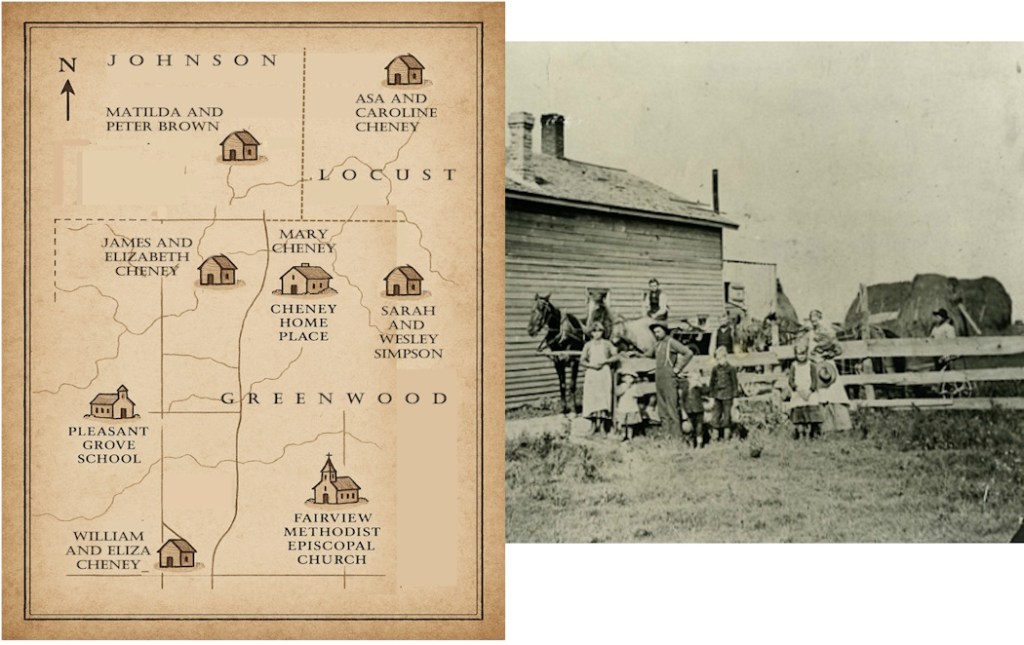
Mary Cheney, now widowed, remained on the home farm with her three youngest children. Her husband, Shadrach, had passed in 1866, but the family continued to grow and settle around her. Life was stable, and the community was familiar.
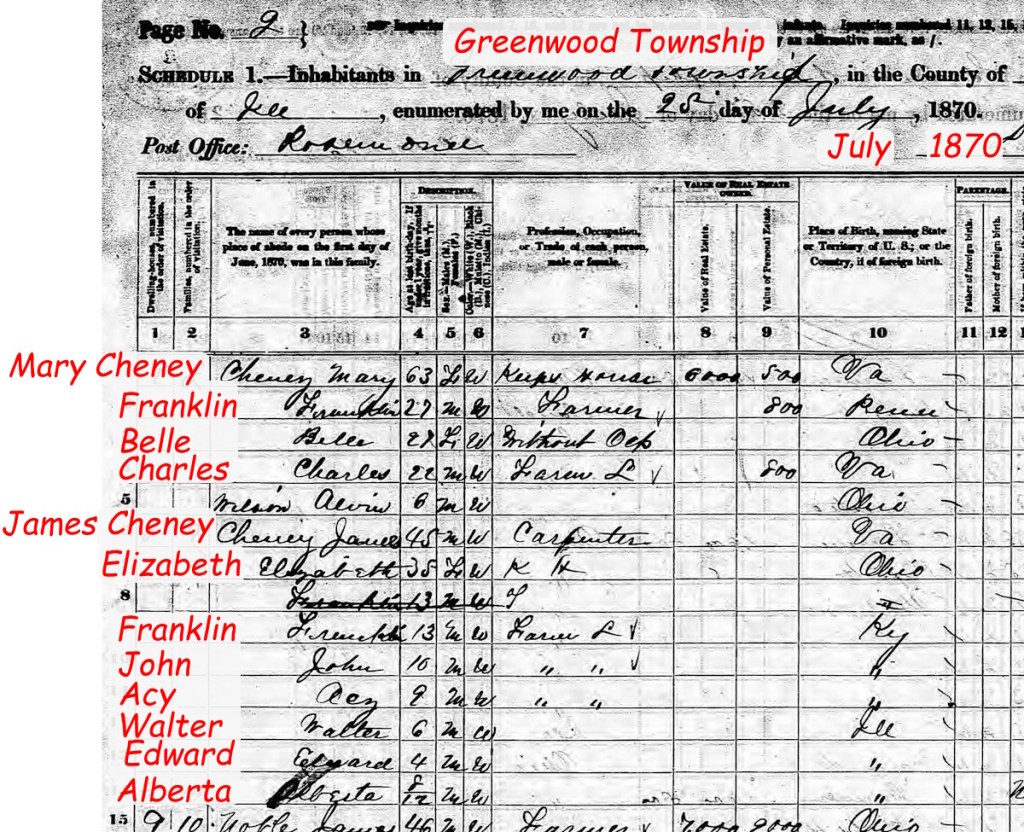
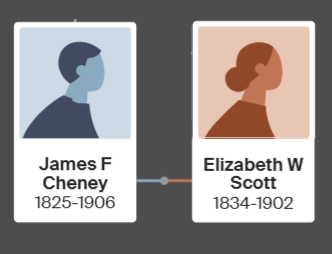
Eldest son James, age 45, lived in the northwest parcel of Mary’s farm. He and his wife Elizabeth had six children.
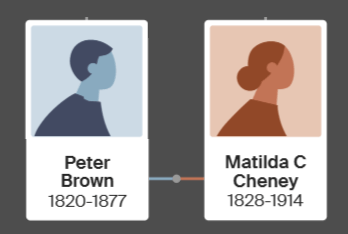
Eldest daughter Matilda, age 42, and her husband Peter Brown had a farm in neighboring Johnson Township. They had five children.
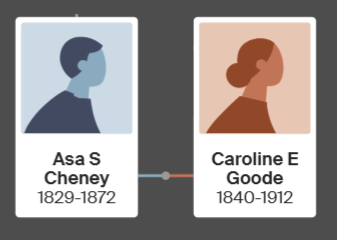
Son Asa, age 40, and his wife Caroline and their three children lived in next door Locust Township.
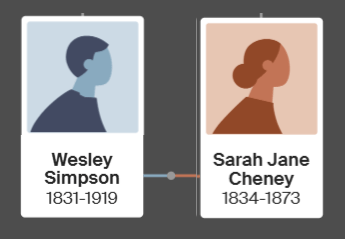
Daughter Sarah, age 36, and husband Wesley and their eight children lived on a farm next door east of the Cheney farm.
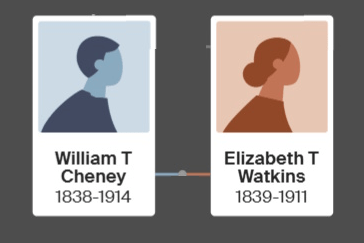
Our grandparents William, age 31, and his wife Eliza, 30, and their two young girls had a farm three miles south of the Cheney home place.
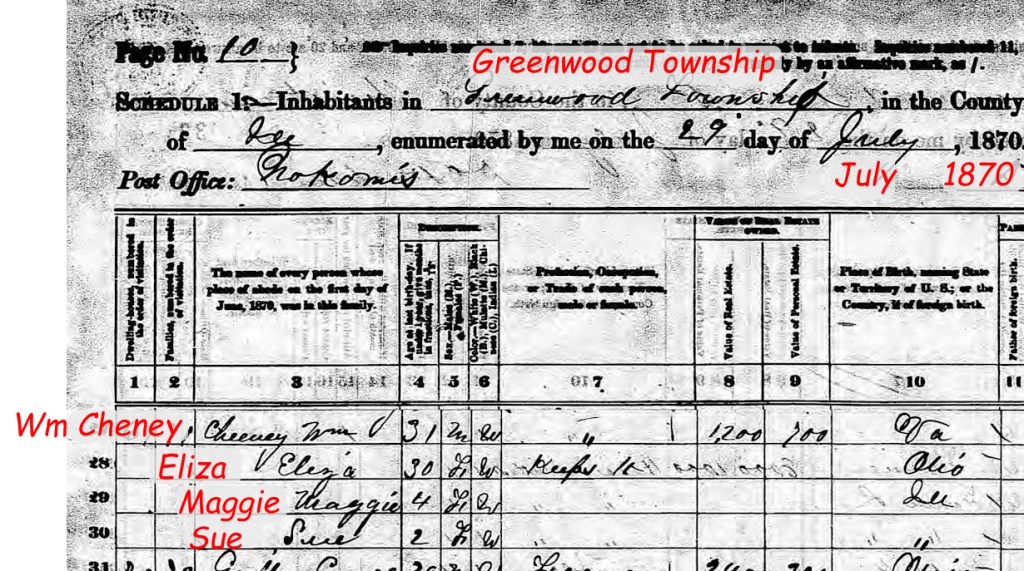
More children for Will and Eliza
Enos Ralph Cheney was born Wednesday, March 1, 1871. He was the third child of William and Eliza Cheney, with older sisters Maggie, 5, and Sue, 3.
Enos was the namesake of Eliza’s brother, Enos L. Watkins, and her uncle, Enos James Watkins.
I can’t find the name Ralph in any known ancestor. Perhaps it was Shadrach’s middle name, as it was common to name a firstborn boy after his paternal grandfather.
Enos is our 2nd great grandfather.
James William Cheney was born Saturday, December 12, 1874. He was the fourth and last child of William and Eliza.
James was the namesake of William’s uncle, James Cheney. And, of course, William was the namesake of William Cheney himself.
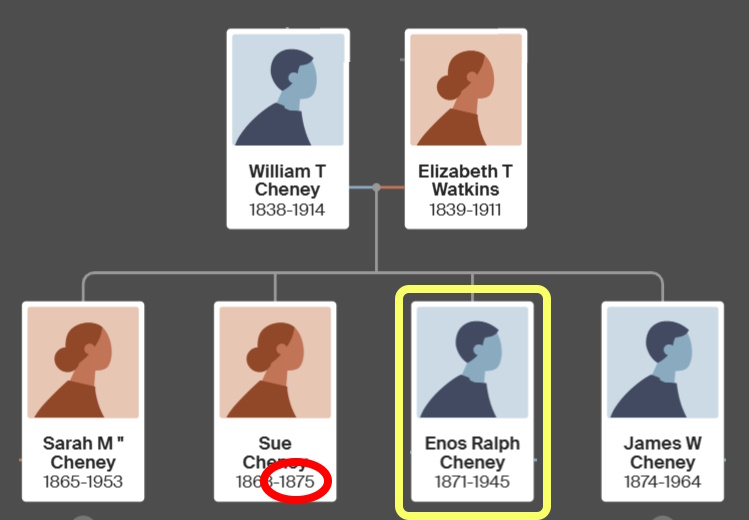
Sadly, Sue Cheney died in 1875 at age 7. We don’t know the cause.
Kansas Fever
William and Eliza Cheney were well settled in Christian County, Illinois. But change was coming. The promise of inexpensive land and new opportunities in Kansas was drawing attention. Families across Illinois were talking about it, and the Cheneys were among those who began to consider a move west.
In 1854 the newly created territory of Kansas was opened for settlement. It was not until after the Civil War, however, that Kansas experienced a significant increase in population. Free and cheap land provided by the Homestead Act and the railroads attracted many settlers.
Settlement in Kansas – Kansas Historical Society
The newly opened land offered beautiful and productive farmland – lots of it. And it was inexpensive.
Kansas Fever spread like wildfire. It seemed like everyone was talking about moving to Kansas.
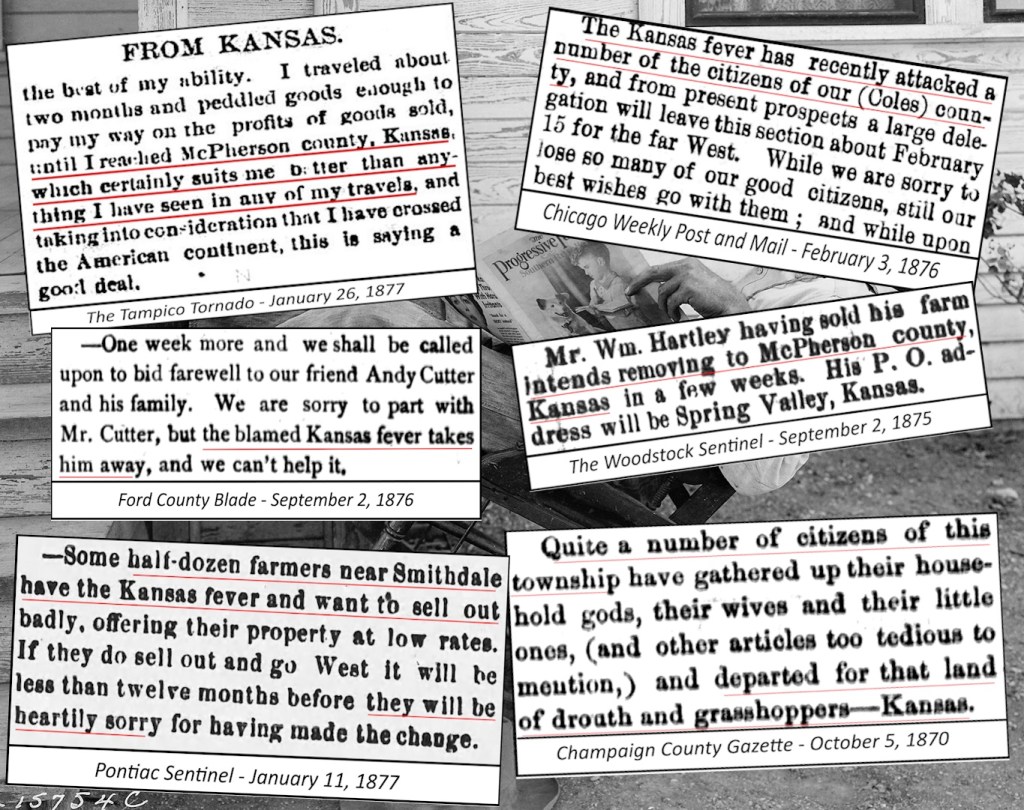
Populations skyrocketed. The state of Kansas grew from a population of just under 365,000 to nearly a million people during the 1870s.
Farmers’ Alliance – Wikipedia
We’ve written about Kansas Fever in earlier stories. Our Maninger grandparents joined a group of families who moved from central Illinois to Harper County. Our Buhrer grandparents came to Kansas from northern Ohio, settling in Pawnee County. John Webb came from Virginia to Solomon County and then to Pawnee County.
Now William and Eliza Cheney were going to move to McPherson County, Kansas.
A plan to move
The Cheneys were settled. Why would William and Eliza Cheney want to move to Kansas? Why would some of their siblings and in-laws want to join them?
Eliza Cheney’s parents John and Anna Watkins were moving. So were her siblings William, Sarah, John and Lee and their families.
At least ten families had decided to move, Will and Eliza Cheney included. Their destination was McPherson County, Kansas.
There were over thirty people in these families. And there were probably other families that we don’t know about.
So why did the families decide to move? And why to McPherson County. It was partly Kansas Fever, but it also had to do with the Simpson family.
The Simpson family
Alexander and Eliza Simpson were neighbors to the Cheneys. Two of the Simpson boys had married two of the Cheney daughters.
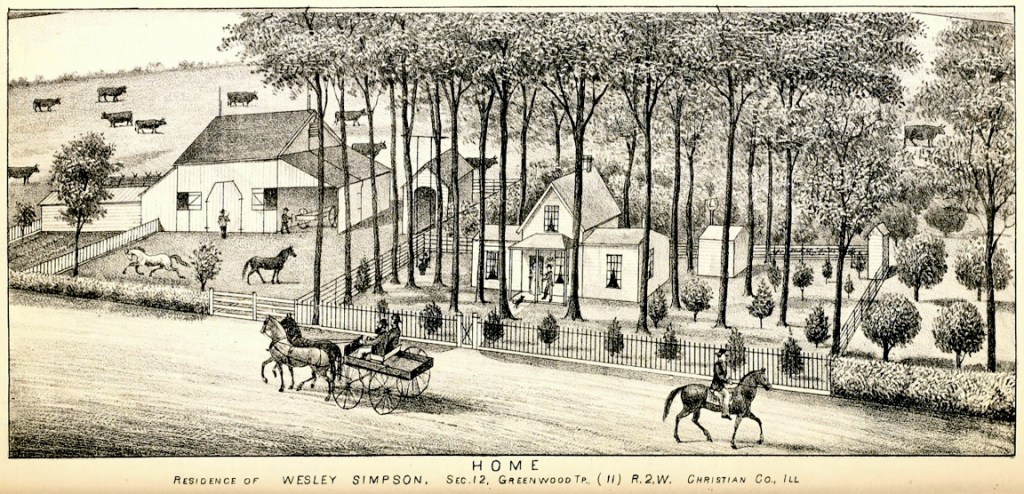
Sarah Cheney had married Wesley Simpson. In an earlier story, we saw a drawing of the Simpson farm, which adjoined the Cheney home place on the east.
Thomas E. Simpson, the eldest sibling, had gone to Kansas in the early 1870s. He had journeyed to the present site of McPherson with others in 1872 to help lay out the town. He was influential in making the town the county seat, and in 1879 helped bring the Santa Fe Railroad to McPherson.
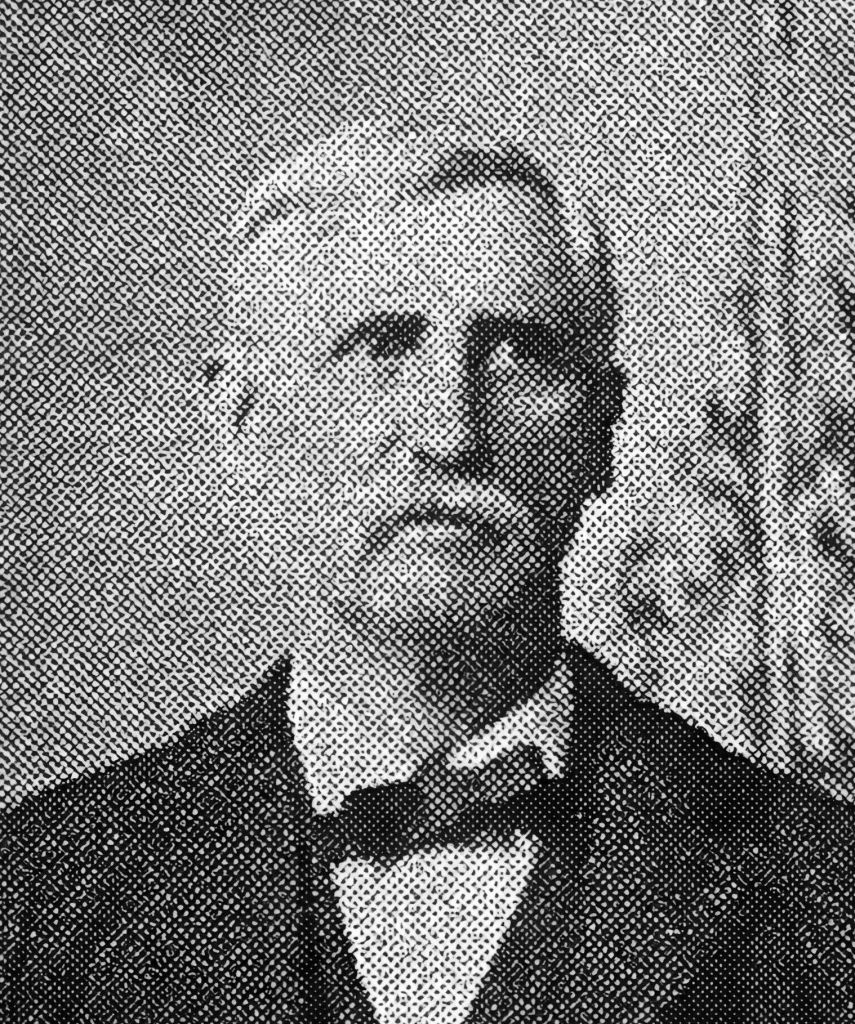
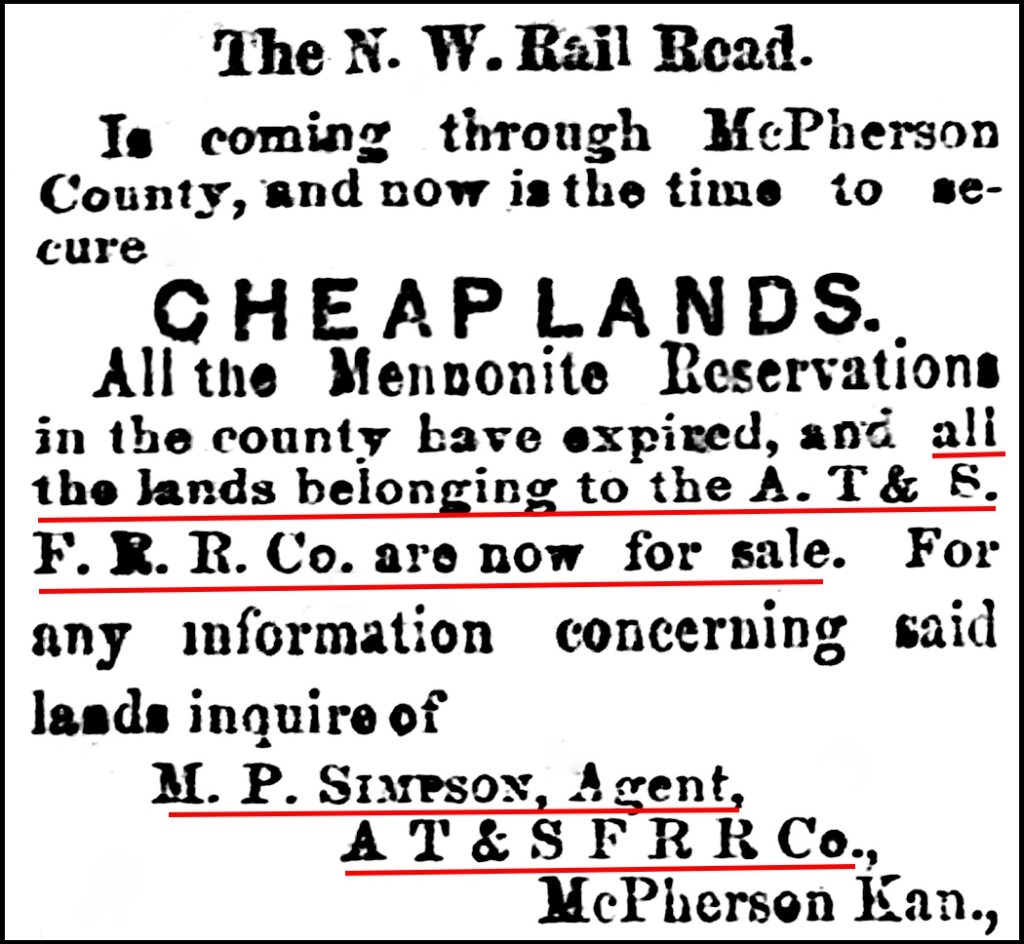
Margaret Belle Cheney had married Matthew Simpson. Matthew had gone to law school after farming a while, and was a lawyer. Matthew and Belle Simpson moved to McPherson in the mid 1870s. He was a prominent attorney there and the Santa Fe agent that sold railroad lots in the county. He later became a judge.
Another sibling, Rev. John A. Simpson, had come to McPherson and organized the Methodist Episcopal Church in 1874.
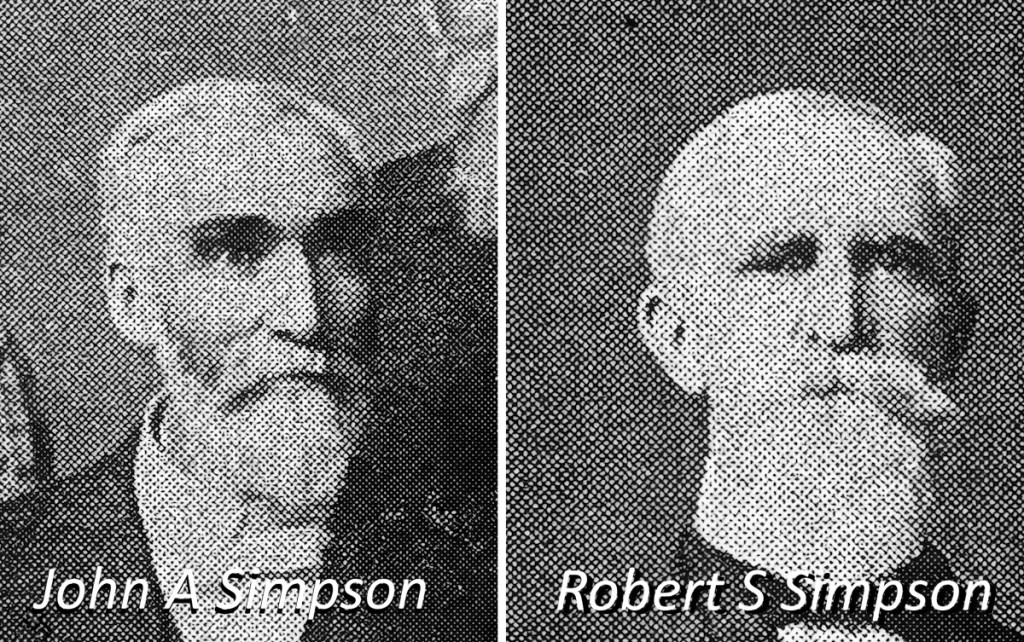
Robert S. Simpson was a physician in McPherson for many years, and James M. Simpson was active in local politics.
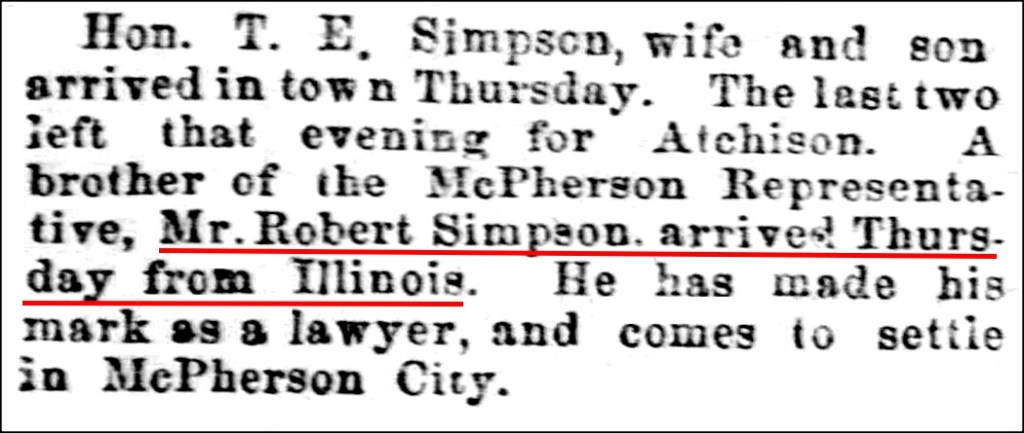
It seems that the “advance” party of Simpsons to McPherson County extended the invitation for friends and family in Illinois to join them.
With Thomas Simpson helping found McPherson and Matthew selling railroad land, there were guiding hands for the new residents.
In the fall of 1876, William Cheney made an exploratory trip to McPherson County. His brother-in-law Matthew Simpson drove William all over the county scouting land.
On William’s return to Illinois, he acquired the McPherson County homestead claim of Jack Taylor.
Father came home and went to see a man by the name of Jack Taylor that had homesteaded the north half of the northwest quarter of Section 15 in Groveland Township. He had starved out and came back home. Father traded a large red and white cow for his relinquished homestead.
Sarah “Maggie” Cheney Poulson, daughter of William and Eliza Cheney
Sold the farm
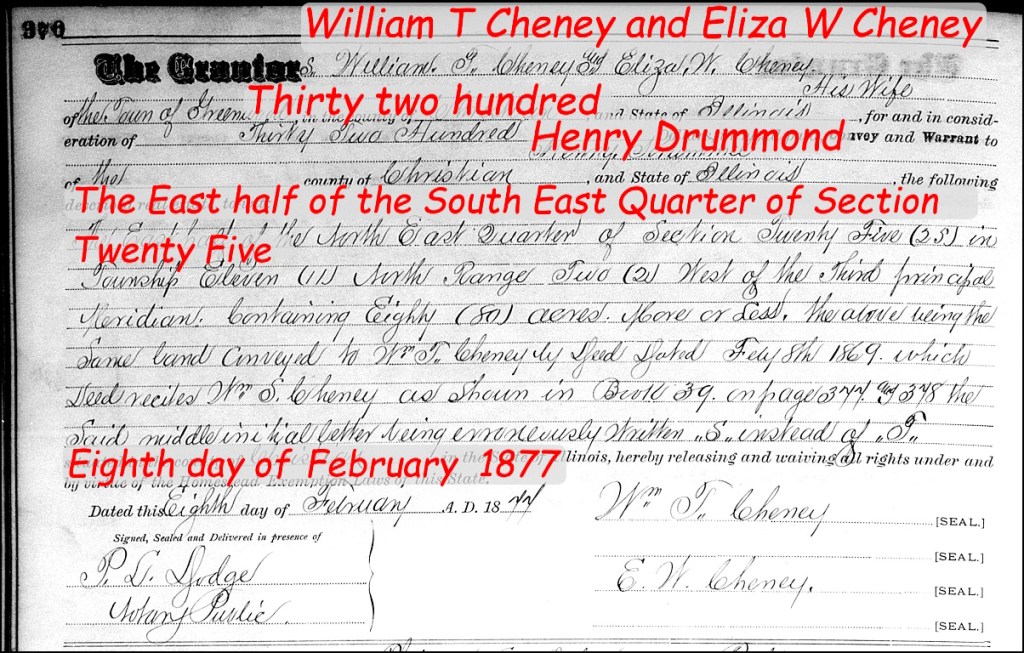
In December 1877, William and Eliza Cheney sold their Greenwood Township farm to Henry Drummond. The sale price was $3,200, a nice increase over the $1,200 they had paid in 1864.
To Kansas
The group arranged railroad transportation for themselves, their furniture and tools and machinery, and their livestock.
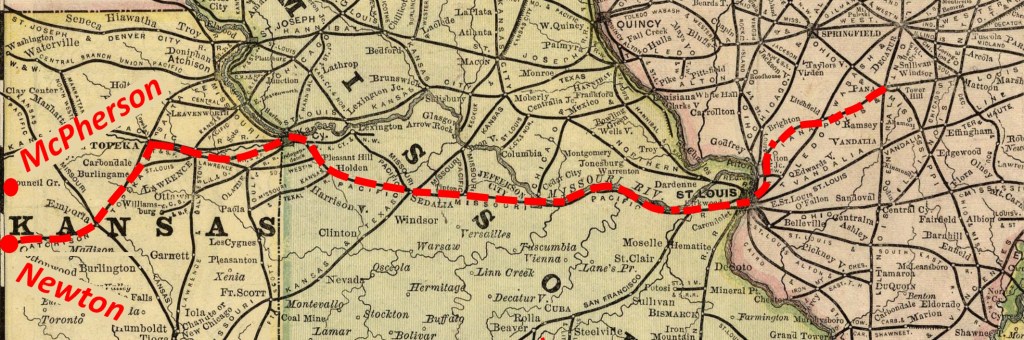
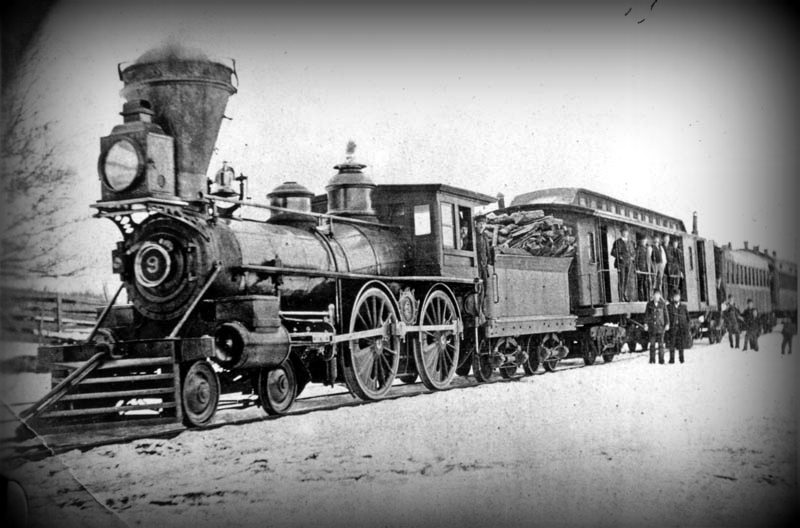
From Nokomis, they took the Indianapolis & St. Louis Railroad, interlined with the Missouri Pacific in St. Louis, transferred to the Atchison, Topeka, and Santa Fe in Kansas City, and disembarked in Newton, Kansas. From Newton, they traveled by wagon to McPherson County, a distance of about 35 miles.
So March 7, 1877, we started from Nokomis, Illinois in the mud, a foot deep, we landed in Newton, Kansas March 9th and were met and drove out to a friends by B.F. Simpson who had a span of Indian Ponies the first we had ever seen.
The 10 mothers and we children started in the stage driven by Smith to McPherson, we stopped at a sod house for dinner. We were taken to Tom E. Simpsons for the night. We came up to M.P. Simpsons to dinner the next day. This was on a Sunday. Monday Father and a man we called Uncle Billie Brown came with our things.
Sarah “Maggie” Cheney Poulson, daughter of William and Eliza Cheney
McPherson County
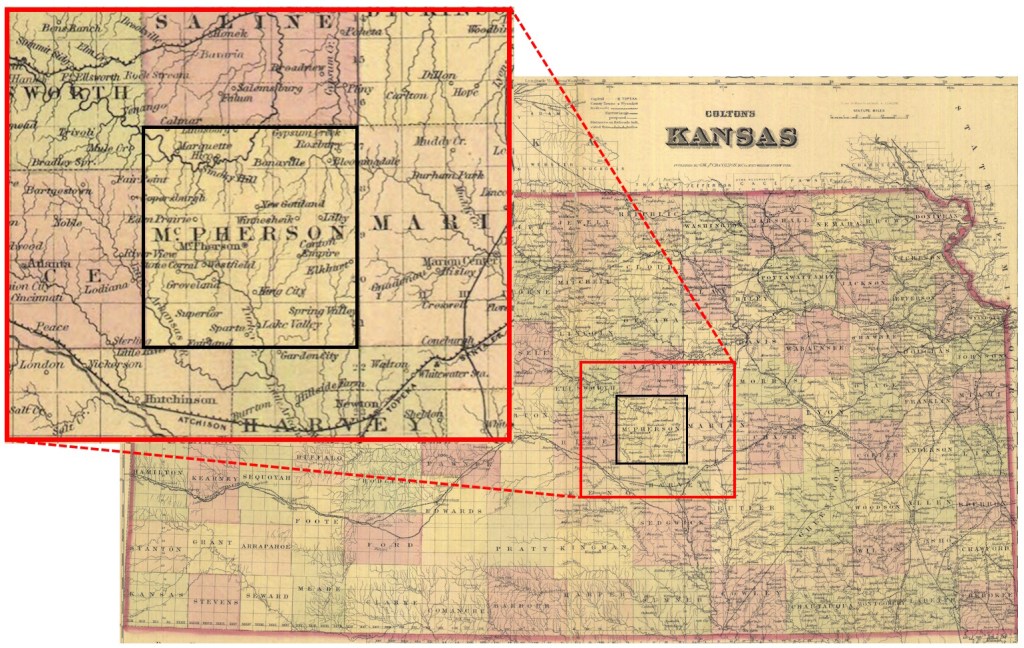
McPherson County had been organized in 1870, with a population of 738 residents spread throughout its 900 square miles. The town of McPherson, the county seat, was surveyed in 1872.
In 1877, William and Eliza Cheney sold their farm and joined a group of relatives and neighbors heading to McPherson County, Kansas. The decision was influenced by the availability of land, the expansion of the railroads, and the presence of family members who had already settled there.
The county’s population grew quickly. By 1880, the population was over 15,000.
The move to Kansas marked the beginning of a new chapter—one that would shape the next generation of the Cheney family in Kansas.
Timeline
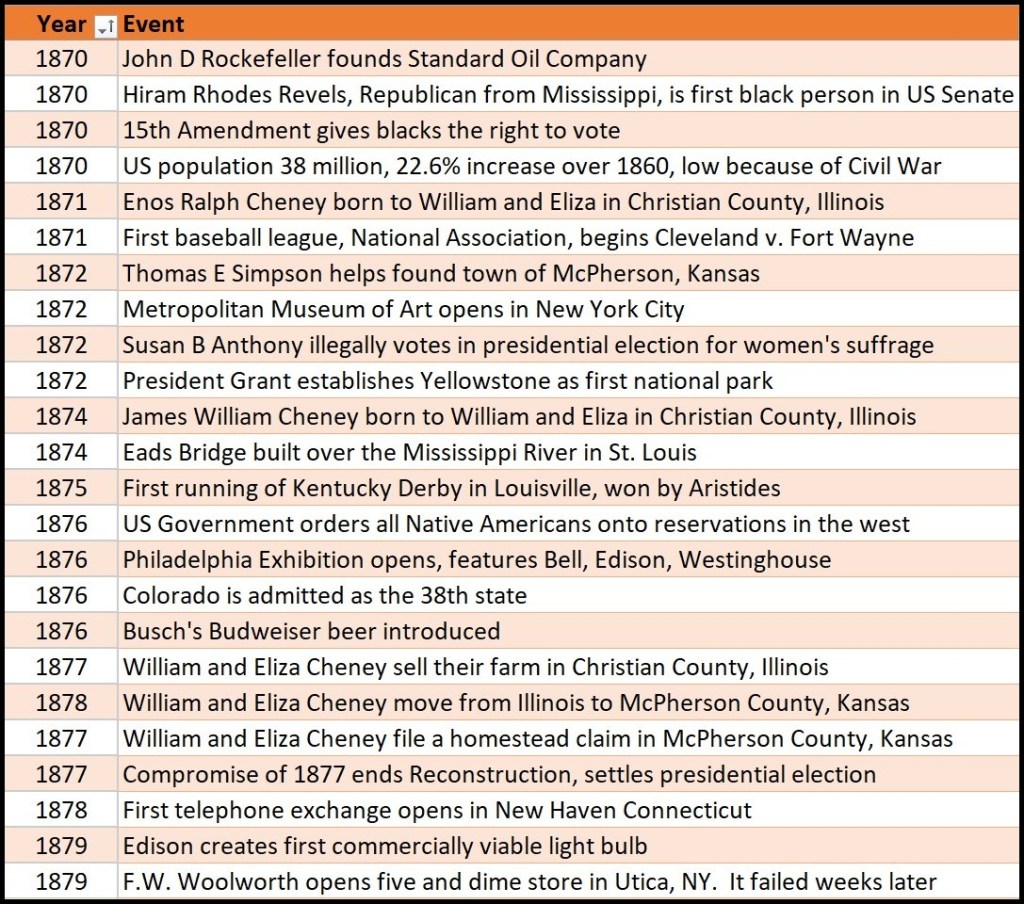
Sources:
- Family trees – Ancestry.com
- Image – Smith farm – Ogden and Springfield – 1884 – Chicago Public Library – Lawndale-Crawford Community Collection – Image 1394 – https://www.chipublib.org/blogs/post/chicagos-farming-history/
- Census – Mary Cheney -1870 – Ancestry.com – https://www.ancestry.com/imageviewer/collections/7163/images/4263656_00060?pId=16992751
- Census – William and Eliza Cheney – 1870 – Ancestry.com – https://www.ancestry.com/imageviewer/collections/7163/images/4263656_00068?pId=16993447
- Deed – William and Eliza Cheney to Henry Drummond – 1877 –https://www.familysearch.org/ark:/61903/3:1:3Q9M-C3QC-LS82-S?view=fullText&keywords=Cheney&lang=en&groupId=
- Map – Railroad Map – Rand McNally Official Railway Guide Map – 1877 – David Rumsey Map Collection – https://www.davidrumsey.com/luna/servlet/detail/RUMSEY~8~1~222332~5505353:Rand-McNally-Official-Railway-Guide?sort=pub_list_no_initialsort%2Cpub_list_no_initialsort%2Cpub_list_no_initialsort%2Cpub_date&mi=0&trs=3&qvq=w4s:/what%2FSeparate%2BMap%2FRailroad%2Fwhen%2F1877;sort:pub_list_no_initialsort%2Cpub_list_no_initialsort%2Cpub_list_no_initialsort%2Cpub_date;lc:RUMSEY~8~1
- History Written by Sarah Cheney Poulson – transcribed by Jan Perdue DeWeese – DeWeese Cheney documents
- Map – Kansas – 1878 – G. W. and C. B. Colton – Wichita State University Libraries – https://cdm15942.contentdm.oclc.org/digital/collection/p15942coll19/id/320/rec/186
- Audio – Barnyard Surprise – The Whole Other – YouTube Free Music Archive – https://www.youtube.com/watch?v=p8MzNuUvOo4
 Family Nibbles