In 1877, William Cheney traded a cow for Jack Taylor’s homestead claim for 160 acres of government land in McPherson County, Kansas. That homestead claim gave William the right to occupy the property, and an additional five years to improve it.
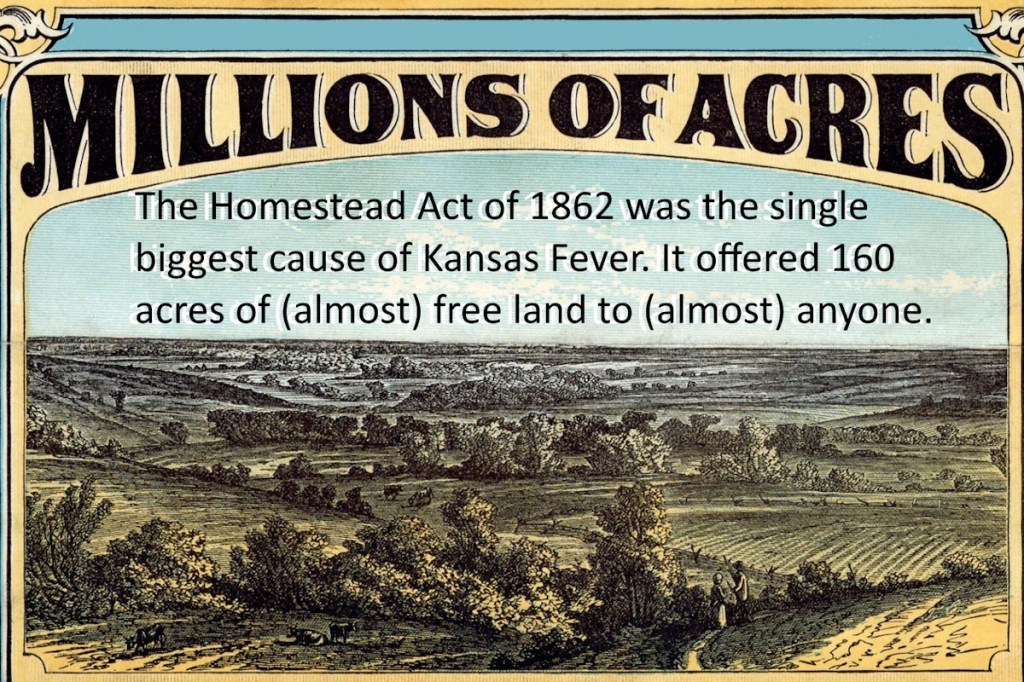
Homestead Act of 1862
The act granted 160 acres of unappropriated public lands to anyone who paid a small filing fee and agreed to work on the land and improve it, including by building a residence, over a five-year period.
The only personal requirement was that the homesteader be either the head of a family or 21 years of age; thus, U.S. citizens, freed slaves, new immigrants intending to become naturalized, single women, and people of all races were eligible.
The potential for free land attracted hundreds of thousands of settlers to move to Kansas, Nebraska, the Indian Territory (present-day Oklahoma), Dakota Territory, and elsewhere in the West.
Homestead Act of 1862 – Britannica
Proving the homestead
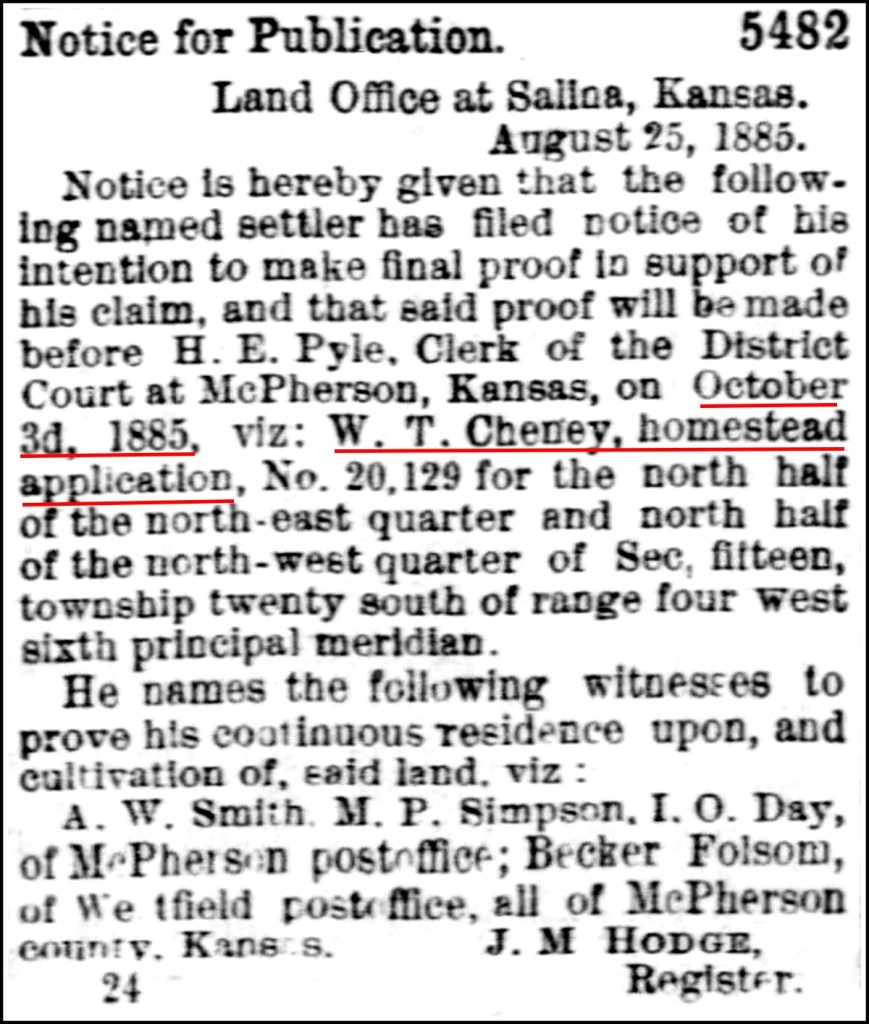
After filing a claim, the homesteader did not yet own the land. Instead, the homesteader had to live on the land for five years, build a dwelling house, and farm the land. If that were successfully completed, the homesteader could file an affidavit of proof, including confirmation from two credible neighbors or witnesses. There was an $8 fee for filing the proof.
William Cheney filed his proof on October 3, 1885, seven years after making his homestead claim.
A land patent
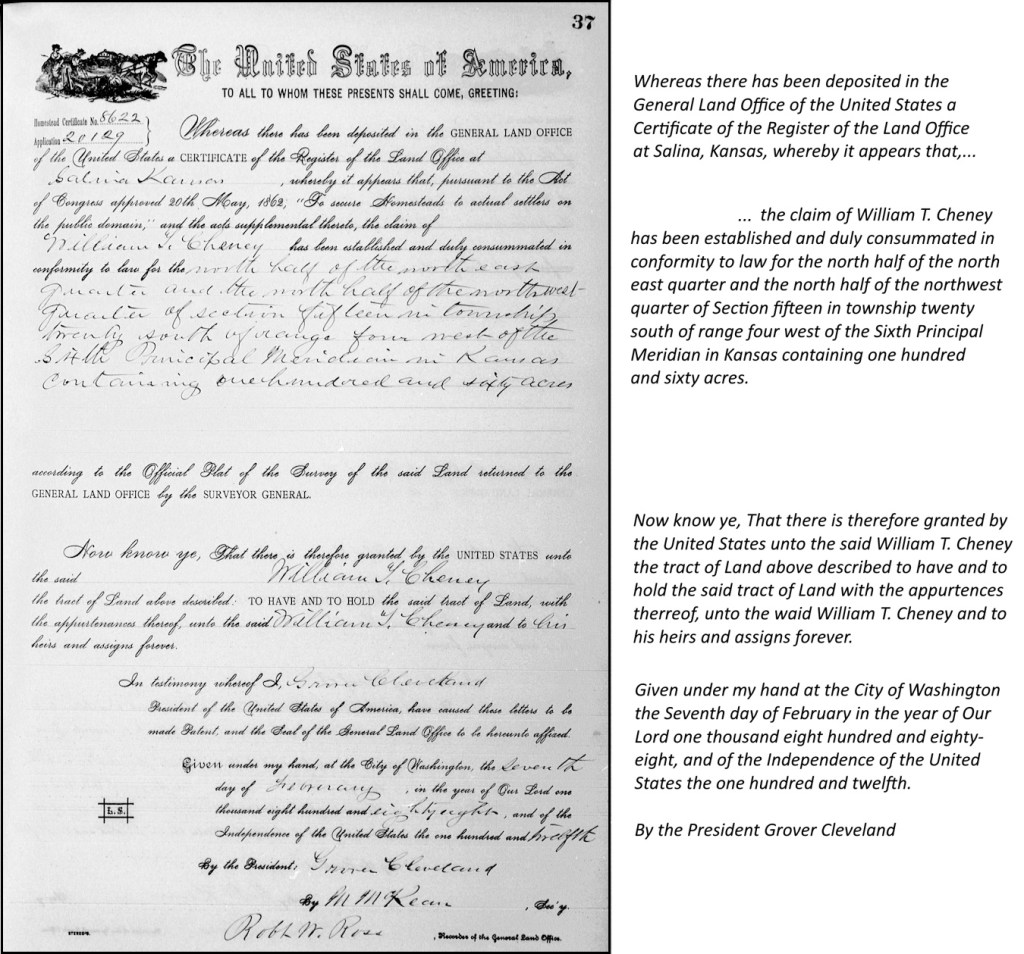
After proofing their claim, the homesteader would receive a patent, the deed of ownership. About 40% of homesteaders completed the process and received patents.
William Cheney received a patent for his land on February 7, 1888.
Homestead Act legacy
The Homestead Act of 1862 was a revolutionary concept for distributing public land in American history. This law turned over vast amounts of the public domain to private citizens. 270 million acres, or 10% of the area of the United States was claimed and settled under this act.
About the Homestead Act – National Park Service
Cheney homestead
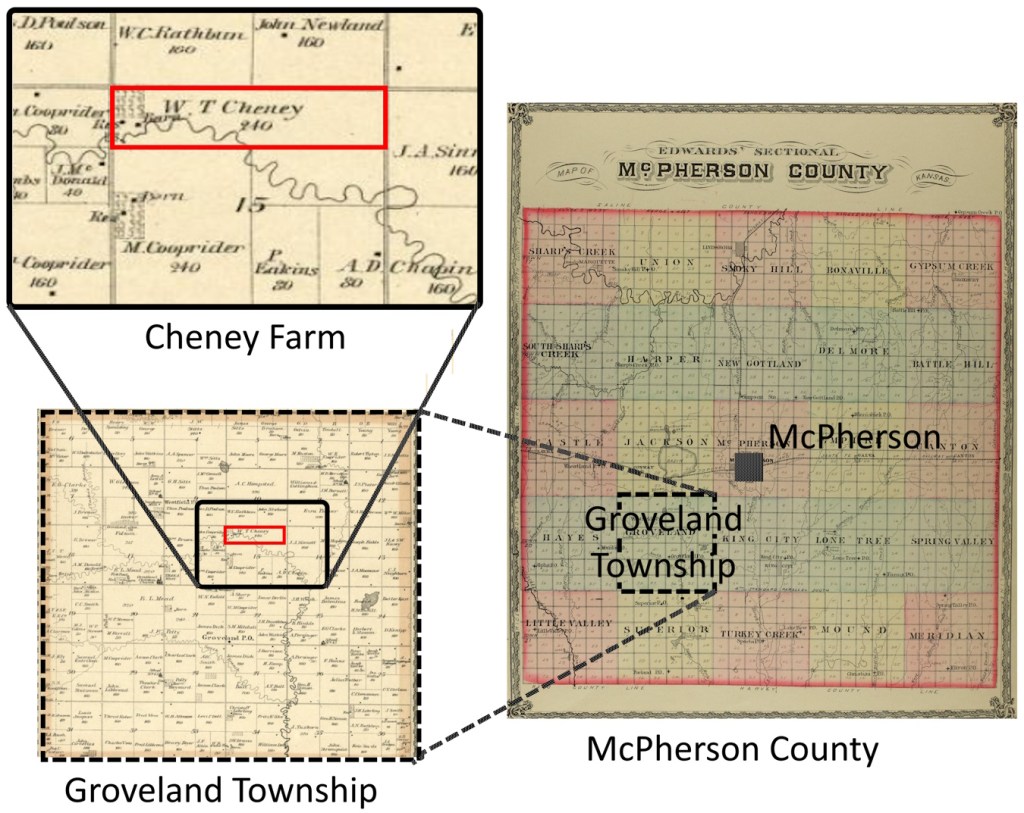
William and Eliza Cheney’s land patent was for the north half of the northeast quarter and the north half of the northwest quarter of Section 15 in Groveland Township, about eight miles southwest of the city of McPherson.
Cheney house
On arrival in McPherson, the families temporarily moved into a house in McPherson.
We lived there a month until Uncle Billie Brown who was a carpenter built our house which was 14′ x 16′ story and half.
We had a well with good water and we thought we were rich. We made a garden and father planted corn and had a good crop, and hauled some to Burrton for 12 cents and garden and melons.
History Written by Sarah Cheney Poulson, daughter of William and Eliza Cheney
It got crowded
When more neighbors moved to McPherson from Illinois, they stayed with Cheneys until their housing was ready.
The fall of 1879 mother’s two brothers drove from Illinois and Grandfather Watkins came on the train and bought land. There was 10 of us in two rooms 14′ x 16′. We had three beds upstairs and one down and the floor was full of youngsters but just as happy as if we were out camping.
History Written by Sarah Cheney Poulson, daughter of William and Eliza Cheney
The farm
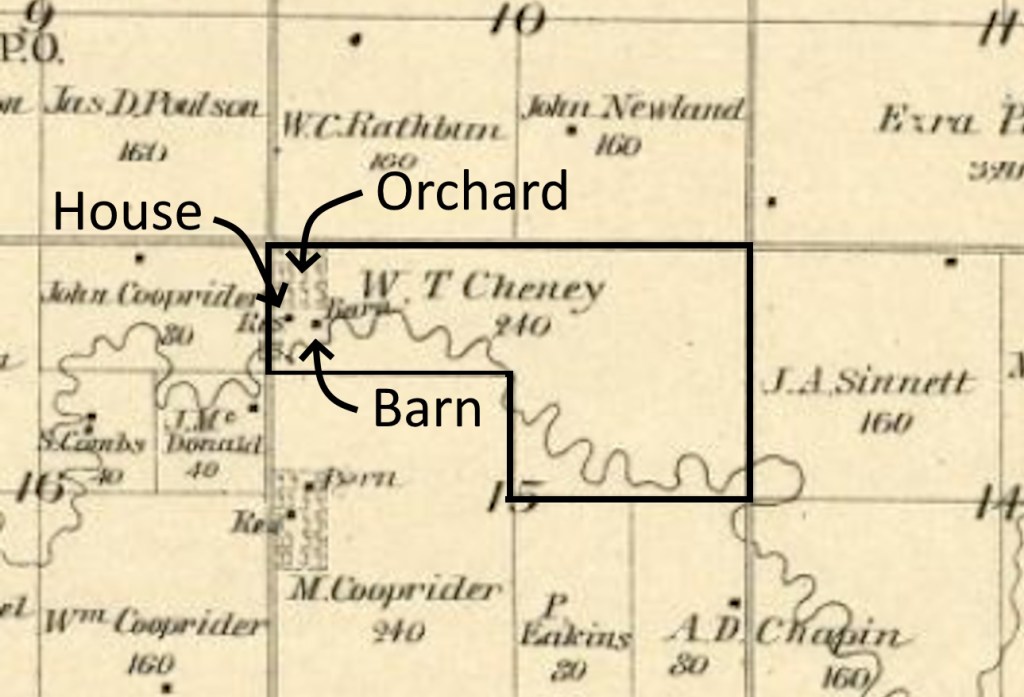
By the time of this 1884 map, the Cheneys had added another 80 acres for a total of 240 acres. The map shows the location of the house and barn and a large orchard on the west side of the property.
Here are Google Street Views of the Cheney farm today.
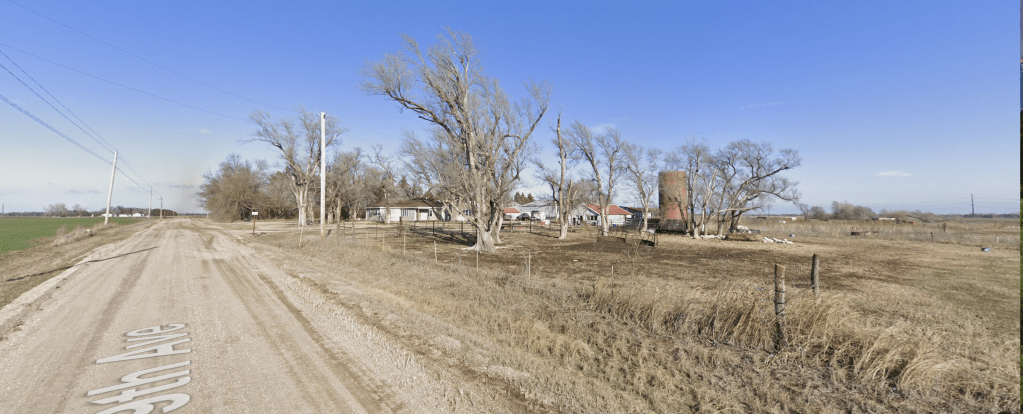
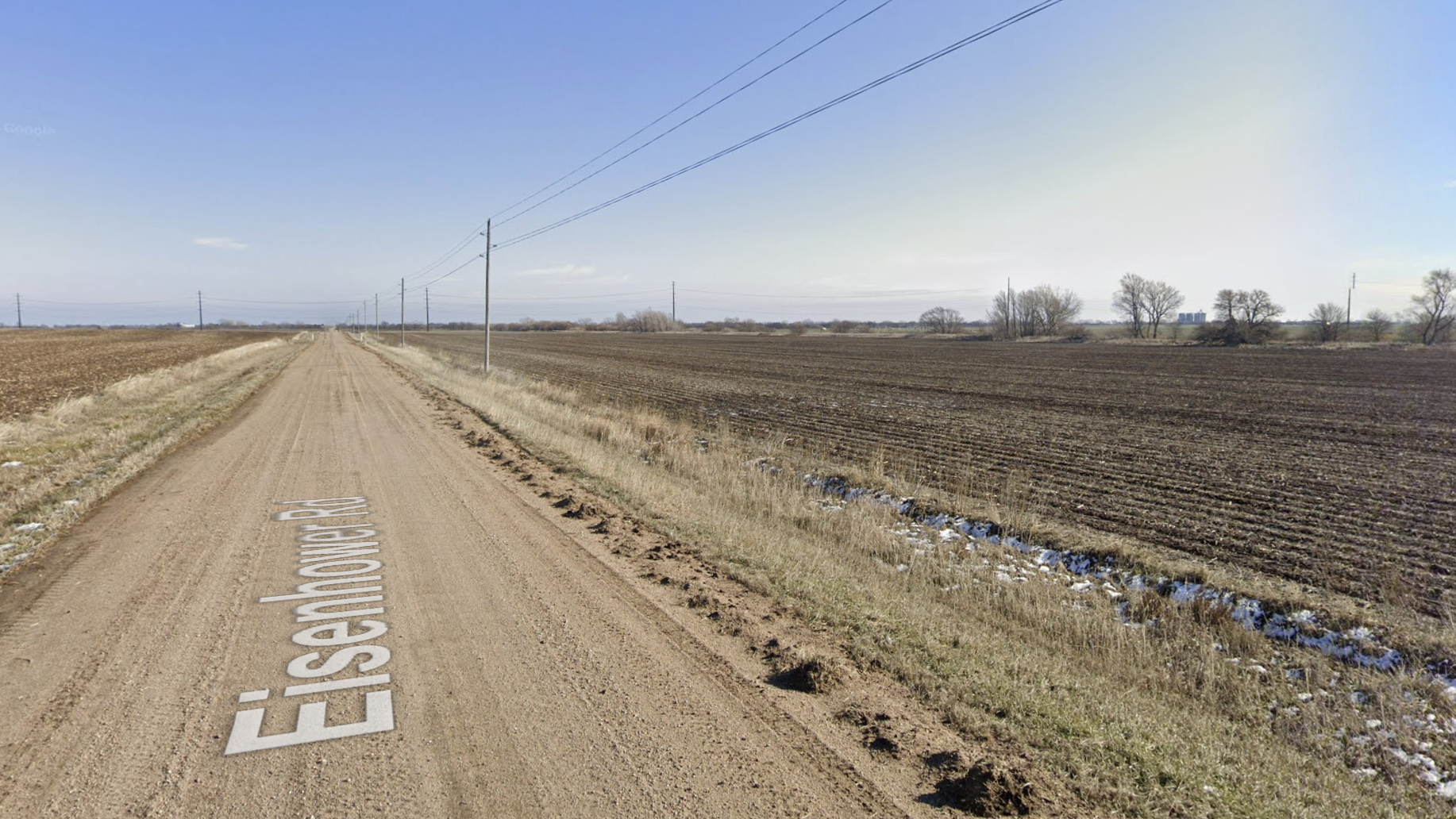
The only tree we could see was one three miles north.
History Written by Sarah Cheney Poulson, daughter of William and Eliza Cheney
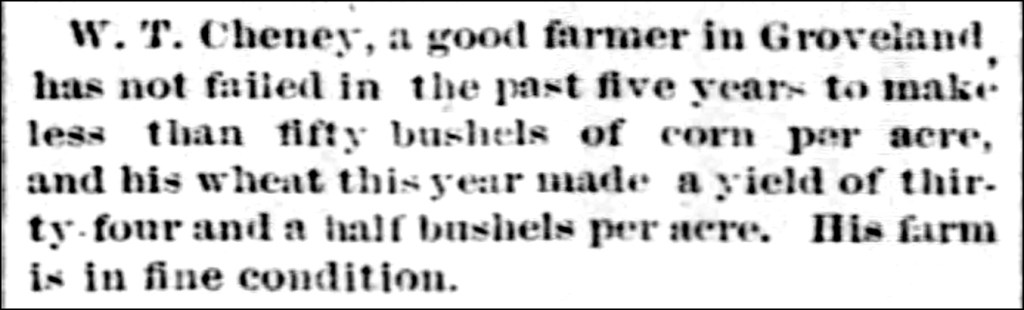
These views might look desolate, but the farms were among the best wheat producing in the area. In 1883, William Cheney produced 50 bushels of corn per acre, and wheat crop in 1883 yielded thirty-four bushels, a bountiful harvest.
Farm stats
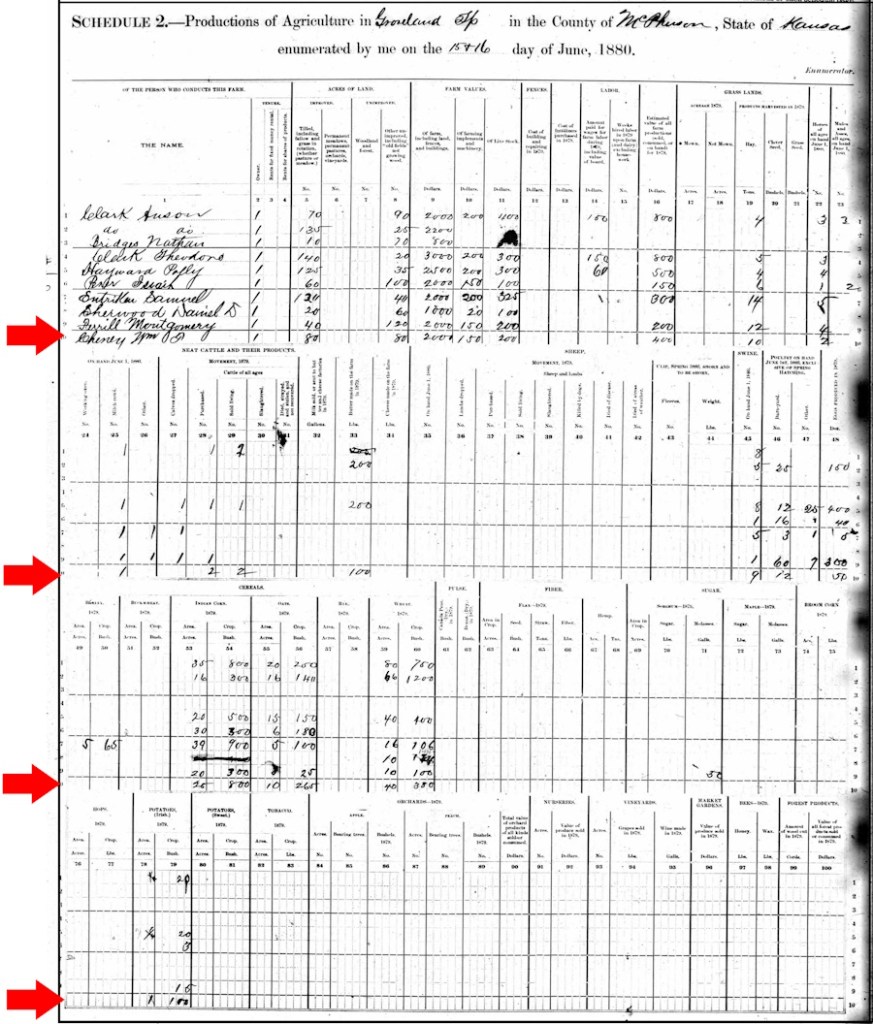
The 1880 Agriculture Production Census provided more information about the Cheney farm. Here are some statistics for the year:
- 80 improved acres, 80 unimproved acres
- 25 acres of corn, 800 bushels
- 10 acres of oats, 265 bushels
- 40 acres of wheat, 380 bushels
- 1 acre of potatoes, 100 bushels
- 50 gallons of sorghum molasses
- Livestock
- 1 milk cow, 100 pounds of butter made
- 9 hogs
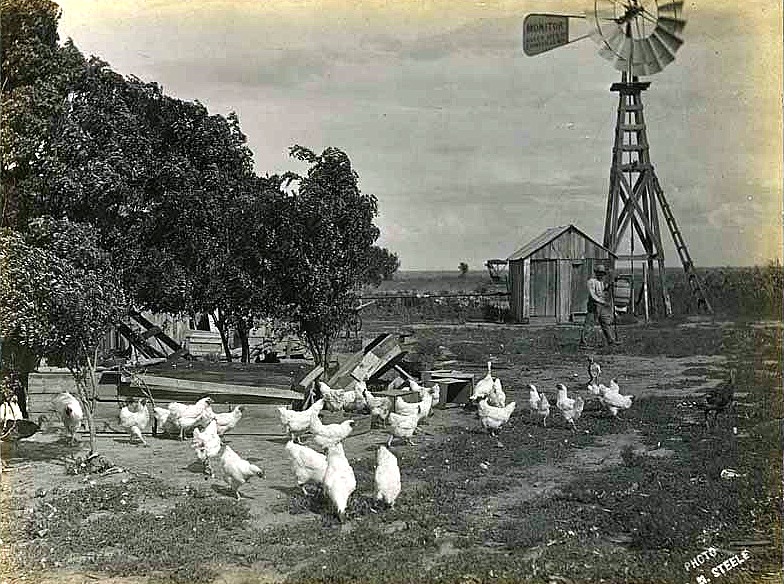
- 12 chickens, 50 dozen eggs produced
- Orchard
- 200 apple trees
- 500 peach trees
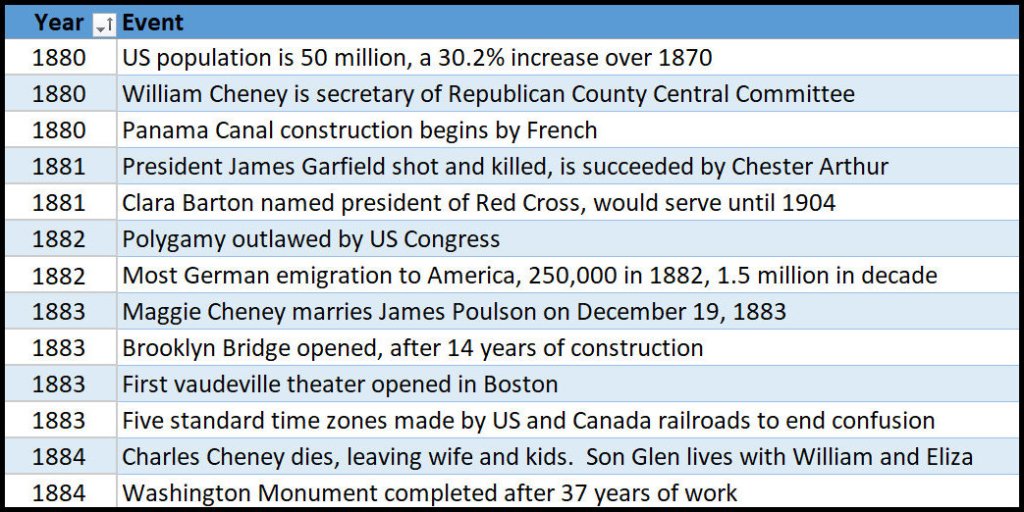
Timeline
Sources:
- Family trees – Ancestry.com
- Quote – Homestead Act of 1862 – Britannica – https://www.britannica.com/topic/Homestead-Act
- Newspaper – William T. Cheney – Notice of proof of claim – McPherson Republican – August 28, 1885 – Newspapers.com
- Image – William T. Cheney land patent – General Land Office – Bureau of Land Management – https://glorecords.blm.gov/details/patent/default.aspx?accession=KS2780__.037&docClass=STA&sid=xfv5hlgz.ya4#patentDetailsTabIndex=1
- Quote – About the Homestead Act – National Park Service – https://www.nps.gov/home/learn/historyculture/abouthomesteadactlaw.htm
- Map – McPherson County, Kansas – Edwards’ historical atlas of McPherson County, Kansas – 1884 – Library of Congress – https://www.loc.gov/resource/g4203m.la000220/
- Map – Groveland Township – Edwards’ historical atlas of McPherson County, Kansas – 1884 – Library of Congress – https://www.loc.gov/resource/g4203mm.gla00193/?sp=40
- Image – Location of Cheney farm today – Google Maps – Street View
- History Written by Sarah Cheney Poulson – transcribed by Jan Perdue DeWeese – DeWeese Cheney documents
- Newspaper – W.T. Cheney corn and wheat yield – McPherson Freeman – August 31, 1883 – Newspapers.com
- Census – William and Eliza Cheney – 1880 – Ancestry.com – https://www.ancestry.com/imageviewer/collections/6742/images/4241331-00539?pId=26592216
- Census – Agriculture Production – Groveland – 1880 – Ancestry.com – https://www.ancestry.com/imageviewer/collections/1276/images/31642_217956-00296?pId=2597446
- Image – A flock of chickens – Steele, F. M. (Francis Marion), 1866-1936 – Kansas Memory – https://www.kansasmemory.gov/item/7855
- Audio – To Weather a Storm – Dan Lebowitz – Directory.Audio – https://directory.audio/free-music/country-folk/4553-dan-lebowitz-to-weather-a-storm#google_vignette
 Family Nibbles