Lorenz Maninger was born around 1690 in Dittwar, a small village in the southwest of present-day Germany. Dittwar is the ancestral home village of our Maninger grandparents.
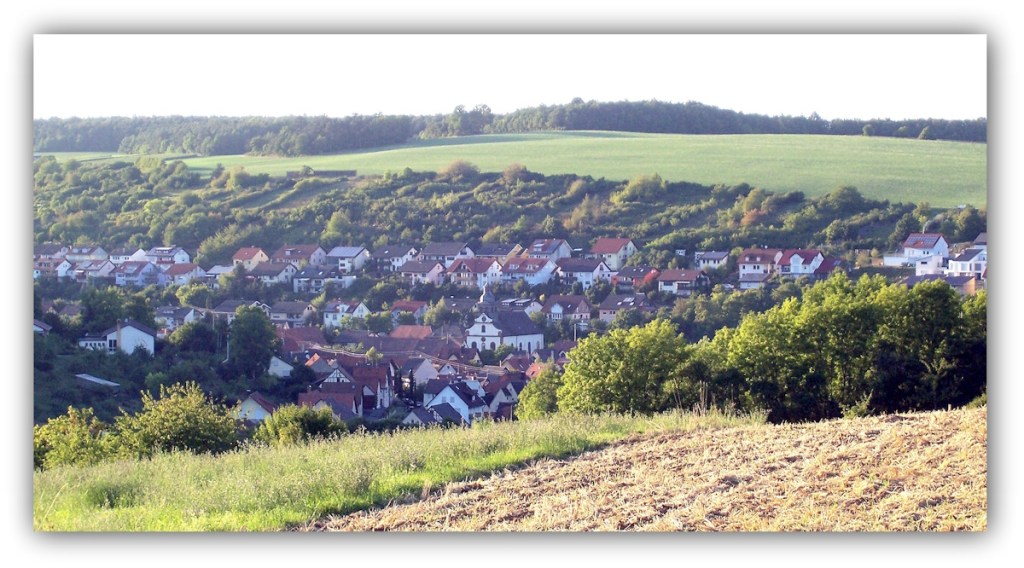
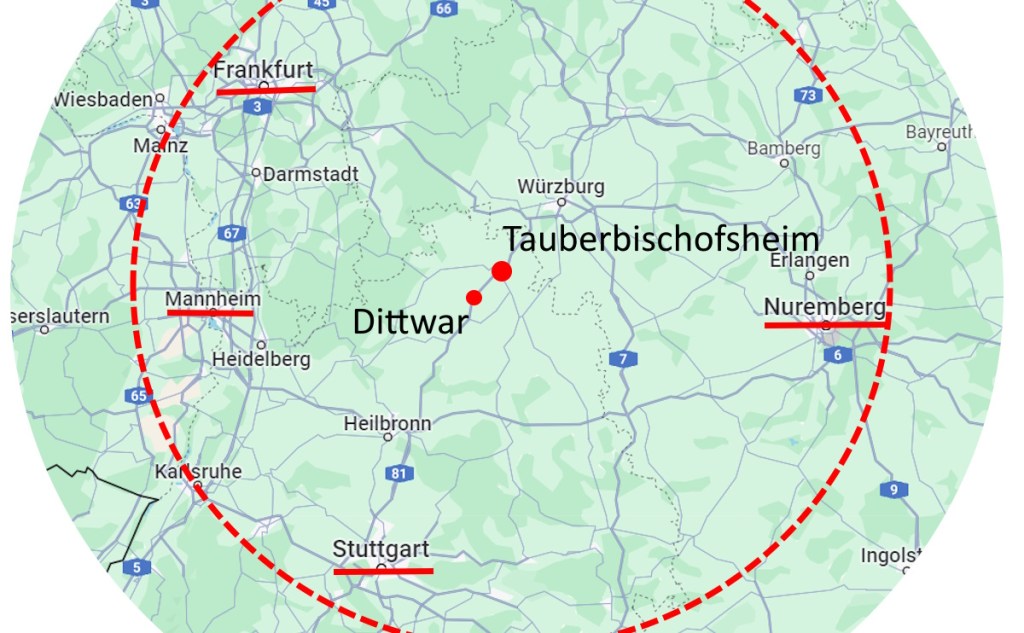
Dittwar is in southwest Germany, in the state of Baden-Württemberg.
Dittwar and the nearby market town Tauberbischofsheim are midway between the larger cities of Frankfurt, Mannheim, Stuttgart, and Nuremberg, about 60 miles from each.
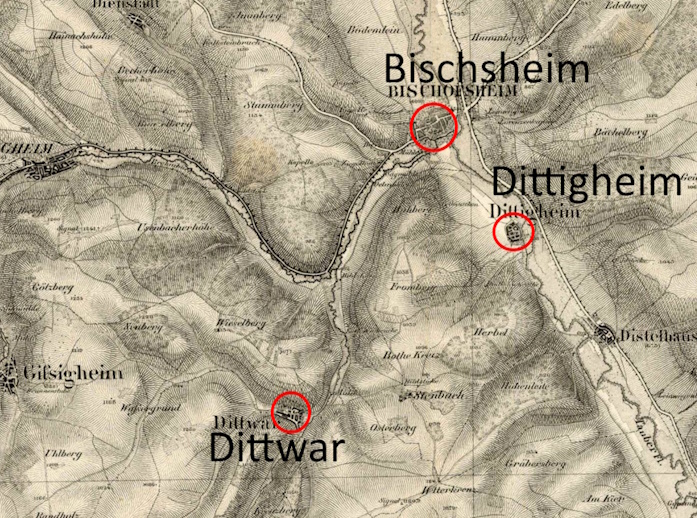
Tauberbischofsheim is the main town of the district. It has a population of about 13,000. It’s named for the Tauber River, and was the location of a bishop’s house (bischofsheim).
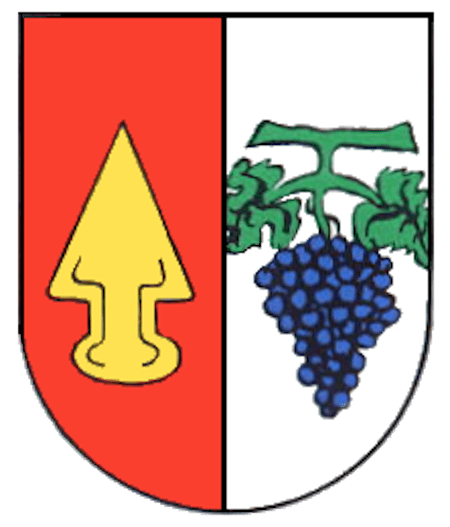
Dittwar is a village in the Tauber district. It’s population is about 700. Its name means dit = common people + bure = farmer / neighbour). Dittwar’s Coat of Arms represents two of its enduring symbols; a plow and a cluster of grapes.
Dittwar is located in a side valley of the Tauber River. The Tauber River Valley runs from southeast to northwest through the area. It’s an area popular for wine and nature tourism.
Dittwar looks idyllic. But it wasn’t always so. Let’s rewind the calendar to 1700.
Lorenz Maninger and Margarethe Wöppel (7G)
Lorenz is the earliest Maninger that we can trace with written records, but it’s likely that Maningers had lived in Dittwar for decades, perhaps centuries. We are estimating Lorenz’ birth year around 1690, because we don’t have a citation for his birth or baptism.
Margarethe Wöppel’s family was from the nearby village of Dittigheim.
Lorenz Maninger and Margarethe Wöppel married on Tuesday, November 17, 1711. They’re our 7th great-grandparents.
Marriage – Lorenz Maninger and Margarethe Wöppel – Dittwar – 1711
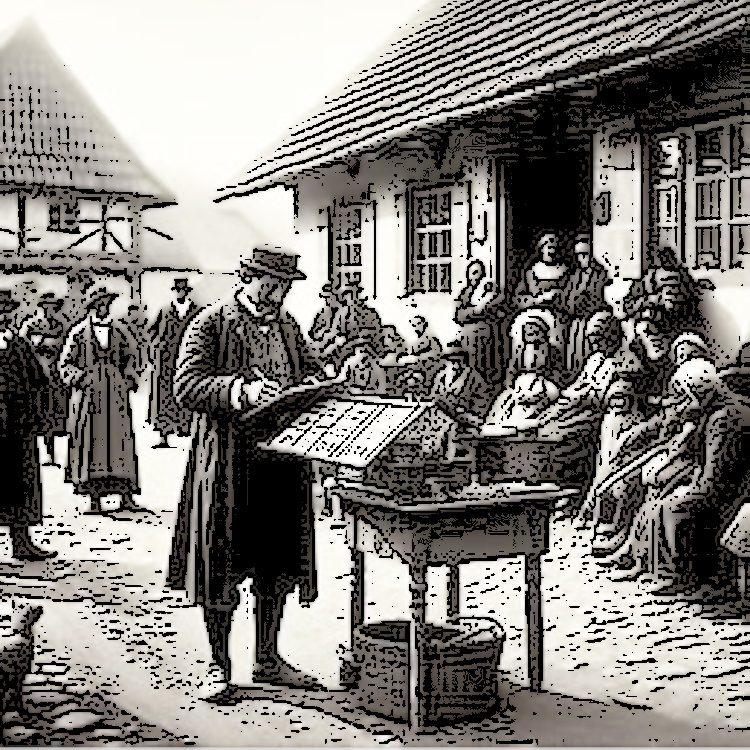
1668 Census
In 1668, Lorenz Maninger’s parents and grandparents were likely counted in Dittwar’s earliest census.
The census recorded 80 hearths (fireplaces) in Dittwar. Hearths were taxed, so the census counted those rather than dwellings. A prosperous villager might have multiple hearths in one building.
The census recorded 357 residents – adults were 80 men and 85 women, children were 100 boys and 92 girls. Those 357 people were members of a few dozen families that had lived in the village for generations – Maninger, Giller, Hammerich, Honickel, Krank, Link, Wöppel, etc.
So the village had about 80 households, and an average of 4.5 people per household.
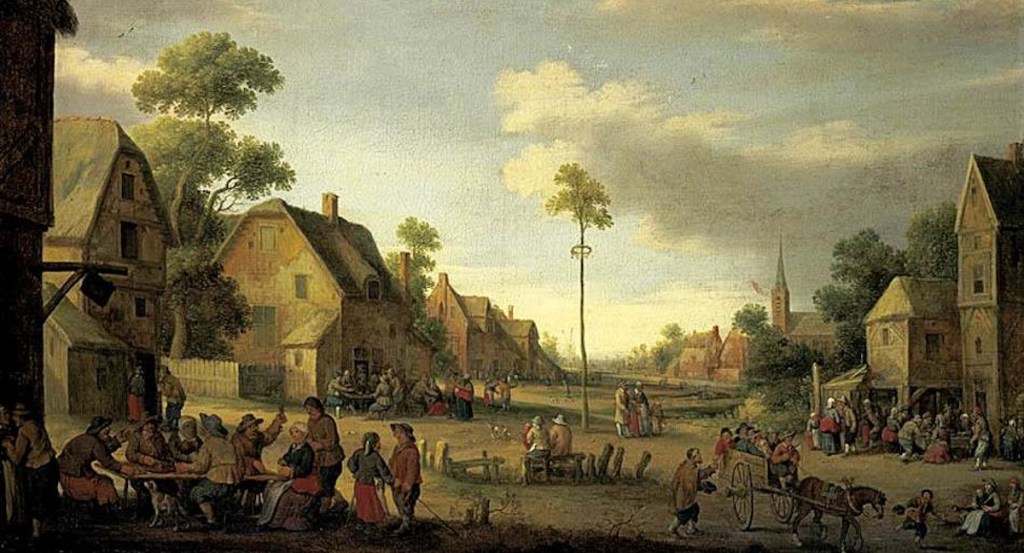
Village Street – Joost Cornelisz Droochsloot – 1646
A rural life
In Dittwar, Lorenz and Margarethe farmed, raised a garden, and eked out a living. Some families supplemented their livelihoods with trades, as bakers or shoemakers or blacksmiths.
Perhaps Lorenz and his neighbors cultivated grapes. Historically, the hills around Dittwar were covered in vineyards.
Fields and vineyards – Dittwar – 1900s
The Tauber wine, which was very well known and was sold primarily as sacramental wine, could be spilled in huge quantities. Sometimes the harvests were so large that it was impossible to accommodate the yield. In Tauberbischofsheim, on Sundays and public holidays, wine was not offered to measure, but according to the drinking time, on tables specially set up for this purpose. Back then, anyone who could swallow a lot in a short time had a very good opportunity to fill their bodies with wine. Wine is still grown in Dittwar today, but since we have no winemakers and the farmers hardly have any time for their vineyards in the age of specialization, this source of income is dwindling more and more.
Chronicle of the Community of Dittwar – Manfred Maninger
Editor’s Note: In 1968, Manfred Maninger wrote a book about the history of Dittwar, “Chronicle of the community of Dittwar.” It’s an extensive history and legends and stories about Dittwar. You’ll find lots of excerpts from his book in our stories. http://www.hkvdittwar.de/chronik-der-gemeinde-dittwar.html
Like Lorenz and Margarethe Maninger, most Germans lived in rural areas as subsistence farmers.
Serfs working a field
Most farmers were not owners of the land. The land belonged to wealthy land owners, and the cultivator of the land was a mere servant and in many instances, a serf. If a farmer was treated as a serf, he had no personal freedom, i.e., he was not able to marry without consent of his sovereign lord, he could not move anywhere else and could not sell or obtain land.
What Was Life Like in Rural Germany (1600-1800)? – FamilySearch
Tithe and tax
The residents of Dittwar lived under the heavy hand of the Archbishop of Mainz and a host of lesser officials and clergy. There was a complex system for the peasants to pay tribute to all these officials.
The tenth part that had to be delivered from the grain was called here, as everywhere else, the big tithe or fruit tithe. The so-called small tithe included root crops and hay. sometimes also recorded spring barley. In addition, the wine tithe and the blood tithe were collected. The blood tithe had to be paid by the young pets, in later times usually in money. Finally, the sovereign claimed the Noval tithe or Neurot tithe from those fields that were only created later through clearing.
Since Charlemagne, the following rule has prevailed everywhere in our country: two thirds of the large tithe and wine tithe are received by the noble local lord who built the church and has the right of patronage. The priest is entitled to the remaining third as a salary in addition to the parish property. The tithe right could be given away and sold as a source of income.
300 years of the Kreuzkapelle – Paster Kleeman – 1983
The collection of the tithe was in itself cumbersome: collecting the 10th sheaf from the fields, bringing it home, threshing it and distributing it to the various tithe owners. This brought with it many problems. Some farmers tried to cheat.
300 years of the Kreuzkapelle – Paster Kleeman – 1983
The feudal system was a hot mess – onerous, unfair, and oppressive. Our Maninger ancestors and all peasant Germans paid crops and wine and currency to those who controlled their land and society.
Village house – Dittwar – 1900s
Maninger next generation…
Lorenz and Margarethe Maninger raised six children in Dittwar:
Lorenz b. 1713
Mathaeus b. 1716 *
Maria Catherina b. 1719
Johann Joseph b. 1722
Johann George b. 1725
Maria Margarethe b. 1728
* Mathaeus is our grandparent
Lorenz and Margarethe’s children came of age in the mid-18th century. Their life in Dittwar was much the same as the lives of their parents and grandparents.
I would love to ask them about their lives. What did they worry about? What did they hope for? Or, more simply, what did they do? What did they eat? How did they stay warm?
Birth record – Margarethe Wöppel – Dittigheim – 1698 – Catholic records from the Archdiocese of Freiburg im Breisgau, Baden, Germany. Baptism, marriage and burial records included – FamilySearch – https://www.familysearch.org/ark:/61903/1:1:WXKP-QWPZ
Marriage record – Lorenz Maninger and Margarethe Wöppel – Dittwar – Catholic records from the Archdiocese of Freiburg im Breisgau, Baden, Germany. Baptism, marriage and burial records included – FamilySearch – https://www.familysearch.org/ark:/61903/1:1:WXKL-7YMM
Image – census taker – Microsoft Image Creator from Designer
Mark…that was a fascinating post about the Maninger beginnings. We’ll be in Strasbourg, France at the end of September this year, and may try to drive up to Dittwar if time permits. Thanks for the most interesting summary of Koma’s roots!





 Family Nibbles


Mark…that was a fascinating post about the Maninger beginnings. We’ll be in Strasbourg, France at the end of September this year, and may try to drive up to Dittwar if time permits. Thanks for the most interesting summary of Koma’s roots!
Jerry.
LikeLike
That would be so neat if it works out that you can visit Dittwar. I’ll be anxious to hear your plans when we get together this spring.
LikeLike