
By 1917, U.S. entry into World War I was imminent.
The United States had remained isolated from the world economically and politically, but was to begin a transformation into a world power. A mostly rural agricultural and small town society would start to be exposed to industrialization on a large scale.
People who had never ventured further than neighboring counties would travel to other states and other countries.
The US declared war on Germany on April 6, 1917.
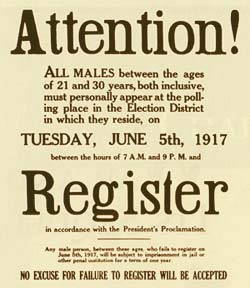
The Selective Service Act of 1917 was enacted one month later on May 18, 1917. It called for a draft to raise a million man army.
All men from age 21 through 30 were to register a few weeks later, on June 5, 1917.
Let’s see how the war effort touched E.R. Cheney and his sons Rollo, Ned, and Fred.
Rollo Cheney
Rollo Cheney enlisted in the medical corps.
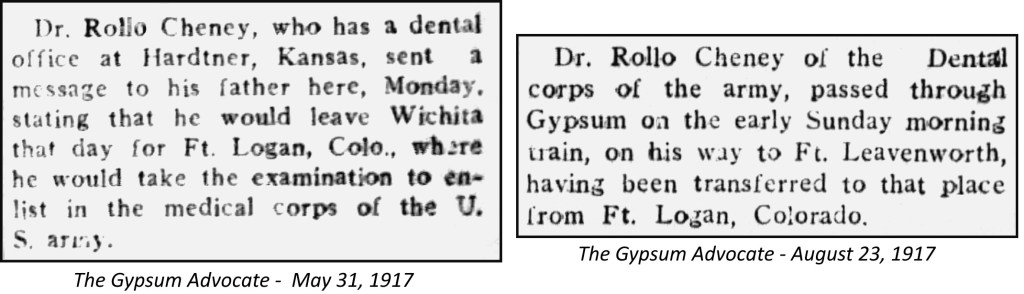
Rollo was stationed at Camp Joseph E. Johnston in Jacksonville, Florida. In July 1918, he was promoted to lieutenant in the medical corps.
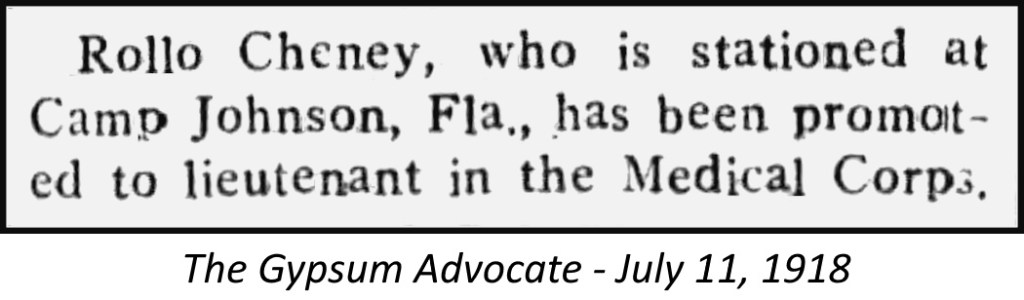
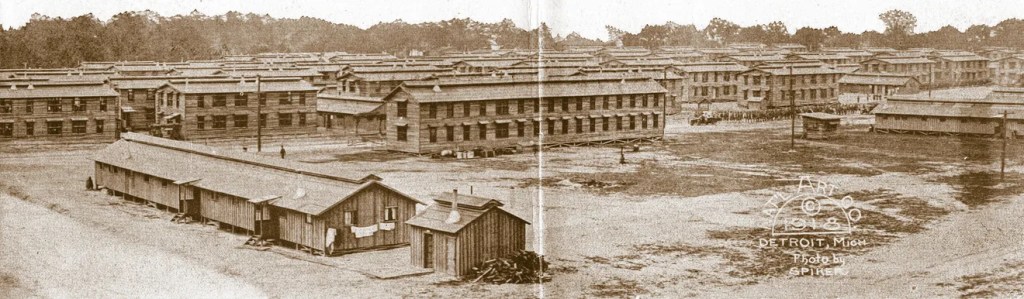
The camp was a major training facility preparing troops for deployment to France. Like Camp Funston in Kansas, Camp Johnston was constructed on a breakneck schedule, used during the war, and then decommissioned.
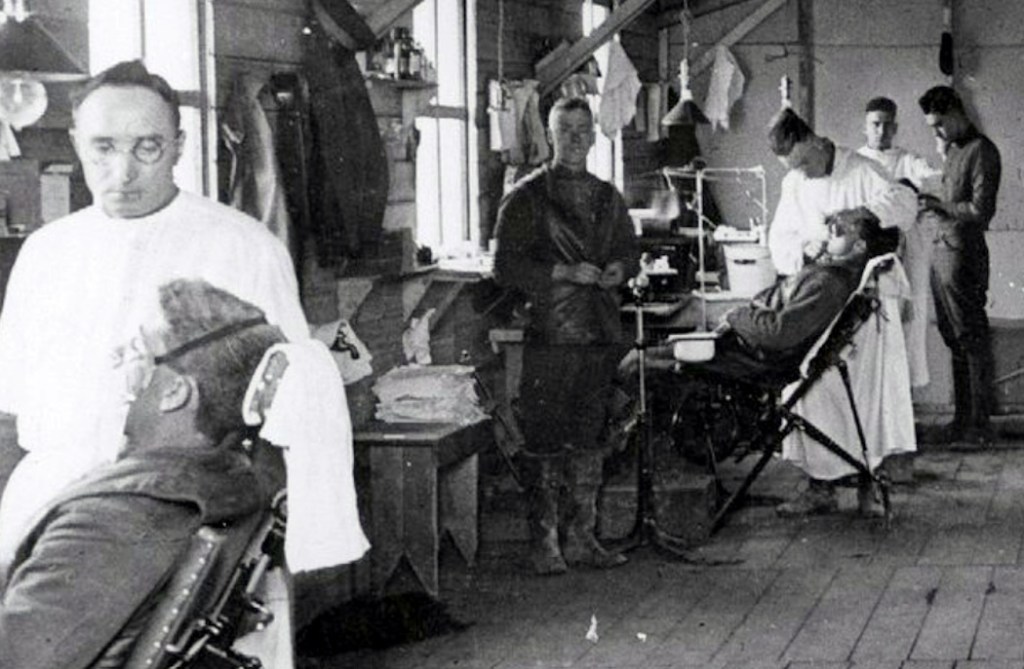
Medical care, including dentistry, was a major operation in preparing troops for deployment. Many World I recruits had never seen a dentist before.
The U.S. Army’s dental staff grew dramatically, from just 86 officers at the start of the war to 4,620 by its end. The Dental Corps was officially recognized as equal to the Medical Corps.
After the Armistice in November 1918, medical staff were in high demand. Tens of thousands of returning troops were returning, many of which needed care for sickness or injuries contracted in France. Soldiers returned with physical disabilities and psychological trauma, then called “shell shock.”
Captain Rollo Cheney was discharged from service on August 5, 1919.
Ned Cheney

On June 5, Ned Cheney, age 22, dutifully registered in Gypsum, Kansas. So did scores of his friends and neighbors.
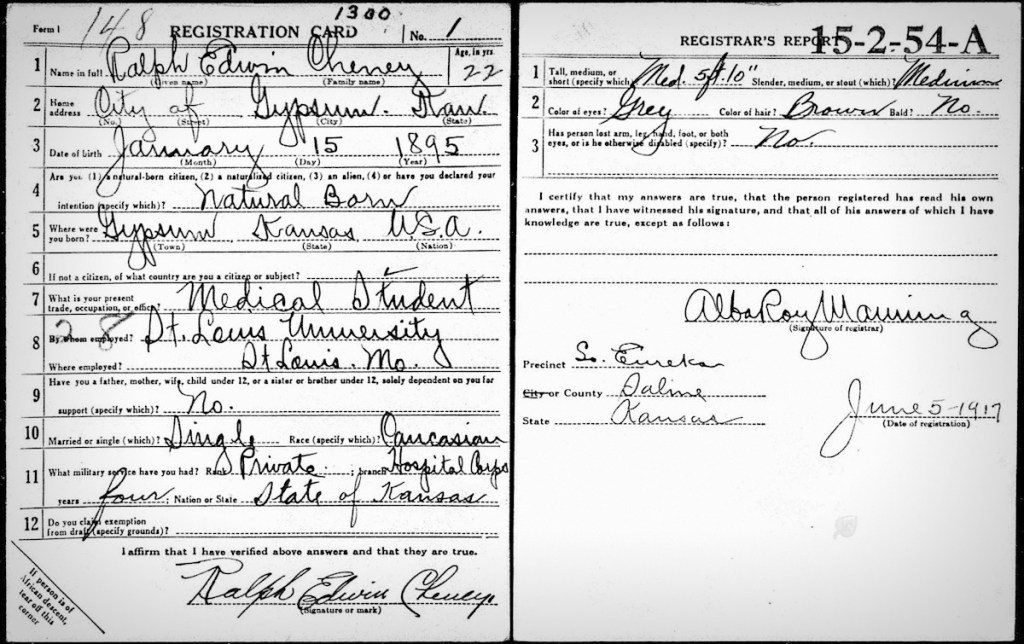
Ned’s registration shows that he had served four years in the Hospital Corps of the National Guard in Kansas. He had been discharged just seven months earlier after an active duty deployment on the Mexican border.
Ned’s lottery number wasn’t selected, so he wasn’t drafted. He returned to his medical studies at St. Louis University.
In 1918, Ned enlisted in the Student Army Training Corps at Jefferson Barracks, ten miles south of St. Louis.
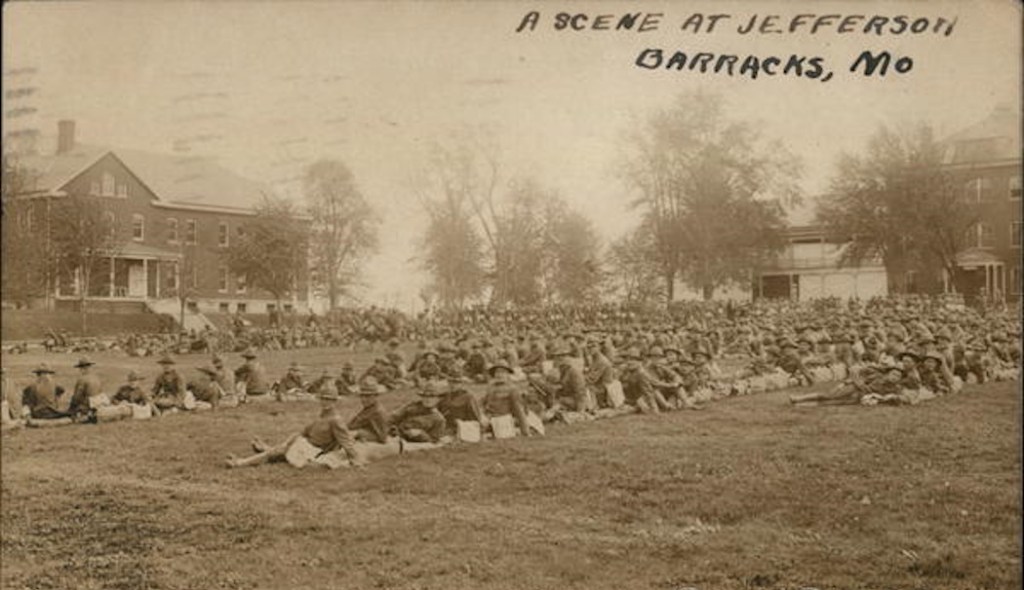
The Student Army Training Corps (SATC) used college campuses to train students for military service. Male students enlisted in the Army and received military training alongside their regular college courses, with the government providing tuition, room, board, and a monthly stipend of $30. The program was a predecessor to the modern ROTC and was officially dissolved shortly after the armistice in November 1918.
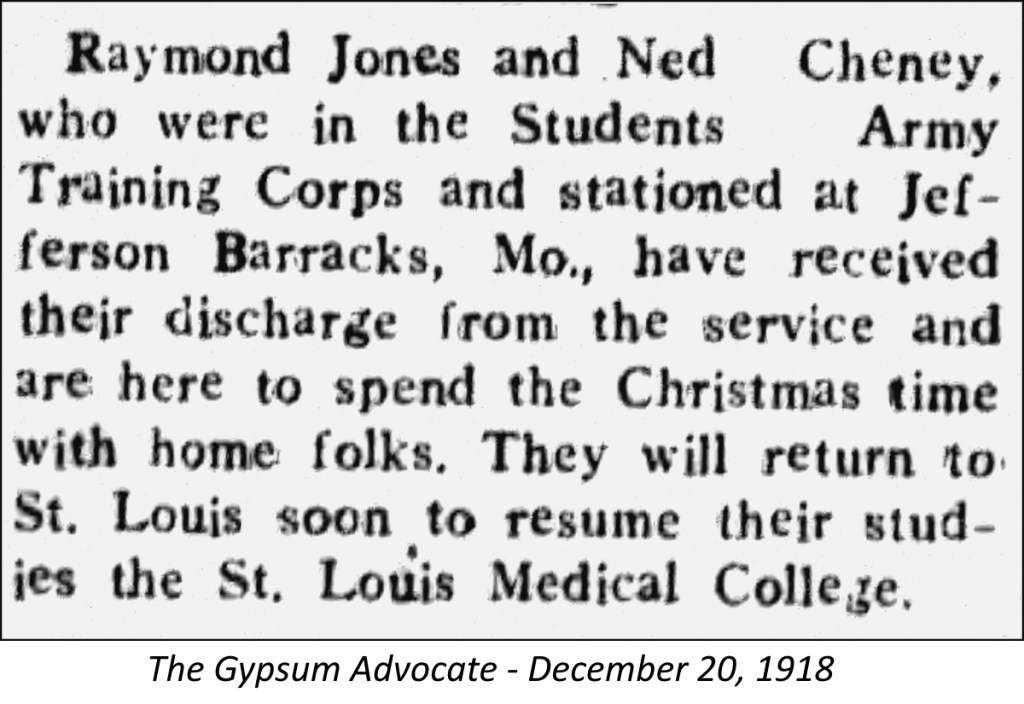
After the Armistice, the SATC was quickly dissolved, and the students discharged. Ned Cheney was discharged in December 1918, and returned to his studies at the St. Louis University campus.
Fred Cheney
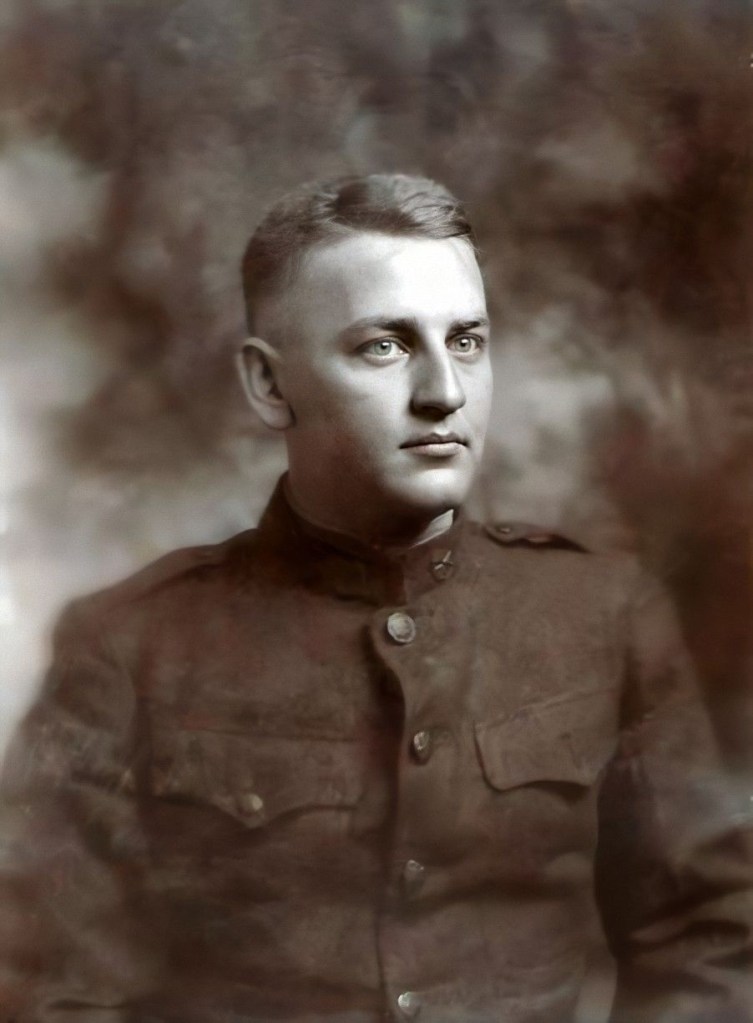
Fred Cheney tried to enlist as a mechanic on April 12, just a week after the U.S. declared war. The mechanic positions were filled to the limit, so he couldn’t enlist.
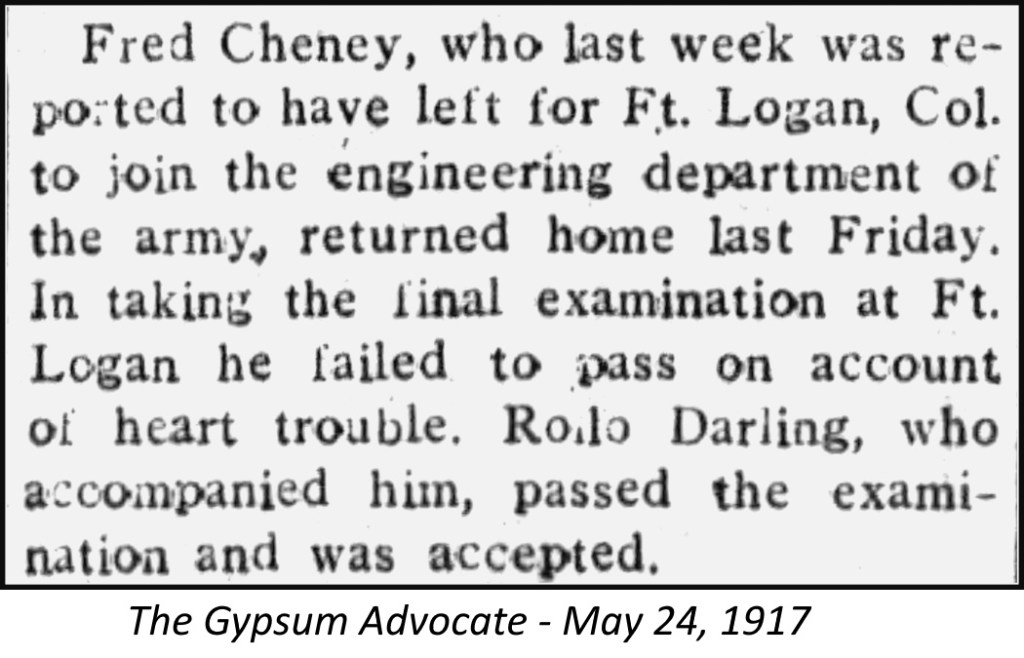
Fred tried again in May 1917 to join the Army Engineering Department, but failed to pass the physical exam.
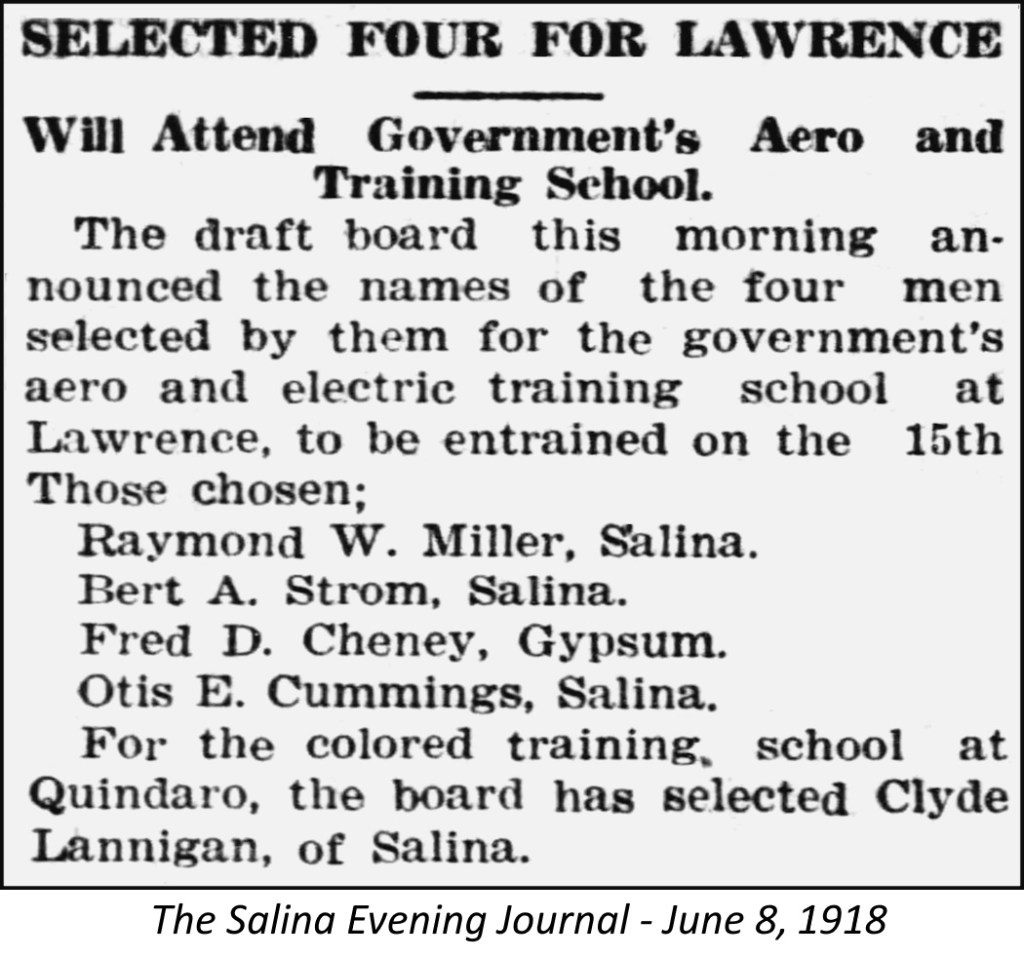
However, in June 1918, Fred was chosen to attend the aero and electric training school at Lawrence.
He continued his training at Camp Funston, Kansas, and was then assigned to Fort Zachary Taylor in Louisville, Kentucky.
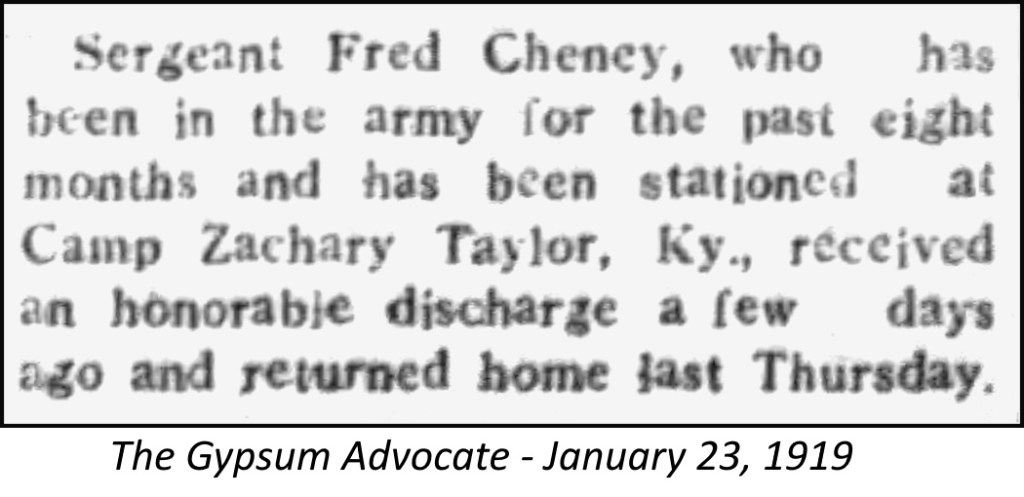
Sergeant Fred Cheney was discharged from service in January 9, 1919.
Enos R. Cheney
Before E.R. Cheney entered military service, he and Ida were busy supporting the war effort. They were active with the Red Cross campaign, and Ida hosted meetings of the Red Cross Auxiliary.
E.R. served as a director on the Saline County Council of Defense.
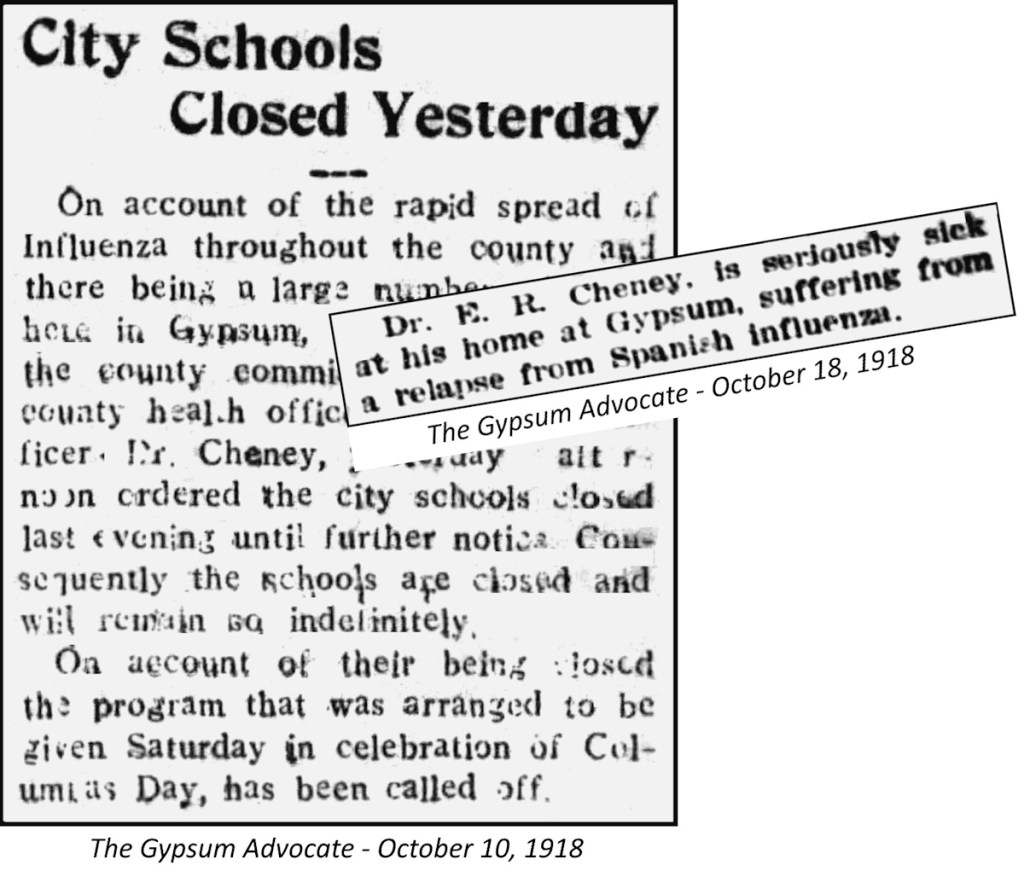
When the second wave of Spanish Flu broke out in fall of 1918, E.R. ordered the Gypsum schools closed indefinitely due to the large number of cases. E.R. himself was seriously infected for over two weeks.
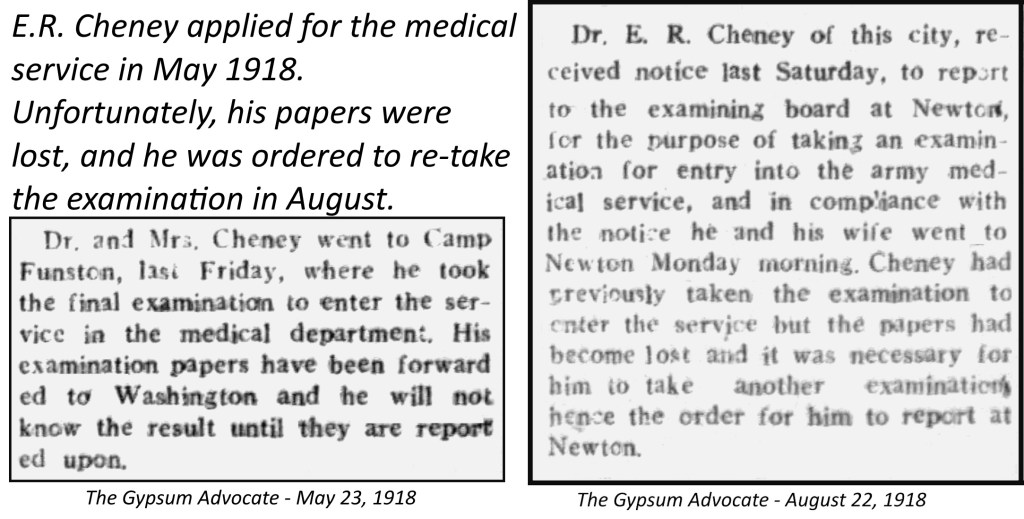
By the summer of 1918, E.R. had navigated the bureaucracy and applied for entry into the army medical service.
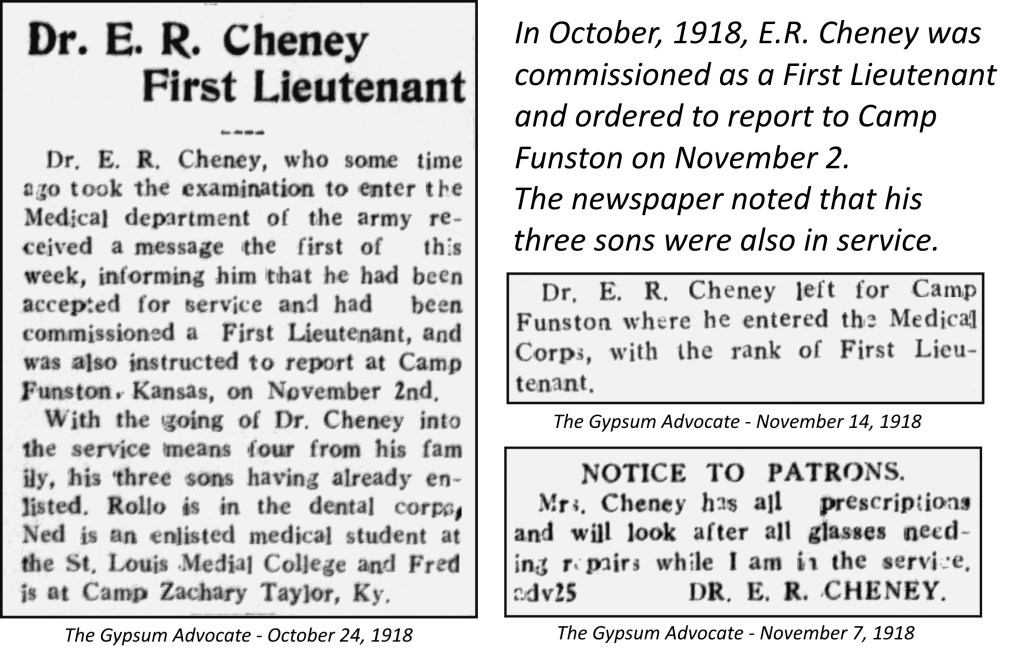
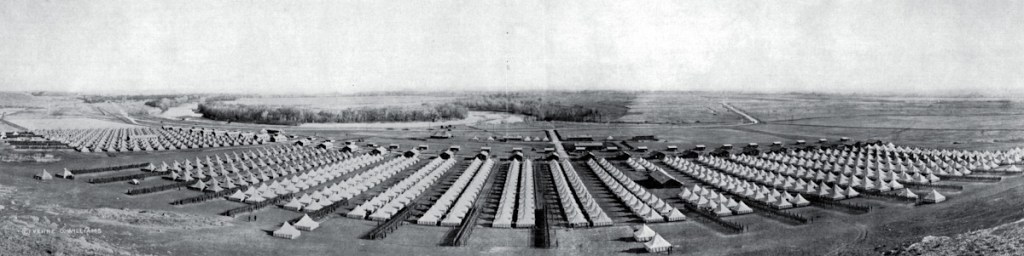
Camp Funston at Fort Riley, Kansas was the largest of the 16 regional training camps in the country.
E.R. Cheney was inducted into service at the time most soldiers were being discharged. The war was over. The Armistice occurred on November 11, 1918.
However, the autumn of 1918 began the camp’s highest hospital occupancies. Dr. E.R. Cheney and other doctors were badly needed.
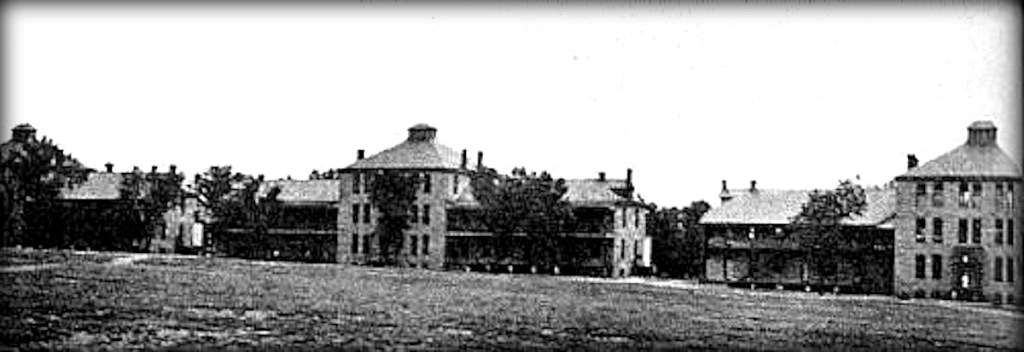
After the Armistice, Camp Funston was designated as a demobilization center. The Medical Corps was responsible for the medical care and processing of many thousands of returning soldiers. The timing also corresponded with the deadly second wave of Spanish Flu.
Statistical data indicates that the highest census of the Fort Riley base hospital was in October, 1918, when there were 11,645 patients in the hospital; the same month there were 958 deaths. In 1918 there were 122 assigned doctors and 297 nurses on duty at the hospital, in addition there were 1,024 attached enlisted men.
An Army Hospital: From Horses to Helicopters — Fort Riley, 1904-1957 — by George E. Omer Jr
Fortunately for E.R. Cheney, his service assignment remained at Camp Funston, so he would have occasional visitors and weekends at home.
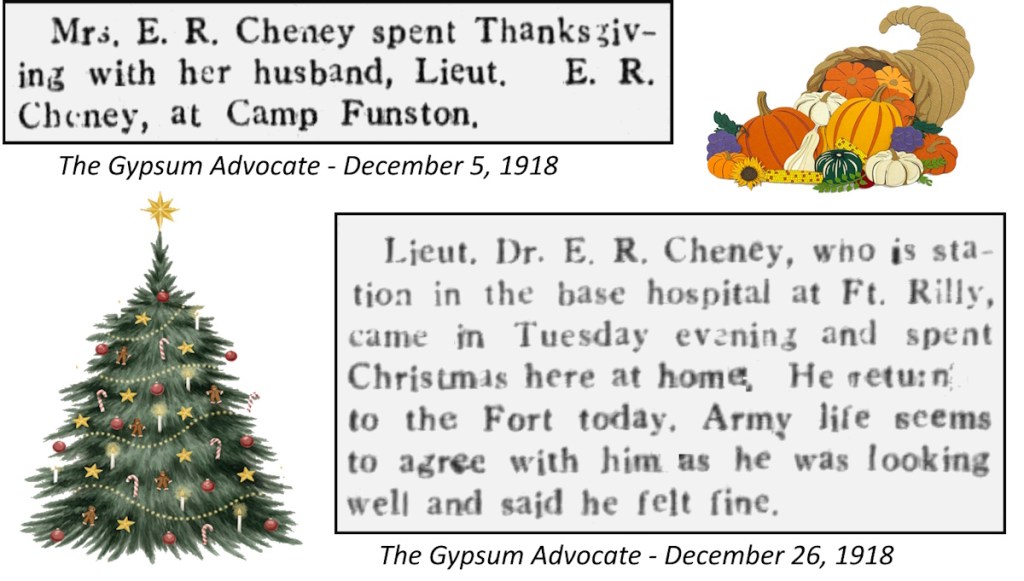
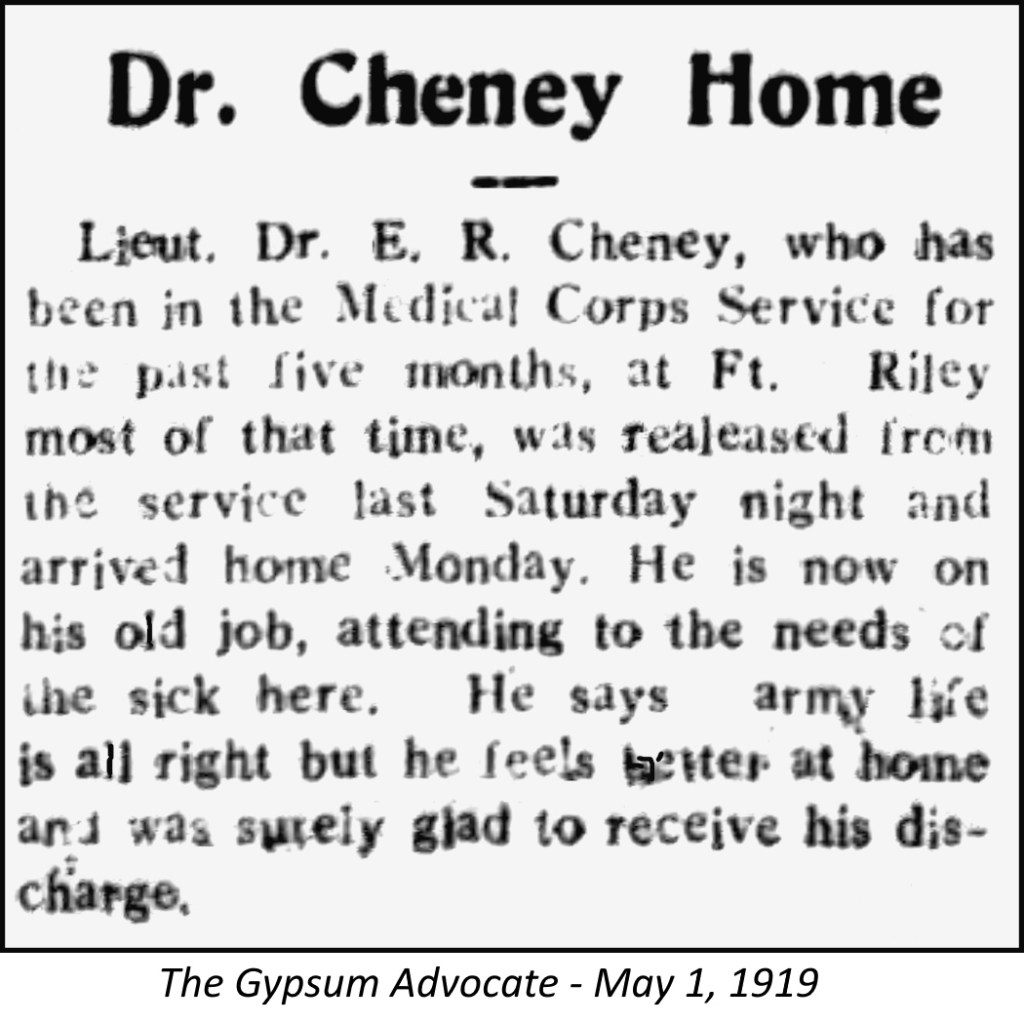
Lieutenant Enos R. Cheney was discharged from service at Camp Funston, Fort Riley, Kansas on April 26, 1919.
Nibbles Extra Credit – Spanish Flu Pandemic
The pandemic is conventionally marked as having begun on 4 March 1918 with the recording of the case of Albert Gitchell, an army cook at Camp Funston in Kansas despite there having been cases before him. The disease had already been observed 200 miles away in Haskell County, Kansas as early as January 1918… Within days of the 4 March case at Camp Funston, 522 men at the camp had reported sick.
Spanish Flu – Wikipedia
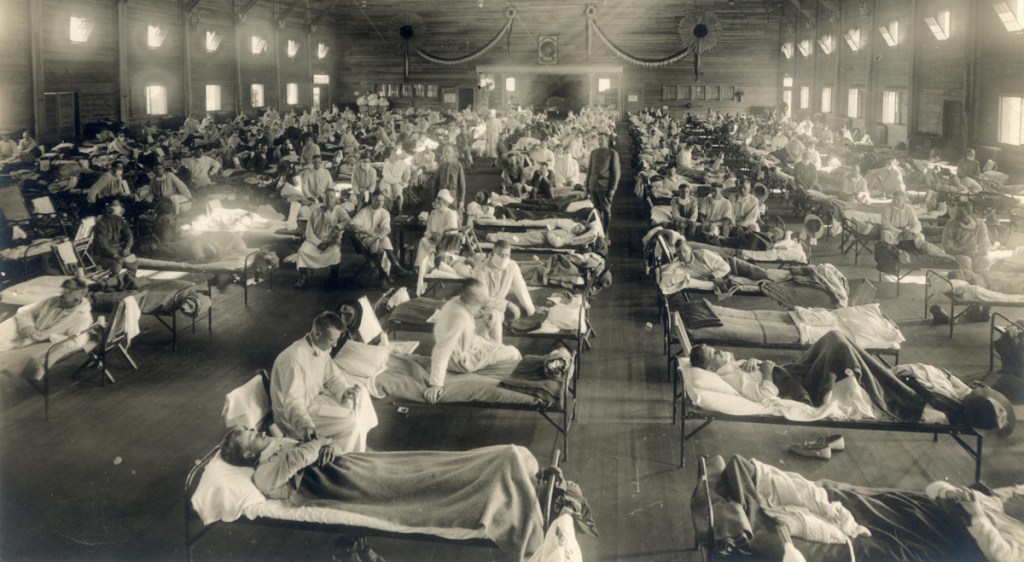
The 1918 influenza pandemic, often nicknamed the “Spanish flu,” was one of the deadliest pandemics in human history, caused by an H1N1 influenza A virus of avian origin. It infected an estimated 500 million people—one-third of the world’s population at the time—and resulted in an estimated 50 to 100 million deaths worldwide.
It was called the “Spanish flu” because neutral Spain was the only country freely reporting on the outbreak (due to WWI wartime censorship in belligerent nations), creating a false impression of Spain as the epicenter.
The pandemic occurred in three main waves from 1918 to 1920. The first wave in spring 1918 was relatively mild, but the second, more virulent wave in the fall of 1918 was by far the deadliest, followed by a third wave in 1919 and possibly a fourth in 1920.
Unlike typical influenza that primarily affects the very young and very old, the 1918 pandemic had unusually high mortality rates among healthy young adults aged 20 to 40 years old.
Spanish Flu – Google Gemini AI
Here’s a remarkable quote:
All subsequent influenza A pandemics and seasonal epidemics have been caused by descendants of the 1918 virus.
Spanish Flu – Google Gemini AI
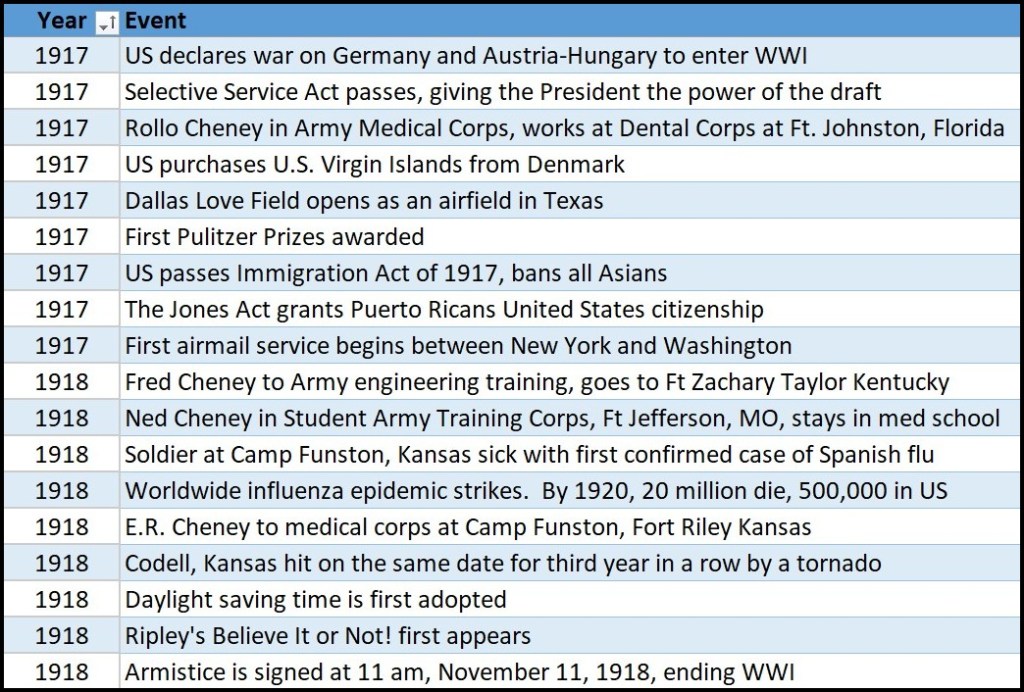
Timeline
Sources:
- Family trees – Ancestry.com
- Images – Cheney family photo – Cheney/Jarvis photograph collection
- Newspapers – each article footnoted with newspaper name and date – Newspapers.com
- The Selective Service Act of 1917 – https://en.wikipedia.org/wiki/Selective_Service_Act_of_1917
- American Entry Into World War I – https://en.wikipedia.org/wiki/American_entry_into_World_War_I
- Uncle Sam and Military Registration photos – Wikipedia (above)
- Image – A Scene at Jefferson Barracks – 1917 – CardCow – https://www.cardcow.com/551815/jefferson-barracks-missouri-scene-at/
- Image – Camp Joseph E. Johnston – 100 Years Gone By…Camp Johnston’s Short History – Florida Times-Union – March 7, 2018 – https://www.jacksonville.com/story/news/2018/03/07/100-years-gone/64877970007/?gnt-cfr=1&gca-cat=p&gca-uir=true&gca-epti=z114105d00—-v114105d–41–b–41–&gca-ft=179&gca-ds=sophi
- Image – Dentistry at the Front Line – ADA Commons – https://commons.ada.org/exhibit/serving-those-who-serve-military-dentistry-and-the-ada/dentistry-at-the-front-line/
- Quote – An Army Hospital: From Horses to Helicopters — Fort Riley, 1904-1957 — Concluded by George E. Omer Jr – Kansas Collection – Kansas Historical Quarterly – https://www.kancoll.org/khq/1958/58_1_omer.htm
- Image – Converted artillery barracks, part of the 3,000-bed World War I base hospital – Fort Riley, Kansas – 1918 – An Army Hospital: From Horses to Helicopters — Fort Riley, 1904-1957 — Concluded by George E. Omer Jr – Kansas Collection – Kansas Historical Quarterly – https://www.kancoll.org/khq/1958/58_1_omer.htm
- Image – Camp Funston – “Camp Funston,” Symphony in the Flint Hills Field Journal. https://newprairiepress.org/sfh/2013/folioIII/3
- Woodrow Wilson photo and war posters – Wikipedia (above)
- Image – Soldiers infected with Spanish Flu at Camp Funston, Kansas – Wikipedia – By Otis Historical Archives, National Museum of Health and Medicine – Emergency hospital during influenza epidemic (NCP 1603), National Museum of Health and Medicine.https://www.buckscountycouriertimes.com/news/20190923/mxfctter-museum-to-mark-historic-influenza-pandemic/1, Public Domain, https://commons.wikimedia.org/w/index.php?curid=25513204
- Quote – Spanish Flu – Wikipedia – https://en.wikipedia.org/wiki/Spanish_flu#:~:text=The%201918%E2%80%931920%20flu%20pandemic,the%20deadliest%20pandemic%20in%20history.
- Audio – Semper Fidelis – Heftone Banjo Orchestra – Free Music Archive – https://freemusicarchive.org/music/Heftone_Banjo_Orchestra/Music_Box_Rag/Heftone_Banjo_Orchestra_-_Music_Box_Rag_-_11_-_Semper_Fidelis/
 Family Nibbles